Profile
Judy Johnson
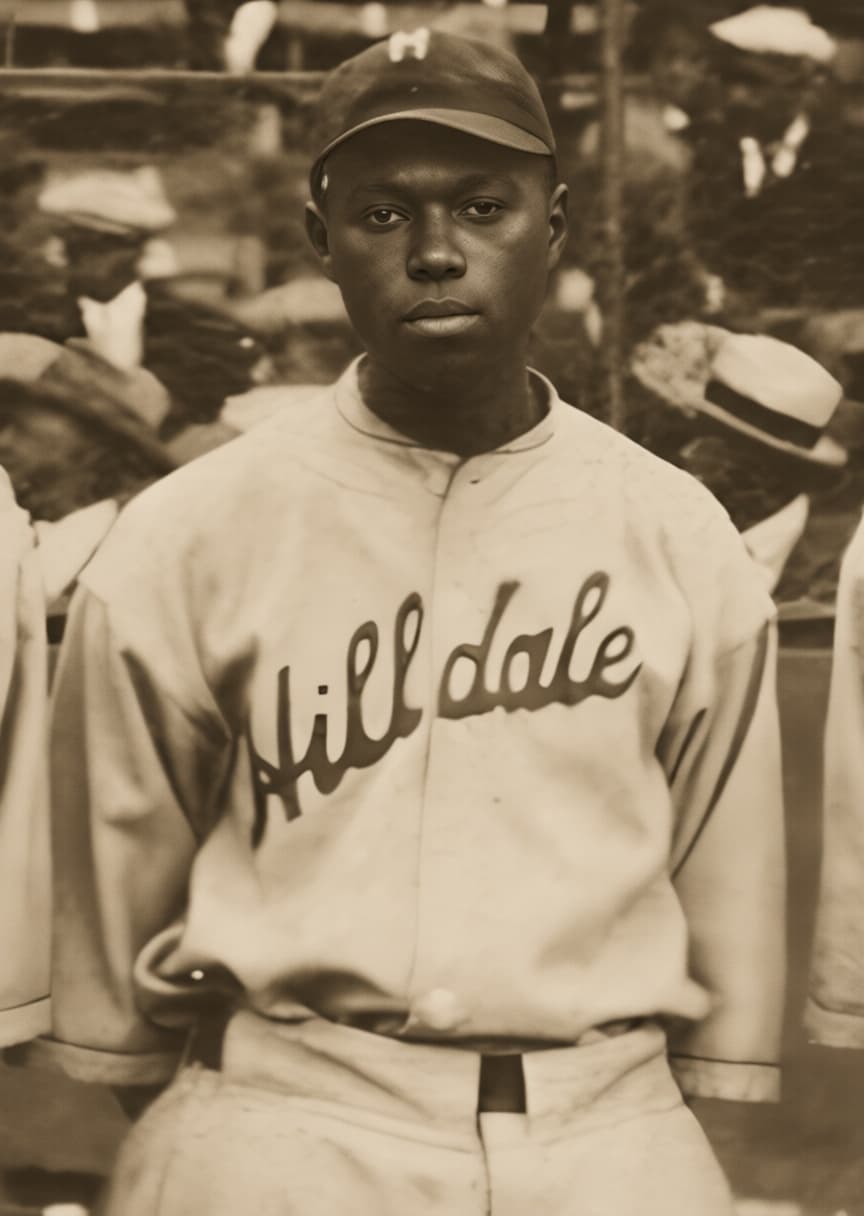
Judy Johnson portrait.
Photo credit: User-provided image via User-provided image
William Julius Johnson's father wanted him to be a prizefighter. "Daddy kept telling me to be a prize fighter," Johnson recalled, "but I couldn't fight a lick." He became the finest third baseman in black baseball instead, playing 17 seasons for Hilldale, the Homestead Grays, and the Pittsburgh Crawfords while earning $135 a month. He captained the 1935 Crawfords, a team that carried four future Hall of Famers on its roster, and after integration he scouted for four major league organizations. He tried to get the Philadelphia Athletics to sign Hank Aaron for $3,500 and was told it was too much money. He broke down sobbing at the podium during his induction speech in 1975.
Snow Hill
Johnson was born on October 26, 1899, in Snow Hill, Maryland, on the Eastern Shore, a few miles from the birthplace of Home Run Baker. His father William Henry had been a sailor and shipbuilder before becoming athletic director at the Negro Settlement House in Wilmington, Delaware, where he also coached boxing. His mother Annie Lee moved the family to Wilmington when Judy was young. He had an older brother John and an older sister Mary Emma. His mother sewed his first baseball uniform, and he recalled strutting around in it at age five.
He attended Howard High School, dropped out to work as a stevedore at Deep Water Point, New Jersey, earning $3 a week, and played sandlot ball for the Rosedale team in Wilmington from about age 13. In 1918 he joined the Bacharach Giants as a semipro at $5 a game. The following year he tried out for Hilldale, the dominant black team in the Philadelphia area, and was rejected as too small. The club sent him to its farm team, the Madison Stars, and paid $100 to acquire him in 1920.
Hilldale
Johnson joined Hilldale full-time in 1921 at $100 a month, earning a raise to $135 the following year. He acquired the nickname "Judy" that year because teammates thought he resembled Judy Gans of the Chicago American Giants. He played shortstop initially, but the great John Henry Lloyd, whom Johnson called "the man I give the credit to for polishing my skills," moved him to third base in 1922. The position fit. Johnson stood five-eleven and weighed about 150 pounds, and he compensated for modest power with positioning, anticipation, and the ability to place the ball where fielders were not.
Hilldale reached the first Colored World Series in 1924 against the Kansas City Monarchs. The series went 10 games, and Johnson led both teams in hitting with a .364 average and hit a three-run inside-the-park home run. Hilldale lost five games to four with one tie. They returned in 1925 and defeated the Monarchs five games to one, with Johnson tripling in two runs during the 12th inning of Game 1.
In 1926, Hilldale played an exhibition series against a team of major leaguers that included Lefty Grove, Heinie Manush, and Jimmy Dykes. Hilldale won three of four, and Johnson hit .374. Connie Mack, who had watched Johnson play at nearby Shibe Park throughout the 1920s, offered the compliment that doubled as an indictment. If Johnson "were only white," Mack said, "he could write his own price."
Johnson was named Negro Leagues MVP in 1929. The following year he and Oscar Charleston joined the Homestead Grays, where Johnson served as player-manager under owner Cum Posey. He returned to Hilldale in 1931 as player-manager, but the Depression was destroying the economics of black baseball. Salaries stopped on June 15, 1932, and the team switched to splitting gate receipts after expenses. Players were making two games every Thursday, two on Saturday, three on Sunday, and traveling overnight by bus to make the next one.
The Crawfords
When Hilldale folded in mid-1932, Johnson joined the Pittsburgh Crawfords. By 1933, under manager Oscar Charleston, he was the team's captain. The 1935 Crawfords are remembered as one of the greatest teams in Negro League history, fielding four future Hall of Famers in the same lineup. Johnson played third base, Josh Gibson caught, Charleston played first base, and Cool Papa Bell patrolled center field. Satchel Paige was under contract but spent the 1935 season pitching semipro ball in Bismarck, North Dakota, after a salary dispute with owner Gus Greenlee. They won the Negro National League championship that year, defeating the New York Cubans four games to three.
Johnson and Gibson developed a sign-stealing operation between third base and home plate. During a barnstorming game in Cincinnati in 1934, Leo Durocher reached third. Johnson whistled to Gibson, positioned his foot in front of the bag, and caught the snap throw for the tag as Durocher slid into it. Twenty years later, Johnson ran into Durocher at Milwaukee County Stadium. "I remember you, Judy, damn your soul," Durocher said. "That's the day you tricked me."
Johnson's statistical record is incomplete, as all Negro League records are. Different databases reconstruct different game logs and arrive at different totals. Across roughly 17 seasons, the available records show approximately 1,100 games, a batting average near .295, and steady production without conspicuous power. Ted Page called him "the smartest baseball player I ever came across." Jimmy Crutchfield said he "was like a rock, a steadying influence on the club. Had a great brain, could anticipate a play, knew what his opponents were going to do."
Johnson played briefly for the New York Cubans in 1936. In March 1937 he was traded to the Homestead Grays alongside Josh Gibson for Pepper Bassett, Henry Spearman, and $2,500, one of the largest player deals in black baseball history to that point. He was unhappy with the move and retired shortly after, ending his playing career at 37.
After the Game
Johnson worked as a supervisor at Continental Can Company, drove a school bus, and ran a general store with his brother in Marshallton, Delaware. In 1951, Connie Mack hired him as a scout for the Philadelphia Athletics, and in 1954 Johnson served as a spring training coach working with the team's African-American players, among the earliest black coaching roles in any major league organization.
He scouted for the Milwaukee Braves and discovered Bill Bruton, the center fielder who would later marry Johnson's adopted daughter Loretta. He urged the Athletics to sign Hank Aaron from the Indianapolis Clowns for $3,500. The response stayed with him for the rest of his life. "He cussed me out for waking him up at one o'clock in the morning," Johnson recalled. "He said, 'Thirty-five hundred! That's too much money.'" He also tried to get the A's to acquire Larry Doby and Minnie Minoso, without success.
He scouted and coached for the Philadelphia Phillies from 1959 until his health declined in the mid-1970s, helping to sign Dick Allen among others. "I love to teach baseball and would rather do it than anything," he said. "It's like putting a seed in the ground, you like to watch it develop. As long as they're ballplayers, they're my kids."
Johnson had served on the Special Committee on the Negro Baseball Leagues from 1971 through 1974, stepping down to become eligible for nomination. The committee elected him on February 10, 1975, the sixth Negro Leaguer inducted after Paige, Gibson, Buck Leonard, Monte Irvin, and Cool Papa Bell. At the ceremony in Cooperstown on August 18, with 7,500 fans in attendance, Johnson stepped to the podium and opened with the boxing story. Midway through his speech he broke down sobbing, and his son-in-law Bill Bruton came onstage to help him compose himself. "When I was young, my daddy wanted me to be a prizefighter," he had begun. He had found something better.
He married Anita Irons in 1923, a schoolteacher he met through her brother's sandlot connections. "Without her, I probably couldn't have been a ball player," he said. "She was a great, great woman." They were married more than 60 years before her death in 1985. Johnson suffered a stroke in 1988 and died on June 15, 1989, at his home in Marshallton, Delaware, at 89. His house on Kiamensi Avenue, where he had lived since 1934, was listed on the National Register of Historic Places in 1995.