Profile
Louis Santop
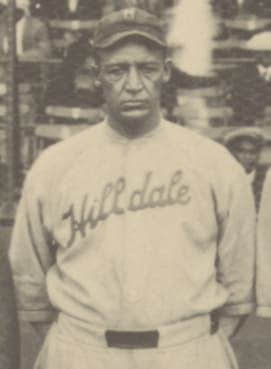
Louis Santop portrait, 1924.
Photo credit: Unknown photographer via Wikimedia Commons (Public domain)
Louis Santop Loftin was the oldest of five children born to parents who survived slavery in Texas. He stood six feet four, weighed 240 pounds, swung from the left side, and hit baseballs so far that sportswriters named him "Big Bertha" after the German artillery piece that shelled Paris during World War I. He caught for the New York Lincoln Giants and the Hilldale Daisies from 1909 through 1926, batted .325 across 523 documented games, called his home run shots years before Babe Ruth pointed to center field, and threw baseballs over the center field fence from behind home plate during pregame exhibitions to prove what his arm could do. Ed Bolden, who owned Hilldale, called Santop "the greatest star and best drawing card we ever had." Jesse Hubbard said, "Santop hit the ball farther than anybody." The Special Committee on Negro Leagues elected him to the Hall of Fame in 2006, 64 years after his death.
Texas
Santop was born on January 17, 1889, in Fort Worth, Texas. His parents Andrew Loftin and Belle Ross were both born into slavery. Santop was the oldest of five children. He began playing baseball in North Texas and debuted with the Fort Worth Wonders, a barnstorming team, in 1909 at 20. By 1910 he joined the Oklahoma Monarchs in Guthrie and the Philadelphia Giants, where he formed the "kid battery" with pitcher Dick "Cannonball" Redding. Both were around 20.
The Lincoln Giants
Sol White recruited Santop to the New York Lincoln Giants in 1911. Santop caught for Smokey Joe Williams and Cannonball Redding on a pitching staff that overwhelmed the competition. In 1913, the Lincoln Giants reportedly won 101 of their 107 games with Santop behind the plate.
Santop hit a 485-foot home run off former major leaguer Doc Scanlan in Elizabethport, New Jersey, in 1913, described as "the longest hit of the season." In 1917, he collected six hits in three games against major league pitchers Chief Bender and Joe Bush. In 1920, he went 3 for 4 against Carl Mays in a postseason exhibition while Babe Ruth went 0 for 4 in the same game.
Sportswriters called him "The Black Babe Ruth," "the Ty Cobb of colored baseball," and "catcher of gigantic proportions." He called his home run shots during games, pointing to where the ball would land years before Ruth's famous gesture in the 1932 World Series. Press accounts described him as the biggest gate attraction in black baseball during the 1910s, a performer who made pregame exhibitions out of his arm strength, firing baseballs from behind the plate over the center field fence.
Hilldale
Santop joined the Hilldale Daisies in 1920 and became the team's top earner at $450 to $500 a month. Hilldale won the Eastern Colored League championship three consecutive years from 1923 through 1925. In the 1924 Colored World Series against the Kansas City Monarchs, Santop collected 8 hits in 24 at-bats across 9 of the 10 games.
In Game 8, with Hilldale leading 2-1 in the ninth inning and the tying and winning runs on base, Santop dropped a popup. Frank Duncan followed with the winning hit. Manager Frank Warfield berated him publicly after the game. Hilldale lost the Series.
The dropped ball ended Santop's tenure as the starter. Biz Mackey took over as Hilldale's primary catcher in 1925, and Hilldale won the Colored World Series that year with Santop appearing in only two at-bats. Hilldale released him on July 10, 1926. Santop organized his own barnstorming outfit called Santop's Broncos and continued playing through at least 1932.
Despite his size, teammates described Santop as "an easygoing, friendly individual" who "didn't use his size to intimidate other players." He broke three of Oscar Charleston's ribs in an altercation that proved he could handle himself when provoked, but the fights were rare. Before Josh Gibson arrived and claimed the title, Santop was black baseball's greatest power-hitting catcher and its most theatrical performer.
Philadelphia
Santop served in the Navy during World War I as a fireman and mess attendant, receiving an honorable discharge in August 1919. After his playing career ended, he worked as a radio broadcaster at WELK in Philadelphia, tended bar, served as a Mason and Republican Committeeman, and worked as a clerk in the Philadelphia City Hall recorder of deeds office.
Santop was confined to the Philadelphia Naval Hospital on November 7, 1941, and died on January 22, 1942, in an oxygen tent, of a condition described as "similar to that which was fatal to Lou Gehrig." He was 53, five days past his birthday. Rollo Wilson named him the starting catcher on his all-time black baseball team. The 1952 Pittsburgh Courier poll placed him on the All-Time All-Star Team. Santop bequeathed his baseball memorabilia collection to Bill Yancey, who donated it to the Baseball Hall of Fame.
Santop finished with a .325 batting average, 101 doubles, 32 triples, 25 home runs, 349 RBI, and 57 stolen bases across 523 documented games in the Seamheads Negro Leagues Database. He batted .316 against major league pitching in 15 recorded games. He was named to the Negro Leagues East All-Star Team five times between 1917 and 1924. Red Smith, the New York sportswriter, remembered him simply, saying, "When he passed away, I got on a train, and I went to Philadelphia for his funeral."