Profile
Al Barlick
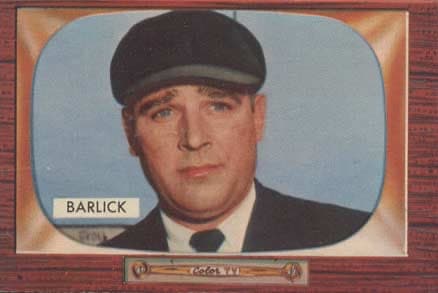
Al Barlick portrait, 1955.
Photo credit: Bowman Gum via Wikimedia Commons (Public domain)
Albert Joseph Barlick worked in a coal mine alongside his father in Springfield, Illinois, until a strike shut the mine in 1935 and someone offered him a dollar to umpire a municipal league game. He was 20 years old, and within five years he was calling balls and strikes in the National League. Barlick umpired 4,231 games across 27 seasons, worked seven World Series and seven All-Star Games, served as home plate umpire in six of those All-Star contests (a record), and earned a reputation for a voice so loud and decisive that colleagues spent the rest of their careers trying to imitate it. Bill Klem, the greatest umpire the game produced, watched Barlick work and told him, "You'll meet some people in baseball you'd like. You'll meet some you didn't like. But help them all, because in doing that you'll be helping all baseball." The Veterans Committee elected Barlick to the Hall of Fame in 1989. "I am very proud of the fact that I came from the coal mines of Illinois and wound up in Cooperstown," he wrote in a letter near the end of his life.
Springfield
Barlick was born on April 2, 1915, in Springfield, Illinois, the youngest of five sons. His father John, an Austrian immigrant, spent 50 years at Peabody No. 59, a bituminous coal mine on the edge of town. After dropping out of high school, Barlick joined the Civilian Conservation Corps and spent a year in Washington State and Wisconsin before returning home when a brother died. He went into the mine with his father, and when the miners struck in 1935, a friend named Pat Ciotti recommended him to the man who ran the Springfield Municipal Baseball League. Jack Rossiter paid him a dollar a game, and Barlick discovered he preferred calling strikes to digging coal.
In August 1936, a Class D league in northeast Arkansas needed an umpire after one fell ill, and Barlick hitchhiked to Paragould because he had no other way to get there. Two years in the Piedmont League and stints in the International and Eastern Leagues followed, and on September 8, 1940, the National League called him to Philadelphia to fill in for the injured Bill Klem. It was the first time Barlick set foot inside a major league ballpark in any capacity. He was 25 years old, umpiring a doubleheader at Shibe Park, and the career that followed lasted three decades.
The Voice
Barlick's strike call was a growling basso that carried to the upper deck, and his hand signals were sharp enough to read from the last row. A 1961 Sporting News poll named him the most respected umpire in the National League, and he won categories for balls and strikes, base calls, rules knowledge, positioning, and seriousness. He umpired Jackie Robinson's major league debut at first base on April 15, 1947, stood behind home plate for Game 1 of the 1954 World Series when Willie Mays made his famous catch off Vic Wertz, and worked the 1970 All-Star Game at Riverfront Stadium when Pete Rose ran over Ray Fosse to score the winning run.
Barlick served in the Coast Guard during the Second World War, stationed at the Coast Guard Academy in New London, Connecticut, and missed the 1944 and 1945 seasons. An enlarged heart forced him to sit out 1956 and 1957, and during the absence he co-operated a gas station in Springfield rather than sit idle. He came back both times, because the alternative was not working, and Barlick only knew how to work. He umpired 161 games in a 154-game season in 1948, including 22 doubleheaders and four consecutive twin bills in a stretch from September 19 through 22. On May 4, 1963, he called five balks against Milwaukee's Bob Shaw in a single game, a record, and the ensuing controversy over the balk rule prompted him to phone the league office at three in the morning to say he was quitting. Warren Giles talked him back. Barlick served as a founding board member of the National League umpires' union in 1963, umpired the first game at the Houston Astrodome and the first game at Dodger Stadium, called six no-hitters across his career (standing behind the plate for Ewell Blackwell's in 1947), and served as crew chief for the first NL Championship Series in 1969. He umpired his final game at Wrigley Field on September 26, 1971, and spent 22 years as a supervisor and scout of NL umpires after retiring from the field.
Springfield Again
At a 1995 event at the Babe Ruth Museum, players lined up for autograph sessions while detoured to Barlick's backstage room to greet him formally as "Mr. Barlick" and ask how he was doing. He was 80 years old. Barlick collapsed at his home in Springfield on December 27, 1995, and died of cardiac arrest at Memorial Medical Center. His Hall of Fame plaque credits his "booming, basso calls, clear and decisive hand signals, knowledge of rules, proficiency on balls and strikes, unceasing hustle," and his "ability to anticipate and then handle rough situations." He earned all of it for a dollar a game at a municipal diamond in Springfield.