Profile
Willie Mays
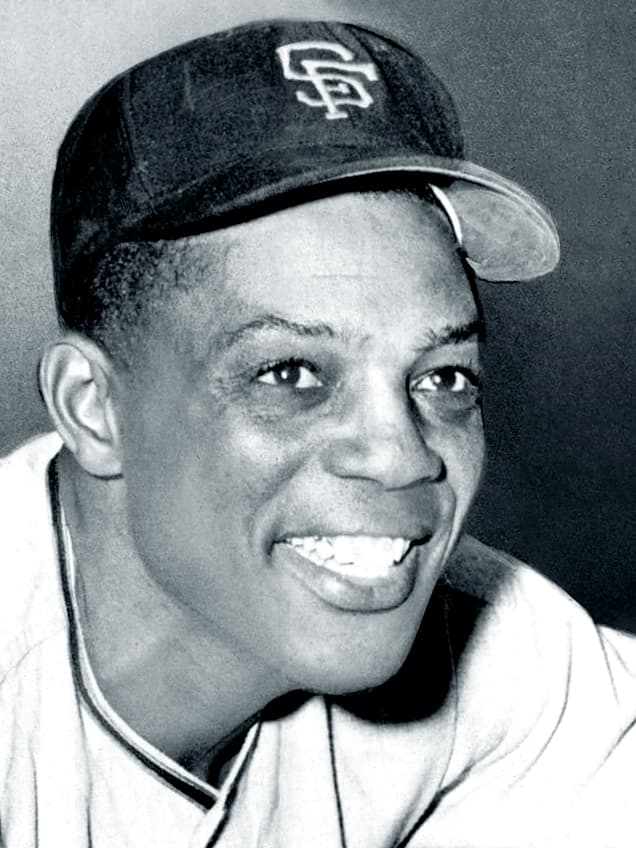
Willie Mays portrait from a 1961 New York World-Telegram image.
Photo credit: William C. Greene / New York World-Telegram and the Sun via Wikimedia Commons (Public domain)
Willie Howard Mays Jr. played baseball with a joy so visible that it became part of his legend, but joy alone doesn't account for 660 home runs, 338 stolen bases, 12 consecutive Gold Gloves, and 24 All-Star selections. Mays could beat a team five different ways in a single game, and for two decades he did, routinely, while his cap flew off rounding the bases and kids in Harlem waited for him to come outside and play stickball. Leo Durocher, who managed Mays from his first day in the major leagues, said, "If somebody came up and hit .450, stole 100 bases and performed a miracle in the field every day, I'd still look you in the eye and say Willie was better." Ted Williams put it shorter. "They invented the All-Star Game for Willie Mays." The BBWAA elected him to the Hall of Fame in 1979 on 94.7 percent of the ballot.
Westfield
Mays was born on May 6, 1931, in Westfield, Alabama, a steel mill community outside Birmingham. His father William Howard Mays Sr., known as Cat, worked in the mills and played semipro baseball well enough that the Birmingham Black Barons noticed the son because they already knew the father. His mother Anna Sattlewhite, a basketball and track star in high school, separated from Cat when Willie was three. Mays was raised by Cat and two of Anna's orphaned sisters, Sarah and Ernestine. Aunt Sarah took him to church every Sunday and sewed him clothes for school. Anna died in 1953 while Mays was in the Army, giving birth to her eleventh child.
Mays attended Fairfield Industrial High School, where he trained for laundry work, averaged 20 points a game in basketball, and punted and played quarterback on the football team. The school didn't have a baseball team. Mays played center field and second base for a semipro squad called the Gray Sox alongside Cat, drawing crowds of up to 6,000 fans. Piper Davis, the Black Barons' manager, signed Mays at 16 in 1947 and let him play weekend home games while he finished school. "Nobody ever saw anybody throw a ball from the outfield like him, or get rid of it so fast," Davis said.
Mays hit .311 for the Black Barons in 1949 and .330 in early 1950. Giants scout Eddie Montague came to scout a different player and saw Mays instead. "This was the greatest young player I had ever seen in my life or my scouting career," Montague said. The Giants signed Mays for a $4,000 bonus and $250 a month, and assigned him to Trenton, where he became the first black player in the Interstate League and hit .353. The following spring he was promoted to Minneapolis, where he batted .477 in 35 games before the Giants called him up.
The Polo Grounds
Mays joined the Giants on May 25, 1951, at Shibe Park in Philadelphia. He went 0-for-12 in his first three games and told Durocher he wasn't ready. Durocher told him he was the Giants' center fielder for as long as Durocher managed the team. Mays broke through on May 28 with a home run over the left field roof at the Polo Grounds off Warren Spahn. Then he went 0-for-13 and cried in front of his locker. Durocher moved him from third in the order to eighth, suggested he stop pulling the ball, and Mays collected four hits over the next two games.
Mays lived in a Harlem rooming house with his roommate Monte Irvin, who served as his mentor and protector. Between homestands Mays played stickball on St. Nicholas Place with neighborhood kids two or three evenings a week, bought them ice cream, and hit the ball five sewer covers, roughly 450 feet. He babysat Durocher's six-year-old adopted son Chris. He hit .274 with 20 home runs, won Rookie of the Year, and was kneeling in the on-deck circle when Bobby Thomson hit the Shot Heard 'Round the World to win the pennant.
The Army took most of 1952 and all of 1953. Mays served as an athletic instructor at Fort Eustis, Virginia, where he played roughly 180 games of military baseball and learned the basket catch from a fellow outfielder named Al Fortunato, holding the glove at his waist with the palm up and letting the ball drop in. The technique became his signature. Mays returned in March 1954 half an inch taller and 10 pounds heavier, and Durocher predicted a .300, 30-homer season. Mays exceeded both.
The Catch
Game 1 of the 1954 World Series, September 29, the Polo Grounds. The score was tied 2-2 in the eighth inning with runners on first and second and nobody out. Vic Wertz, who already had a triple and two singles, hit a towering drive to deep center field. Mays turned his back to the infield, sprinted toward the bleacher wall, and caught the ball over his left shoulder without breaking stride. He then spun and threw the ball back to the infield in one motion, a throw Arnold Hano described as a "Greek javelin hurler, a howitzer made human," preventing the runners from scoring. The Giants won in the 10th inning on a pinch hit homer that scored three runs by Dusty Rhodes and swept the Indians in four games.
Mays said he made better catches. He probably did, including one at Ebbets Field in 1952 where he caught a Bobby Morgan liner while flying parallel to the ground, hit the fence, and knocked himself out. Jackie Robinson ran over to see if Mays caught it before checking whether Mays was conscious. But the World Series catch happened on the biggest stage, in the deepest part of a ballpark built for a different era, and it became the single most replayed defensive moment in baseball history. Al Lopez, whose Indians lost that game, called it "the best I ever saw."
The Long Prime
Mays won the 1954 batting title at .345 and the MVP award at 23. Over the next 12 seasons he was the best player in baseball by almost any measure available. He hit 51 home runs in 1955 at age 24. He stole 40 bases in 1956 and became the first National Leaguer in the 30-30 club. He won the first of 12 consecutive Gold Gloves in 1957 and stole more bases than any player in the league for four straight years.
The Giants moved to San Francisco after the 1957 season, and Mays never received the same warmth from his new city that he earned at the Polo Grounds. San Francisco weighed him against the memory of Joe DiMaggio, the city's native son, and kept some affection in reserve. Frank Conniff wrote, "San Francisco is the damnedest city I ever saw in my life. They cheer Khrushchev and boo Mays." When Mays tried to buy a house in a white neighborhood, the real estate broker withdrew the offer under pressure from neighbors. A brick came through the window shortly after the family moved in. Mays gave the city everything anyway. "It only took them five years," he said.
On April 30, 1961, Mays hit four home runs against the Milwaukee Braves at County Stadium, all of them over 400 feet. He felt sick before the game after eating spare ribs at midnight with Willie McCovey, borrowed a teammate's lighter bat, and drove every pitch he saw. McCovey asked afterward, "How 'bout some more ribs?" In 1962 Mays hit 49 home runs and a game-winning homer on the final day of the regular season to force a tiebreaker with the Dodgers. The Giants won the playoff and reached the World Series, where they lost to the Yankees in seven games.
Mays won his second MVP in 1965 at age 34, hitting 52 home runs and a league-leading .645 slugging percentage. On August 22, when Juan Marichal hit Dodgers catcher John Roseboro over the head with a bat, Mays ran from the dugout and cradled Roseboro's bleeding head while teammates from both sides brawled. He tackled Lou Johnson to prevent an attack on the umpires, took a kick to the head, and returned to the game dizzy. Mays then hit a homer that scored three off Sandy Koufax to win the game. Warren Giles, the National League president, said of Mays, "This man was an example of the best in any of us."
Mays hit his 500th home run on September 13, 1965, a 440-foot blast off Don Nottebart at the Houston Astrodome. Spahn, who gave up Mays's first career home run 14 years earlier, was now a teammate. "Was it anything like the same feeling?" Spahn asked. "Exactly the same feeling," Mays said. "Same pitch, too." On September 22, 1969, Mays hit his 600th, becoming the second player after Babe Ruth to reach the milestone.
Coming Home
The Giants traded Mays to the New York Mets on May 11, 1972, for pitcher Charlie Williams and cash. "When you come back to New York, you come back to paradise," Mays said. He was 41 and diminished, but on Mother's Day at Shea Stadium, in his first game as a Met against his old team, Mays homered in the fifth inning to break a 4-4 tie.
Mays played his final season in 1973 at 42. On September 25, the Mets held Willie Mays Night at Shea Stadium, and Mays addressed the crowd. "I hope that with my farewell tonight, you'll understand what I'm going through right now," he said. "Something that I never feared, that I were ever to quit baseball. But there always comes a time for someone to get out. Willie, say goodbye to America."
The Mets reached the World Series that October against the Oakland Athletics. In Game 2, with the score tied in the 12th inning, Mays duped catcher Ray Fosse by telling him, "Ray, it's tough to see the balls with that background. I hope he doesn't throw me any fastballs." Rollie Fingers threw a fastball, and Mays bounced it over the pitcher's head for the winning hit. It was the last hit of his career.
The Say Hey Kid
Mays finished with 3,293 hits, 660 home runs, 338 stolen bases, and 24 All-Star selections, every one of them consecutive. He won two MVP awards, 12 Gold Gloves, and the inaugural Roberto Clemente Award in 1971. Joe Posnanski ranked him the greatest player of all time. Roberto Clemente said, "To me, Willie Mays is the greatest who ever played." DiMaggio, asked to define perfection, said, "Willie Mays came the closest."
Commissioner Bowie Kuhn banned Mays from baseball in 1979 for accepting a public relations job with a casino in Atlantic City. Peter Ueberroth reinstated him in March 1985. "They are two of the most beloved and admired athletes in the country today," Ueberroth said of Mays and Mickey Mantle, who received the same ban, "and they belong in baseball." Mays returned to the Giants as a special assistant and signed a lifetime contract with the team in 1993.
President Barack Obama presented Mays with the Presidential Medal of Freedom in 2015. Mays sent Obama a note when he took office. "Dear Mr. President," it read. "Move on in. Your Friend, Willie Mays."
Mays married Margherite Wendell in 1956 and adopted a son, Michael, in 1958. The marriage ended in divorce. He married Mae Louise Allen in 1971, and she was diagnosed with Alzheimer's before turning 60. Mae died in 2013. Mays spent his final years in Atherton, near the ballpark the Giants named after him, at 24 Willie Mays Plaza.
Mays died on June 18, 2024, in Palo Alto, at 93, two days before a game at Rickwood Field in Birmingham was scheduled to honor him and the Negro Leagues. The game went on. At his Hall of Fame induction 45 years earlier, Mays told the crowd, "I chose baseball, and I loved every minute of it. I give you one word, love." The tributes that followed his death said the same thing in different words. There would never be another player who did everything Willie Mays did.