Profile
Billy Evans
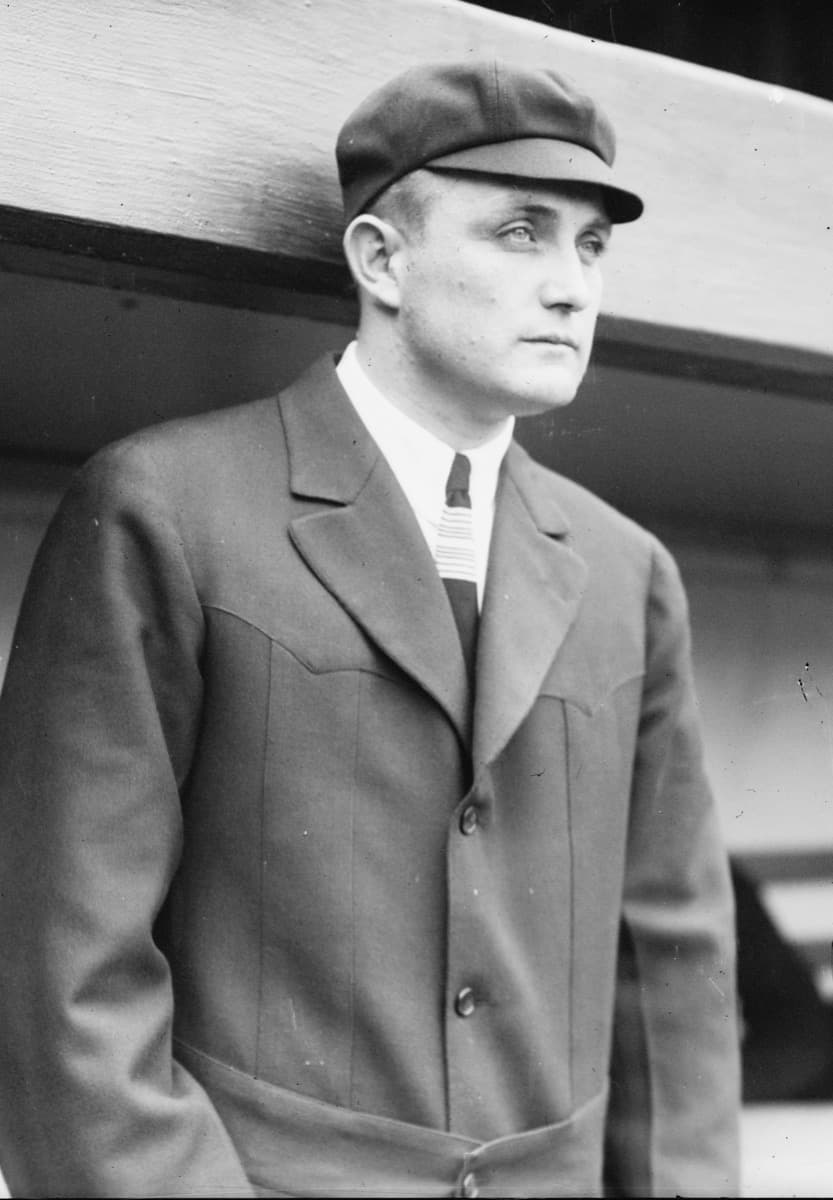
Billy Evans portrait, American League umpire.
Photo credit: Bain News Service via Wikimedia Commons (Public domain)
William George Evans never played professional baseball, never attended umpire school, and got his start because a scheduled umpire failed to show up at a game he was covering as a newspaper reporter. He was 22 when Ban Johnson hired him for the American League in 1906, making him the youngest umpire in major league history. Over the next 22 seasons he worked 3,319 games and six World Series, survived a fractured skull from a thrown bottle, fought Ty Cobb bare-knuckle outside the dressing rooms at Griffith Stadium, and wrote a nationally syndicated column while doing all of it. Then he became a general manager and presided over the signing of Bob Feller and the scouting of Pee Wee Reese. The boy umpire turned out to be good at almost everything he tried.
Youngstown
Evans was born on February 10, 1884, in Chicago. His father, a Welsh immigrant, worked as a superintendent at a Carnegie Steel mill in Youngstown, Ohio, where the family relocated during Billy's childhood. Evans attended Rayen School in Youngstown, excelling in baseball, football, and track, and enrolled at Cornell University around 1902. His baseball coach at Cornell was Hughie Jennings, the former Baltimore Orioles shortstop who later managed the Detroit Tigers. Evans left Cornell after roughly two and a half years when his father died suddenly, forcing him to support his family.
He took a job as a sports reporter at the Youngstown Daily Vindicator for $15 a week and quickly became sports editor. The newspaper work sharpened the writing instincts he would use for the rest of his life, and it also put him in front of a baseball diamond on the afternoon when an umpire didn't show.
The Boy Umpire
The missing umpire forced Evans behind the plate for a semipro game, and he called it well enough to catch the attention of Charlie Morton, president of the Class-C Ohio-Pennsylvania League, who hired him as a full-time umpire in 1904 while allowing him to continue his newspaper work. In 1905, fellow Youngstown native Jimmy McAleer, the former Cleveland outfielder and St. Louis Browns manager, met Evans at a clothing store and was impressed enough to recommend him to Ban Johnson. Johnson hired Evans for the 1906 American League season at $2,400 per year plus a $600 bonus.
He was 22. The press called him "the Boy Umpire." He was the only umpire of his era who had never played professional baseball, and he pioneered the practice of running to the bases to position himself directly over plays, a technique that became standard for the profession. In 1907, he single-handedly umpired seven doubleheaders in eight days. He worked six World Series between 1909 and 1923, becoming the youngest World Series umpire in history at 25 when he worked the 1909 Fall Classic between the Pirates and Tigers.
The Bottle and the Fight
On September 15, 1907, during a doubleheader between the Browns and Tigers in St. Louis, a 17-year-old spectator threw a glass bottle that struck Evans in the head, fracturing his skull and knocking him unconscious. The New York Times called it "one of the most disgraceful scenes ever witnessed on a ball field." Evans refused to press charges against the youth.
Fourteen years later, on September 24, 1921, at Griffith Stadium in Washington, Evans called Cobb out on a hook slide at second base during a game between the Tigers and Senators. Cobb threatened to "whip" Evans at home plate. Evans, knowing that an on-field fight would result in Cobb's immediate suspension, invited him to settle things after the game instead.
The fight took place in the areaway outside the dressing rooms after Washington's 5-1 victory. Players from both teams gathered to watch. Cobb replied to Evans's question "How do you want to fight?" with "I'm no fighter. You challenged me. Everything goes." They fought under old London prize ring rules, where the round ends when a man falls. Cobb threw roughly eight punches, cutting Evans's lip, before both men went down. Cobb then grabbed Evans by the throat until groundskeeper Jim O'Dea pried his fingers loose. He umpired the next day's game wearing bandages while Cobb sat out a suspension. Both men had agreed beforehand not to report the incident.
The Syndicated Umpire
Evans maintained a parallel career as a sportswriter throughout his years on the field. He served as sports editor of the Newspaper Enterprise Association from 1918 through 1928, writing the nationally syndicated column "Billy Evans Says," which ran in more than 100 newspapers. He published articles in Collier's and The Sporting News and wrote two books, Umpiring from the Inside (1947) and Knotty Problems of Baseball (1950), along with a Spalding Athletic Library manual that became standard reading for young umpires.
His most famous line captured the tension between accuracy and authority. After being told a borderline call was wrong, he replied, "Well, it would have been a fair ball yesterday and it will be fair tomorrow and for all years to come. But right now, unfortunately, it's foul because that's the way I called it."
He mentored Bill McGowan, who called the pairing "the greatest break of my life" and credited Evans with his accomplishments. On what makes a good umpire, Evans offered a list that doubled as a self-portrait: "Good eyes, plenty of courage, mental and physical, a thorough knowledge of the playing rules, more than average portions of fair play, common sense and diplomacy, an entire lack of vindictiveness, plenty of confidence in your ability."
Cleveland
Evans retired from umpiring after the 1927 season to become general manager of the Cleveland Indians. According to Bill James, he was the first front-office executive in major league history to hold the official title of general manager. He earned $30,000 a year, a significant jump from an umpire's salary, and elevated the Indians from the second division to the first division, where they finished in seven of his eight seasons.
His front office oversaw the development of Bob Feller, Wes Ferrell, Hal Trosky, and Joe Vosmik. The Vosmik discovery had an unlikely origin. Evans attended a Cleveland amateur all-star game in 1928 with his wife Hazel, who pointed to a player and called him "that good looking blond boy." Evans signed Vosmik, who played 13 years in the major leagues.
Evans left Cleveland in 1935 amid reports of salary disputes and disagreements with manager Walter Johnson.
Boston
The Red Sox hired Evans as farm director in 1935. He identified Pee Wee Reese as a top prospect and recommended the Red Sox buy the Louisville Colonels to acquire him. Manager Joe Cronin, who was also the team's starting shortstop, recognized that Reese was his own replacement and deliberately downplayed the scouting report. The Red Sox sold Reese to the Brooklyn Dodgers on July 18, 1939, for $35,000 and four players to be named later, over Evans's strong objections. Evans left Boston on October 8, 1940. The deal is now considered one of the most lopsided in baseball history.
The Southern Association and Detroit
Evans served as president of the Southern Association from 1942 through 1946, leading the minor league through the manpower shortages of World War II when most other minor leagues folded. He considered the league's survival through 1943 his biggest professional achievement. Attendance more than doubled under his leadership, crossing the one-million mark by 1945.
The Detroit Tigers hired him as executive vice president and general manager in December 1946. His first major move, selling aging star Hank Greenberg to the Pittsburgh Pirates, was unpopular with fans. The Tigers finished in the first division under Evans but never won the pennant. Evans resigned in July 1951 after the team's standing declined.
Knollwood
Evans suffered a massive stroke on January 21, 1956, while visiting his son Robert in Miami. He died two days later at North Shore Hospital at 71. He was buried at Knollwood Cemetery in Mayfield Heights, Ohio.
The Veterans Committee elected him to the Hall of Fame in 1973, the third umpire inducted after Bill Klem and Tom Connolly. He had started as a 22-year-old reporter who wandered onto a diamond when the scheduled umpire didn't show. He ended up running ballclubs, discovering future Hall of Famers, and writing the book on how to call a game. "The public wouldn't like the perfect umpire in every game," he once said. "It would kill off baseball's greatest alibi: 'We wuz robbed.'"