Profile
Joe Cronin
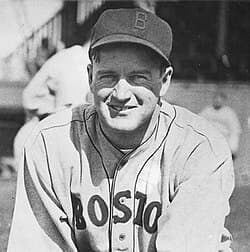
Joe Cronin portrait, undated.
Photo credit: Unknown photographer via Wikimedia Commons (Public domain)
Joseph Edward Cronin played shortstop for 20 seasons, managed for 15, and then ran the American League for 15 years as its president. He was one of the most powerful-hitting shortstops of the 1930s, a player-manager who led by force of personality, and an executive who oversaw the league through expansion and the introduction of the designated hitter. He touched every level of the game and left his mark on each one. The BBWAA elected him to the Hall of Fame in 1956.
San Francisco
Cronin was born on October 12, 1906, in San Francisco, the son of an Irish immigrant father. He grew up in the Excelsior District and played baseball at Mission High School and later Sacred Heart High School and at local playgrounds around the city. The Pittsburgh Pirates signed him in late 1924, and he spent parts of two seasons with the club, appearing in 50 games across 1926 and 1927 without establishing himself. He was sent to Kansas City of the American Association, where a Washington Senators scout purchased his contract in mid-1928, and the move changed his career.
He became the regular shortstop in Washington in 1929, hitting .281 with 8 home runs and 88 RBI. By 1930, he had become one of the best players in the American League. He hit .346 that year, then .306 with 12 home runs and 126 RBI in 1931. He hit .318 with 116 RBI in 1932, establishing a pattern of run production unusual for a shortstop in any era. The Senators had Heinie Manush in the outfield during those years, acquired from the Browns in a June 1930 trade for Goose Goslin, and the combination of Manush's hitting with Cronin's production from the shortstop position gave Washington one of the strongest lineups in the league.
Player-Manager
In 1933, at age 26, Senators owner Clark Griffith named Cronin player-manager of the club, making him one of the youngest managers in major league history. Cronin responded by hitting .309 with 118 RBI and leading the Senators to the American League pennant. Washington lost the World Series to the New York Giants in five games, but the pennant validated Griffith's faith in a 26-year-old shortstop running the club from the field.
The relationship between Cronin and Griffith extended beyond baseball. Cronin married Mildred Robertson, Griffith's niece whom Griffith had adopted and raised as his own daughter, in September 1934. The marriage complicated the professional relationship, and after the 1934 season, Griffith sold Cronin to the Boston Red Sox for $250,000 and shortstop Lyn Lary. The price was the highest ever paid for a player at the time, and the transaction sent one of baseball's best players to a franchise that desperately needed one.
Boston
Cronin became player-manager of the Red Sox and held both roles from 1935 through 1945. He hit .295 with 95 RBI in his first Boston season and continued producing at the plate through the late 1930s, batting .307 with 18 home runs and 110 RBI in 1937 and .325 with 17 home runs in 1938. He was a right-handed hitter with enough power to drive the ball over the left-field wall at Fenway Park, and his run production from the shortstop position placed him in a class with only a handful of contemporaries.
His playing career ended abruptly in April 1945 when he broke his right leg sliding into second base in the season's third game. He was 38 years old, and the leg never healed well enough for him to return as an everyday player. He continued managing the Red Sox through the 1946 and 1947 seasons, leading Boston to the 1946 American League pennant. The Red Sox lost the World Series to the St. Louis Cardinals in seven games, with Enos Slaughter's famous dash from first base to home on a hit by Harry Walker deciding Game 7. Cronin's career managerial record stood at 1,236 wins and 1,055 losses when he stepped down.
Running the League
Cronin became general manager of the Red Sox in late 1947 and held the position until the American League owners elected him president of the league in 1959, replacing Will Harridge. He served as league president until 1973, a tenure that spanned some of the most transformative years in baseball history. The league expanded from eight to twelve teams during his presidency, adding new franchises in cities that had never had major league baseball. He oversaw the introduction of the designated hitter rule in 1973, the most significant rule change in the American League since the founding of the league, and navigated the early years of the Players Association's growing power under Marvin Miller.
Cronin finished his playing career with a .301 batting average, 2,285 hits, 170 home runs, and 1,424 RBI over 2,124 games. He died on September 7, 1984, in Osterville, Massachusetts, at age 77.