Profile
Tom Connolly
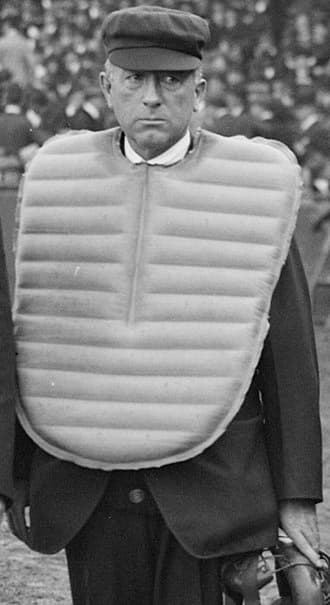
Tom Connolly portrait, 1916.
Photo credit: Bain News Service via Wikimedia Commons (Public domain)
Thomas Henry Connolly umpired the first American League game ever played, then spent the next three decades establishing the standards for how the league's games would be called. He worked eight World Series, served 31 seasons on the field, and accomplished all of it without ever playing organized baseball himself. He was an Englishman who fell in love with the game as a teenager in New England and devoted his entire professional life to officiating it. The Veterans Committee elected him to the Hall of Fame in 1953, alongside Bill Klem, making them the first two umpires inducted into Cooperstown.
Manchester to Natick
Connolly was born on December 31, 1870, in Manchester, England, and emigrated to the United States as a boy, settling in Natick, Massachusetts, with his family. He never played baseball at any competitive level. Instead, he became fascinated with the rules of the game after attending a local match, and he began studying the rulebook with an intensity that went beyond casual interest. He could recite the rules from memory, and his command of the regulations drew the attention of people involved in organized baseball in the New England area.
He began umpiring amateur contests as a young man and quickly established a reputation for consistency and fairness. Tim Hurst, a National League umpire, recognized Connolly's ability and helped secure him a position in the New England League in 1894. Connolly worked his way through the minor leagues and reached the National League in 1898, where he spent parts of three seasons umpiring at the highest level. He resigned in mid-1900 over disputes with NL president Nicholas Young about the institutional support and protection the league provided to its umpires. The National League in the late 1890s was a rowdy circuit where players routinely abused umpires and the league office did little to back them up, and Connolly had seen enough to know that effective umpiring required an organization willing to stand behind its officials.
The American League
When Ban Johnson launched the American League as a major league in 1901, Johnson's vision included a different approach to umpiring. He wanted his officials treated with respect and backed by the league office, and he was willing to discipline players and managers who abused them. Connie Mack recommended Connolly, and Johnson hired him. The fit was ideal. Connolly wanted institutional support for umpires. Johnson wanted umpires who could command respect without creating confrontations. Both men got what they needed from the arrangement.
Connolly umpired the American League's first official game on April 24, 1901, between the Cleveland Blues and the Chicago White Stockings in Chicago. He called balls and strikes in a league that did not yet have a second year of existence, and he helped give it credibility through his consistency and composure on the field.
Connolly believed umpiring should be quiet authority rather than theatrical confrontation. He rarely ejected players. By traditional accounts, he once went ten consecutive years without ejecting a single player, a stretch that reflected his philosophy rather than any absence of conflict on the diamond. He controlled games through body language, tone of voice, and the patient willingness to explain his reasoning to anyone who asked, without ever conceding that the call might have been wrong. Managers who expected a fight found instead a man who would listen, acknowledge the complaint, and then move the game along. His restraint was deliberate and principled. He believed that the fewer ejections an umpire needed, the more respect he commanded, and that respect was the only tool an umpire truly possessed once the game began.
Eight World Series
Connolly worked eight World Series between 1903 and 1924, including the first modern World Series in 1903 between the Boston Americans and the Pittsburgh Pirates. He umpired across the Dead-Ball and Live-Ball eras, calling games that featured Cy Young, Walter Johnson, Christy Mathewson, and Babe Ruth at various stages of their careers. His longevity at the highest level reflected the American League's trust in his judgment across two generations of the game, and his World Series assignments confirmed that the league considered him its most reliable official for the games that mattered most.
He moved off the field during the 1931 season and transitioned into an administrative role as the American League's umpire-in-chief, a position he held until 1954. In that capacity he oversaw the hiring, training, and evaluation of every umpire in the league for more than two decades. He shaped the standards and expectations of American League umpiring long after his own career behind the plate had ended, and the generation of umpires who worked under his supervision carried forward the principles of composure and quiet authority that Connolly had practiced throughout his career.
Natick
Connolly died on April 28, 1961, in Natick, Massachusetts, at age 90. He had returned to the town where he first encountered baseball as a boy, and he had spent more than six decades serving the sport in one capacity or another. His career and Bill Klem's together established that umpiring was a profession with its own traditions, standards, and rightful place in the game's history, and their joint induction in 1953 affirmed that the men who called the games deserved recognition alongside the men who played them.