Profile
Bill Klem
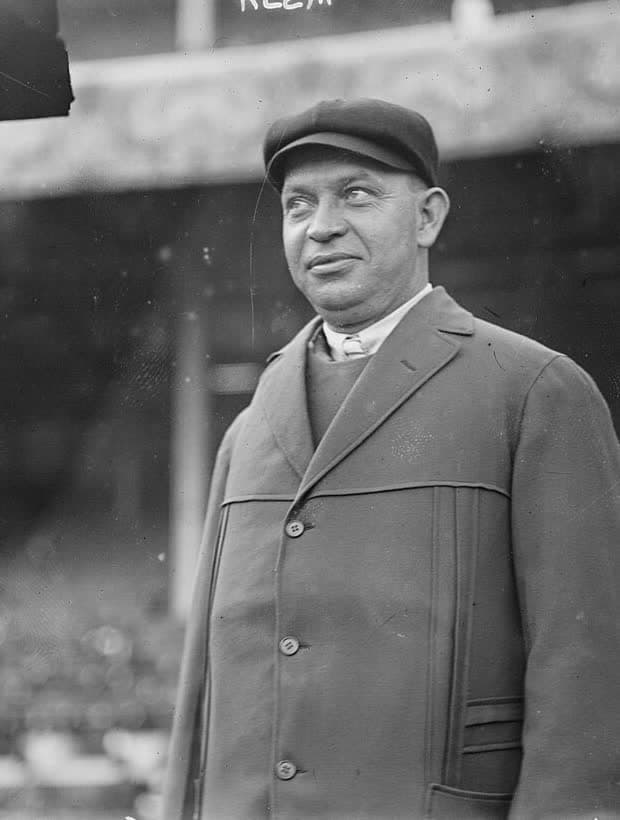
Bill Klem portrait.
Photo credit: Bain News Service via Wikimedia Commons (Public domain)
William Joseph Klem umpired for 37 years in the National League, worked 18 World Series, and transformed umpiring from a job that attracted journeymen into a profession that demanded authority and commanded respect. He was among the first umpires to use arm signals for balls and strikes, giving spectators in the upper decks a way to follow the game without hearing the call. He umpired from behind home plate for the first 16 years of his career, insisting that the plate was where every critical call happened. When the National League eventually required umpires to rotate positions, he resisted before relenting. The Veterans Committee elected him to the Hall of Fame in 1953, alongside fellow umpire Tom Connolly, making them the first two umpires inducted into Cooperstown.
Rochester
Klem was born on February 22, 1874, in Rochester, New York. He played semipro baseball as a young man and briefly considered a career as a player before recognizing that his abilities lay elsewhere. He began umpiring in the minor leagues in 1902 and reached the National League in 1905 at age 31. He was short and stocky, with a booming voice and a temper that matched it.
He understood from the start that an umpire's authority was earned, not given. Players who argued too long were ejected. Managers who questioned his integrity were warned once and then removed. He drew a line in the dirt with his shoe when arguments grew heated, and any man who crossed it was finished for the day. John McGraw, who fought with umpires as a matter of principle, considered Klem the one umpire he could not intimidate.
The Plate
Klem pioneered the inside chest protector, wearing it beneath his jacket rather than holding the inflated balloon protector used by American League umpires. The inside protector allowed him to position himself directly over the catcher's shoulder, giving him a clearer view of the strike zone and enabling the more precise ball-and-strike calls that became his trademark. The National League adopted the inside protector as standard, and the difference in calling style between the two leagues persisted for decades.
His signature line, repeated across his career, was "I never missed one in my heart." He meant it as a statement of conviction, not accuracy. He believed that the integrity of the game depended on the umpire presenting every call with certainty, and he performed that certainty so convincingly that even the players who disagreed with him trusted the process. The nickname "The Old Arbitrator" followed him through the second half of his career, and he wore it with visible pride.
The World Series
Klem worked 18 World Series between 1908 and 1940, a record that reflected both his longevity and the league's confidence in his ability to handle the highest-pressure games. He worked five consecutive Fall Classics from 1911 through 1915 and called games involving Christy Mathewson, Ty Cobb, Babe Ruth, and Lou Gehrig, spanning the Dead-Ball and Live-Ball eras. He worked the famous 1908 National League playoff game between the Giants and Cubs that decided the pennant in the aftermath of Fred Merkle's baserunning mistake, sharing duties with Jim Johnstone.
After the Field
He pushed throughout his career for higher salaries, better working conditions, and professional standards for umpires. He refused to allow players to address him by his first name during games, insisting on "Mr. Klem." He believed that umpires were as essential to the game as the players, and his insistence on dignity shaped the expectations of every umpire who followed him. He moved off the field after the 1941 season, served as the National League's chief of umpires, and died on September 16, 1951, in Coral Gables, Florida, at 77.