104 Years of Baseball at Michigan and Trumbull
From a wooden grandstand built on a former hay market in 1896 to Robert Fick's rooftop grand slam in 1999, the corner of Michigan and Trumbull hosted professional baseball longer than any other site in America.
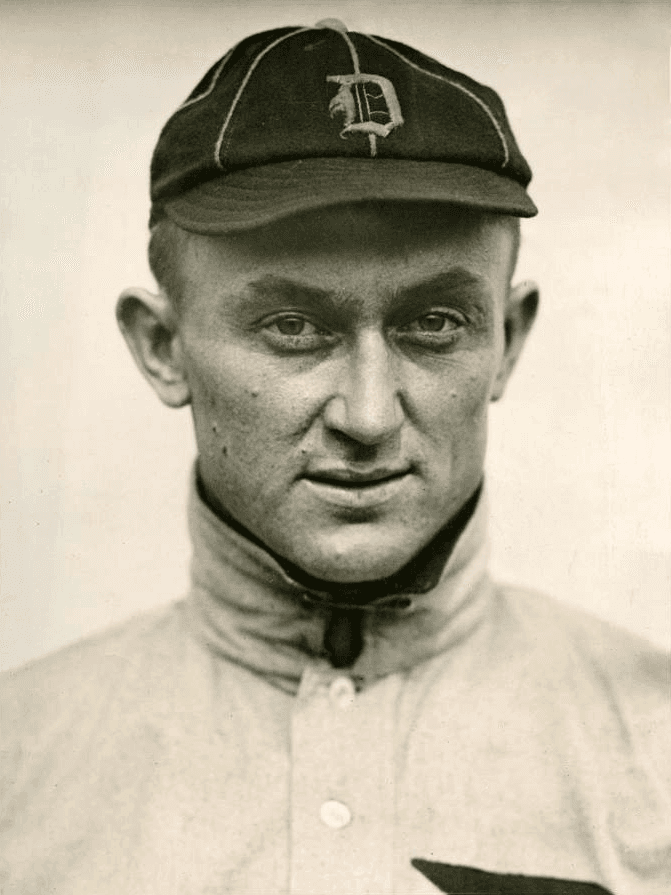
Ty Cobb portrait, 1913.
Photo credit: International Film Service via Wikimedia Commons (Public domain)
The intersection of Michigan and Trumbull avenues sits in Corktown, Detroit's oldest neighborhood, settled by Irish immigrants in the 1840s. Professional baseball arrived there on April 28, 1896, when the Western League's Detroit Tigers played at a new wooden grandstand called Bennett Park. The park was named for Charlie Bennett, a catcher who had been a star of the National League's Detroit Wolverines in the 1880s before a train accident in 1894 cost him both legs. Bennett himself caught the ceremonial first pitch on opening day, and he continued that tradition at Detroit home openers through 1926.
For the next 104 years, through four names and three full reconstructions, the corner never stopped hosting baseball. No other site in the country held professional games for so long.
Bennett Park and the Arrival of Cobb
Bennett Park was a bare-bones facility, a 5,000-seat wooden structure with a peaked roof over the grandstand. When the Tigers became charter members of the new American League in 1901, capacity was expanded to roughly 8,500, but the park remained cramped and rudimentary.
Ty Cobb arrived in August 1905, an 18-year-old from Georgia who had been purchased from the Augusta Tourists for $750. He debuted at Bennett Park on August 30 before a weekday crowd of around 1,200. Bennett Park was the stage for his first decade of terror on the basepaths, including three consecutive batting titles from 1907 to 1909 and three straight World Series appearances, all of which the Tigers lost.
Navin Field, Steel, Concrete, and a New Diamond
By 1911, owner Frank Navin had seen enough of the wooden grandstand. He commissioned a new steel-and-concrete ballpark on the same site, rotating the diamond 90 degrees so that home plate sat where left field had been. Navin Field opened on April 20, 1912, the same day Fenway Park opened in Boston. The initial capacity was 23,000, with original dimensions of roughly 340 feet down the left field line, 400 to center, and 365 to right.
Navin expanded the park over the next two decades, adding a second deck and pushing capacity to roughly 30,000 by 1923. On July 13, 1934, Babe Ruth launched his 700th career home run at Navin Field, a shot off Tommy Bridges that sailed into the right field bleachers. Ruth reportedly shouted "I want that ball!" as he circled the bases, and police retrieved it from a teenager named Lenny Bielski, who received $20 and an autographed ball for his trouble.
The following October, Navin Field hosted the World Series for the fourth time. In Game 6, on October 7, 1935, Goose Goslin delivered a walk-off single in the ninth inning to give Detroit its first championship in five tries. Frank Navin, who had waited decades for that title, died of a heart attack on November 13, barely five weeks later.
Briggs Stadium, the Overhang, and the Lights
Walter Briggs, Navin's partner, took full ownership and launched a massive expansion. Workers extended the upper deck to both foul poles and across right field. Because Trumbull Avenue ran directly behind the right field fence and prevented any outward expansion, the architects pushed the upper deck 10 feet over the lower deck and into the field of play, creating the famous right field overhang. The first row of the upper deck in right hung just 315 feet from home plate, while the fence below it stood at 325. Fly balls that would have been routine outs in other parks sometimes caromed off the overhang's face for home runs.
By 1938, after the city agreed to vacate a stretch of Cherry Street to allow double-decking on the left field side, the renamed Briggs Stadium seated approximately 53,000, making it the second-largest park in baseball. But it remained one of the last without lights. Owner Briggs believed baseball belonged in daylight and refused to install them until June 15, 1948, when eight 150-foot light towers and 1,386 bulbs went live at a cost of $400,000. A crowd of 54,480 watched Hal Newhouser throw a two-hitter in a 4-1 win over Philadelphia.
In 1945, the stadium hosted three games of the World Series against the Cubs, with the Tigers winning in seven behind Hal Newhouser's two victories, including the Game 7 clincher. That wartime Series, played while many stars were still overseas, gave Detroit its second championship.
Tiger Stadium, 1968 and 1984
John Fetzer purchased full ownership of the club and renamed the park Tiger Stadium on January 1, 1961. The ballpark's final decades produced its most vivid postseason memories.
In October 1968, the Tigers trailed the Cardinals three games to one in the World Series. Game 5 at Tiger Stadium turned on a single defensive play. With Lou Brock attempting to score from second on a single, left fielder Willie Horton fired a strike to catcher Bill Freehan, who tagged Brock out at the plate when Brock chose not to slide. The Tigers won that game and the next two, with Mickey Lolich pitching three complete-game victories to earn Series MVP honors. The 1968 championship arrived in a city still raw from the riots of July 1967, and the celebration briefly united a fractured Detroit.
Sixteen years later, the 1984 Tigers opened the season 35-5 and never looked back. In Game 5 of the World Series against San Diego, Kirk Gibson hit two home runs, including a three-run blast off Goose Gossage in the eighth inning, to clinch the championship at Tiger Stadium. It was the last World Series game played at the corner.
The Final Game
By the 1990s, Tiger Stadium was showing its age. Support columns blocked thousands of sightlines, the concourses were narrow, and the infrastructure was crumbling. The Tigers announced a move to the new Comerica Park in downtown Detroit, and September 27, 1999, became the last day.
A crowd of 43,356 filled the old park for an 8-2 win over Kansas City. In the eighth inning, Robert Fick hit a grand slam that struck the right field roof, the stadium's 11,111th and final home run. After the game, Ernie Harwell emceed a closing ceremony as 65 former Tigers, spanning the 1930s to the 1990s, walked one by one through the center field door to their old positions. The oldest was pitcher Elden Auker, who had played at the corner from 1933 to 1938.
The stadium sat empty for nearly a decade. Preservation efforts failed to secure enough funding. Demolition began on June 30, 2008, and was completed on September 21, 2009. The 125-foot flagpole that had stood in center field, in play, for the park's entire life was preserved.
The Corner Today
In 2016, the Detroit Police Athletic League acquired the property. The Corner Ballpark, which opened on March 24, 2018, sits on the original Tiger Stadium footprint, with a youth baseball field aligned where the diamond once was. The old flagpole still stands in what used to be center field. The facility seats 2,500 and houses PAL's permanent headquarters. Detroit named it the Willie Horton Field of Dreams.
Corktown has become one of the most active neighborhoods in Detroit's ongoing recovery, with restaurants and development pressing in from all sides. The Corner Ballpark is the only structure on the block that remembers what was there before. Professional baseball was played at Michigan and Trumbull from 1896 to 1999. No other address in the country held the game that long.