Profile
Billy Herman
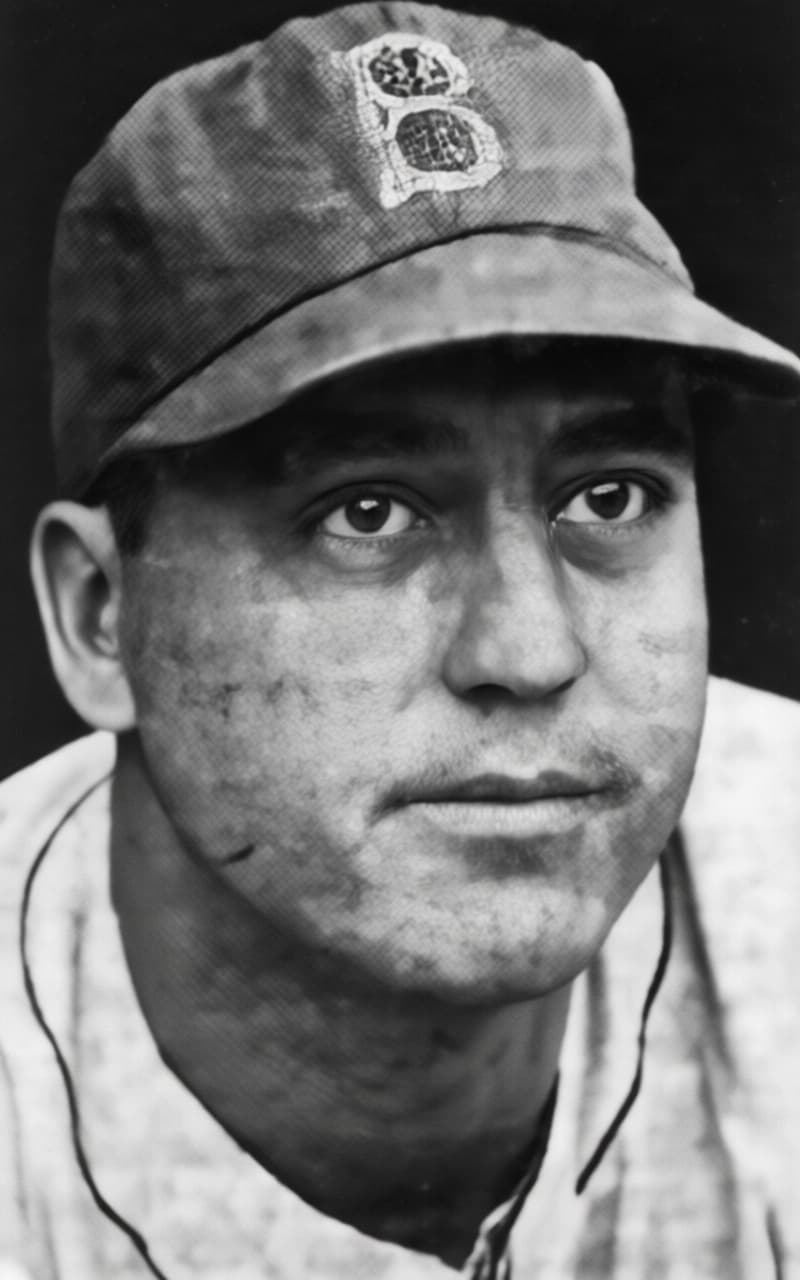
Billy Herman portrait.
Photo credit: User-provided image via User-provided image
William Jennings Bryan Herman was named after a three-time presidential candidate who lost all three elections, and he joked about it his entire life. "Named after a loser," he said, hoping it wouldn't follow him. It didn't. He collected 2,345 hits, made 10 consecutive All-Star teams, and became the finest hit-and-run batter of his generation, all while playing a position he had never tried before a minor league general manager lied about it on a scouting report. Paul Waner said, "I'll hit one I think is through there and Herman suddenly comes up through a trapdoor." He appeared in four World Series and lost every one of them.
New Albany
Herman was born on July 7, 1909, in New Albany, Indiana, one of 10 children of William Herman, a machinist, and Elizabeth Herman. He attended New Albany High School and signed with the Louisville Colonels of the American Association without attending college. He had played third base and shortstop in high school, but when Louisville's Cap Neal assigned him to the Class-D Vicksburg Hill Billies, Neal listed his position as second base on the paperwork. It was a fabrication. Herman had never played second base in his life, and the lie launched a Hall of Fame career.
He struggled early and nearly washed out of Class D, the lowest level of professional baseball. "Since Class D is the end of the road, and I had failed to make it at Class D, the chances are that I'd of dropped out of baseball," he said later. He stuck with it, found his footing at the new position, and hit well enough in the minors that the Chicago Cubs purchased his contract on August 4, 1931. He debuted at Wrigley Field on August 29 against Cincinnati.
Wrigley Field
Herman hit .314 with 206 hits in his first full season in 1932 and played in the World Series against the Yankees, a four-game sweep in which Ruth hit his famous "called shot." Herman was in the opposing dugout and spent the rest of his life denying the legend. "If he'd have pointed, he'd have been on his ass the rest of the series," Herman said. Ruth was arguing with the Cubs dugout between pitches, not predicting the future.
He set the National League single-season record for putouts by a second baseman with 466 in 1933, a record that still stands. His positioning was unconventional and precise. He stood behind second base for pull hitters, claiming a 70 percent success rate on line drives hit through the middle, and deep on the grass between first and second for slower runners. By one estimate his positioning yielded 50 additional line drive outs per season beyond what a conventionally positioned second baseman would have recorded.
His best year was 1935, when he led all of baseball with 227 hits and the National League with 57 doubles, batted .341, and led NL second basemen in assists, putouts, double plays, and fielding percentage. He finished fourth in the MVP voting. He hit 57 doubles again in 1936. Casey Stengel called him "one of the smartest players ever to come into the National League" and nicknamed him "John the Baptist."
He was selected for the All-Star Game 10 consecutive years, from 1934 through 1943. In the 1937 game at Griffith Stadium, he was the second baseman who fielded Earl Averill's line drive off Dizzy Dean's toe and threw to first for the out that effectively ended Dean's career. Herman appeared in four World Series with the Cubs (1932, 1935, 1938) and the Brooklyn Dodgers (1941) and lost all four, three of them to the Yankees. His best October performance came in 1935 against the Tigers, when he batted .333 with six RBI.
Brooklyn
The Cubs traded Herman to the Brooklyn Dodgers on May 6, 1941, for two players and $65,000. He went 4-for-4 in his debut and 5-for-5 four days later. Leo Durocher, the Brooklyn manager, had pushed for the deal. "Herman will help us more than you expect," Durocher said. "He'll steady the kid at shortstop. He'll take charge of the infield. And he gives us sustained power." Phil Cavarretta, still in Chicago, didn't take it well. "When we traded Billy, I was sick, believe me," Cavarretta said. "He went over to Brooklyn and won pennants."
Herman helped Brooklyn win the 1941 pennant but lost the World Series to the Yankees in five games. He played two more seasons in Brooklyn, producing his finest offensive year in 1943 at age 34, when he batted .330 with 100 RBI on just two home runs, a testament to how thoroughly he could place the ball where it needed to go. He was classified 1-A for the draft, enlisted in the Navy, and was stationed at Pearl Harbor, where he played baseball on base teams throughout the Pacific. He missed the 1944 and 1945 seasons entirely.
He returned in 1946, split between Brooklyn and the Boston Braves, and finished his playing career in 1947 as player-manager of the Pittsburgh Pirates. The Pirates went 61-92, last in the National League, 32 games behind Brooklyn. When the front office traded Bob Elliott, his best player, Herman summarized the situation. "Why, they've gone and traded the whole team on me." He resigned before the final game of the season.
After the Game
Herman coached for the Brooklyn Dodgers from 1952 through 1957, a period that included four National League pennants and the franchise's first World Series championship in 1955. He coached for the Milwaukee Braves in 1958 and 1959, adding another pennant, and served as third-base coach for the Boston Red Sox from 1960 through 1964. He managed the Red Sox for the final two games of 1964 after Johnny Pesky was fired, winning both, and then served as full-time manager in 1965, going 62-100 for a ninth-place finish. He was fired partway through the 1966 season with a 64-82 record. His lifetime managerial record was 189-274.
He scouted for the Oakland Athletics from 1968 through 1974 and coached for the San Diego Padres in the late 1970s. He was an excellent golfer who carried a 3 handicap and an accomplished bridge player. He married Hazel Jean Steproe in 1927, divorced her in 1960, and married Frances in 1961. His granddaughter Cheri married Mitch Daniels, who served as Governor of Indiana and later as president of Purdue University.
The Veterans Committee elected Herman to the Hall of Fame in 1975. His election falls in the broader period associated with the Frankie Frisch Veterans Committee controversy, during which former teammates and contemporaries of Frisch and Bill Terry were elected in a pattern that drew charges of favoritism. Frisch died in 1973, two years before Herman's election, but the committee continued selecting players from the same orbit. Herman's case is considerably stronger than most of the Frisch-era selections. In 15 seasons he accumulated 2,345 hits, a .304 batting average, 486 doubles, and 10 All-Star selections while playing elite defense at second base. Charlie Grimm, who managed him on the Cubs, put it in terms the committee would have understood. "Frankie Frisch, at his best, wasn't the fielder Billy is."
Herman died on September 5, 1992, in West Palm Beach, Florida, at 83, from cancer. He was buried at Riverside Memorial Park in Tequesta, Florida. "Baseball was always kind of a struggle for me," he once said. "I guess maybe I was doing all right and didn't realize it."