Profile
Paul Waner
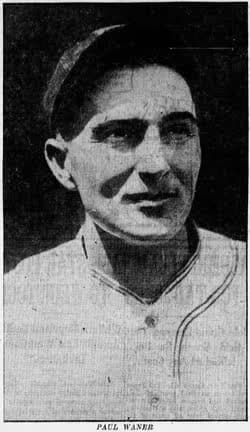
Paul Waner portrait, 1927.
Photo credit: Unknown author via Wikimedia Commons (Public domain)
Paul Glee Waner collected 3,152 hits over twenty major league seasons, batted .333 for his career, and did much of it while drinking more than any of his contemporaries thought a professional athlete could sustain. Sportswriters called him "Big Poison" and called his younger brother Lloyd "Little Poison," a pairing that followed both men through their careers and into Cooperstown. The origin of the nicknames is disputed. The most commonly repeated account traces them to a Brooklyn fan whose accent turned "big person" and "little person" into something the press box heard differently, while another version credits sportswriters who noted the damage the brothers inflicted on opposing pitching and reached for the obvious metaphor. The BBWAA elected Paul Waner to the Hall of Fame in 1952.
Harrah to Pittsburgh
Waner was born on April 16, 1903, in Harrah, Oklahoma, a small town east of Oklahoma City. He grew up in a rural setting and developed the hand-eye coordination that would define his career through years of informal competition. He attended East Central State Teachers College in Ada, Oklahoma, where he played college baseball, and his performance there led to a contract with the San Francisco Seals of the Pacific Coast League.
He hit .401 for the Seals in 1925, a performance that made him one of the most sought-after minor leaguers in the country. The Pittsburgh Pirates acquired his contract, and he reached the major leagues in 1926, hitting .336 in his first season with a collection of doubles, triples, and singles that sprayed to all fields. His debut established the characteristics that would define two decades of production. He choked up on a light bat, maintained extraordinary bat control, and could place the ball wherever the defense was not.
The 1927 Season and Beyond
Waner's second season was his best. In 1927, he hit .380 and won the National League batting title with 237 hits, 18 triples, 9 home runs, and 131 RBI. The National League awarded him the Most Valuable Player prize. The Pirates won the pennant that year, riding Waner's bat and the production of a lineup that included Kiki Cuyler and the newly arrived Lloyd Waner. Pittsburgh reached the World Series and faced the 1927 New York Yankees, a team widely regarded as the greatest ever assembled. The Yankees swept the Pirates in four games, and the mismatch overshadowed what had been an outstanding season for Waner and his teammates.
He won two more National League batting titles, hitting .362 in 1934 and .373 in 1936. Across twelve consecutive seasons from 1926 through 1937, he batted .300 or better every year, a stretch of consistency that placed him among the most reliable hitters in baseball history. He collected 200 or more hits in eight seasons, and his ability to maintain that level of contact over more than a decade reflected an approach to hitting that prioritized precision over power.
Waner was a line-drive hitter who used the entire field and rarely struck out. He accumulated only 376 strikeouts in 9,459 career at-bats, an average of fewer than 20 per full season, a number so low that it bordered on the absurd even by the standards of his era. He did not chase pitches outside the strike zone, he did not try to hit the ball farther than his frame would allow, and he punished mistakes by lining them into gaps with a swing that was compact and repeatable. The results accumulated steadily rather than dramatically, and his greatness sometimes went underappreciated by fans and writers who preferred the spectacle of home runs to the relentlessness of base hits.
The Waner Brothers
Paul and Lloyd Waner played together in the Pittsburgh outfield from 1927 through 1940, forming one of the most productive sibling partnerships in the history of professional sports. They combined for 5,611 career hits, the most by any pair of brothers in baseball history, a record that stands unchallenged. Paul batted in the middle of the order while Lloyd led off or batted second, and opposing pitchers faced them in sequence for more than a decade without discovering a reliable formula for getting both of them out.
Lloyd was a singles hitter with exceptional speed who reached base at a rate that kept the lineup turning over ahead of Paul. Paul drove the runners in. The partnership was so effective that Pittsburgh's offense during the late 1920s and early 1930s was built around their complementary skills, with the rest of the lineup arranged to maximize the damage the Waner brothers could do together. Lloyd was inducted into the Hall of Fame in 1967, making them one of the few pairs of brothers enshrined in Cooperstown.
3,000 Hits
Waner's production declined in the late 1930s as age and his lifestyle caught up with his skills. The Pirates released him after the 1940 season, and he spent the final years of his career bouncing between the Brooklyn Dodgers, Boston Braves, and New York Yankees, collecting the hits he needed to reach the milestones that would secure his legacy.
He reached his 3,000th hit on June 19, 1942, singling off Rip Sewell of the Pittsburgh Pirates while playing for the Boston Braves. He was the seventh player in major league history to reach the milestone, joining a club that included Ty Cobb, Tris Speaker, Honus Wagner, Nap Lajoie, Eddie Collins, and Cap Anson. He finished his career with 3,152 hits, 605 doubles, 191 triples, 113 home runs, and that .333 batting average.
The Drinking
Waner's relationship with alcohol was an open secret throughout his career and a source of stories that circulated through clubhouses and press boxes for decades. Teammates and opponents described a man who drank heavily and often, whose ability to perform while hungover or, by some accounts, still intoxicated defied every assumption about what professional athletes could tolerate.
Pie Traynor, who managed the Pirates in the mid-1930s, reportedly tried to convince Waner to stop drinking. When Waner went dry and slumped badly, Traynor reversed course and told him to go back to the bottle. Waner went 4-for-4 the next game and finished the season hitting .362. The story may have been embellished over the years, but it circulated widely enough to become part of his legend, and the underlying truth that Waner could hit regardless of his personal habits was attested to by too many witnesses to dismiss.
His drinking eventually contributed to health problems that shortened his post-baseball life. He retired after the 1945 season at age forty-two, having squeezed every hit his talent and determination could produce. He died on August 29, 1965, in Sarasota, Florida, at age sixty-two.