Profile
Earl Averill
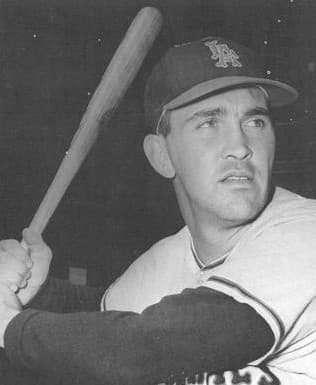
Earl Averill Jr. portrait, 1962.
Photo credit: Unknown author via Wikimedia Commons (Public domain)
Howard Earl Averill hit a home run on his first major league at-bat, broke Dizzy Dean's toe with a line drive that effectively ended Dean's career, and spent 13 seasons as the best hitter on one of the best lineups in the American League. He came from Snohomish, Washington, a lumber town of 2,000 people, and his San Francisco Seals manager believed his hitting was powered by sauerkraut juice. Cleveland's owner called him a midget when he first saw him. Averill stood five feet nine and a half inches tall, swung bats weighing 42 to 44 ounces, and hit .318 with 238 home runs over a career shortened by a congenital spinal condition that eventually required six pins. The Veterans Committee elected him to the Hall of Fame in 1975. "It's been a long time coming," he said, "but better late than never. It is wonderful to make it while you are still alive."
Snohomish
Averill was born on May 21, 1902, in Snohomish, Washington. His father Jotham died when Earl was two, and his mother Anna worked in a shingle factory to support three children. Averill dropped out of high school during his freshman year and worked in lumber mills, on road crews, and in his brother Forrest's greenhouse. He played weekend semipro baseball for the Snohomish Pilchuckers beginning around 1920, and fans would pass a hat after outstanding performances. He once collected $80.
In 1924, citizens of Snohomish raised funds to send him to a tryout with the Seattle Indians of the Pacific Coast League. Manager Red Killefer rejected him. Averill played for Bellingham at $15 a game and then for Anaconda, Montana, at $250 a month, where he hit .430. The San Francisco Seals signed him in 1926, and over three PCL seasons he averaged roughly 250 hits per year with a .342 batting average. His 1928 season produced 270 hits, 53 doubles, 36 home runs, 178 runs scored, and 173 RBI. His manager Nick Williams credited the sauerkraut juice Averill drank regularly and threatened to bench him if he ever stopped. Cleveland purchased his contract for $45,000.
Cleveland
Averill debuted on Opening Day, April 16, 1929, at League Park against the Detroit Tigers. In the bottom of the first inning, facing left-hander Earl Whitehill, he drove an 0-and-2 pitch over the right-field fence and screen, landing among the frame houses across the street. He was 26 years old and had never played above the Pacific Coast League. When Cleveland owner Alva Bradley had first seen him, he called him a midget.
He batted .332 with 18 home runs in his rookie year and .339 with 19 home runs in 1930. On September 17, 1930, he hit four home runs in a doubleheader against Washington, three in the first game and an inside-the-park home run in the second, driving in 11 runs across the two games. He was the first player in major league history to hit four home runs in a doubleheader.
His peak power arrived in 1931 when he hit .333 with 32 home runs and 143 RBI, career highs in both power categories. He matched the 32 home runs in 1932 and hit 31 more in 1934. In 1936 he produced his finest all-around season, batting .378 with 232 hits and 15 triples (leading the American League in both), 28 home runs, and 126 RBI. He hit .451 in July and carried the pace deep into August before Luke Appling overtook him by hitting .477 in September to win the batting title at .388.
Averill was selected for the All-Star Game in each of its first six years, from 1933 through 1938, the only outfielder in either league chosen for all six. In the inaugural game at Comiskey Park on July 6, 1933, he pinch-hit for pitcher Alvin Crowder and singled sharply to center, driving in Joe Cronin. In 1934 he hit a double and a triple with three RBI in a 9-7 American League victory. He also toured Japan with the 1934 "All-American" team alongside Ruth, Jimmie Foxx, Lou Gehrig, and Connie Mack, where he was awarded a Japanese sword for being the first American player to hit a home run against the All-Nippon Stars.
The All-Star Game
On July 7, 1937, at Griffith Stadium in Washington, Averill came to bat in the bottom of the third inning against National League starting pitcher Dizzy Dean. He hit a line drive that struck Dean on his left big toe and caromed to second baseman Billy Herman, who threw to first in time for the out. Dean's toe was fractured. "Fractured, hell," Dean said, "the damn thing's broken!" He returned too soon, altered his delivery to compensate for the pain, injured his arm, and was never the same pitcher. Dean had averaged 24 wins per season before the injury and won only 17 more games in the rest of his career. Averill had eaten breakfast with Dean that morning. "You didn't have to hit me," Dean told him afterward.
That same season, Averill's own body began to fail. A congenital spinal condition, in which his tailbone and spine had never fully joined, caused temporary leg paralysis mid-season. He had been batting .394 on June 26 before the symptoms appeared and finished the year at .299. The condition altered his swing and reduced his power for the remainder of his career.
Detroit and After
Cleveland traded Averill to the Detroit Tigers on June 14, 1939, for pitcher Harry Eisenstat and cash. Cleveland fans were angry. He played for Detroit through 1940, appearing in three games of the World Series against Cincinnati as a pinch-hitter, going 0-for-3. He made the final out of the Series in the decisive Game 7, a 2-1 Reds victory. The Boston Braves released him after eight games in 1941, and he returned to Snohomish for good.
He operated a greenhouse with his brother Forrest and later opened the Earl Averill Motel, a landmark on the north approach to town, which he ran for 20 years. His son Earl Douglas played seven seasons in the major leagues as a catcher and outfielder, primarily for the Indians, Cubs, White Sox, Angels, and Phillies. The younger Averill hit 21 home runs for the Angels in 1961. "I tried to follow in the footsteps of my dad," he said. "That was a mistake because there was no following him."
The Veterans Committee elected Averill to the Hall of Fame on February 3, 1975. He had reportedly arranged that his name never appear in the Hall if elected posthumously, a measure of how long the wait had grated on him. Cleveland retired his number 3 on June 8, 1975, joining Bob Feller's 19 and Lou Boudreau's 5 as the franchise's honored numbers.
Averill died on August 16, 1983, in Everett, Washington, at 81, from respiratory failure brought on by pneumonia. Six weeks earlier he had attended the 50th anniversary celebration of the 1933 All-Star Game at Comiskey Park. Of the original All-Stars, roughly a dozen survived for the reunion. He was buried at Grand Army of the Republic Cemetery in Snohomish. In 13 seasons he had accumulated 1,669 games, 2,019 hits, 238 home runs, 1,164 RBI, and a .318 batting average. Lefty Gomez offered the truest compliment: "One more like him probably would have kept me out of the Hall of Fame."