Profile
Bill Terry
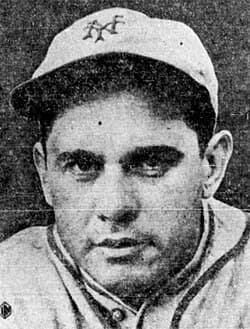
Bill Terry portrait, 1933.
Photo credit: Bain News Service via Wikimedia Commons (Public domain)
William Harold Terry hit .401 in 1930, the last National League player to reach that number, and nobody in the league has matched it in the nearly a century since. He played fourteen seasons for the New York Giants, compiled a .341 career average that ranks among the highest of any first baseman in history, and managed the club for a decade with a tactical precision that produced three pennants and one World Series championship. He carried himself with a bluntness that made him respected and resented in roughly equal measure. The BBWAA elected him to the Hall of Fame in 1954.
Atlanta to the Polo Grounds
Terry was born on October 30, 1898, in Atlanta, Georgia. He left school as a teenager and went to work loading freight on Atlanta's railroad docks, hard labor that built the physical strength he would carry into his baseball career. He drifted into semipro ball and then into the minor leagues as a pitcher, showing enough ability to draw attention from major league scouts but not enough to project as a frontline arm.
The New York Giants signed him, and manager John McGraw made the decision that shaped Terry's career by converting him from a pitcher to a first baseman. Terry reached the major leagues in 1923 and spent parts of two seasons on the bench before becoming the regular first baseman in 1925, when McGraw moved George Kelly to second base to create an opening. Terry lost playing time in 1926, but when Kelly was traded to the Cincinnati Reds before the 1927 season, the position belonged to Terry for good.
He hit .326 in 1927, .326 again in 1928, and .372 in 1929, establishing himself as one of the best contact hitters in the National League. He stood six feet one and weighed around 200 pounds, a left-handed hitter who drove the ball into the Polo Grounds' expansive outfield gaps with a smooth, level swing. He did not strike out often, he hit to all fields, and he ran the bases well for a first baseman. McGraw, who was notoriously demanding of his players, considered Terry indispensable.
.401
The 1930 season produced an offensive explosion across both leagues. The baseball was livelier, pitching staffs were thin, and hitters took full advantage. The National League as a whole batted .303 that year, and the New York Giants' team batting average was .319. Within that context, Terry's .401 average stood at the highest summit in a season of peaks.
He collected 254 hits that year, tying the National League record set by Lefty O'Doul with the Philadelphia Phillies in 1929. He drove in 129 runs, hit 23 home runs, and scored 139 runs. His average was the highest in the National League since Rogers Hornsby had hit .403 in 1925, and it remains the last time a National Leaguer has reached the .400 mark. The achievement placed Terry in a conversation that included only a handful of twentieth-century players, and the passage of nearly a century without another NL player matching it has only made the number more prominent.
Terry's success in 1930 was not a fluke inflated by a single hot summer. He hit .372 in 1929 and .349 in 1931, bracketing his .401 season with averages that would have been career highlights for almost anyone else. His peak from 1929 through 1931 produced a three-year batting average above .370, sustained production that placed him alongside the best hitters of the Live-Ball Era.
Managing the Giants
McGraw's health had been declining for years, and on June 3, 1932, he resigned as manager of the Giants. Terry replaced him. The transition was not entirely smooth. McGraw had run the club as an autocrat for three decades, and Terry's personality was different in style if not in authority. He was quieter than McGraw but equally firm, and he brought a tactical precision to his managing that reflected his experience watching McGraw work.
In his first full season as manager, 1933, Terry led the Giants to the National League pennant. The Giants faced the Washington Senators in the World Series and won in five games. Mel Ott hit the decisive home run in the tenth inning of Game 5, driving in the run that gave New York the championship. It was the Giants' first World Series title since 1922, and it validated Terry's appointment at age 34.
Before the 1934 season, a reporter asked Terry about the Brooklyn Dodgers' chances for the coming year. "Is Brooklyn still in the league?" Terry replied. The remark was casual, possibly even joking, but it landed in Brooklyn like an insult. The Dodgers, who had little chance of winning the pennant themselves, beat the Giants in the final two games of the season and knocked them out of the pennant race. Brooklyn fans treated the quote as a blood oath, and sportswriters cited it for decades as a parable about the dangers of disrespecting an opponent. Terry never apologized and rarely discussed it.
The Giants won pennants again in 1936 and 1937, giving Terry three in his first five full seasons as manager. Both years they faced the New York Yankees in the World Series, and both years the Yankees won. The 1936 Yankees, with Lou Gehrig and Joe DiMaggio in his rookie season, beat the Giants in six games. The 1937 Yankees won in five. Terry's Giants had the pitching of Carl Hubbell and the hitting of Ott, but they could not match the depth and power of the Yankees' lineup.
Terry's playing career wound down during his managerial tenure. He hit .354 in 1934, .341 in 1935, and .310 in 1936, his final season as a player. He stepped away from the field at age 37 with fourteen seasons of service, all with the Giants. His managerial record from 1932 through 1941 stood at 823 wins and 661 losses.
After Baseball
Terry left managing after the 1941 season and served briefly in the Giants' front office before leaving the organization entirely. He settled in Jacksonville, Florida, where he operated an automobile dealership and invested in real estate. He avoided the baseball spotlight during his retirement years, appearing at old-timers' events infrequently and granting few interviews. His personality, direct to the point of brusqueness, made him a difficult subject for nostalgic profiles, and he seemed comfortable with the distance.
He finished his playing career with a .341 batting average, 2,193 hits, 154 home runs, 373 doubles, and 1,078 RBI across 1,721 games. His .341 average ranked among the highest of any first baseman in major league history, and his combination of batting skill, defensive competence, and managerial success placed him in rare company at his position.
Terry died on January 9, 1989, in Jacksonville, at age 90.