Profile
Mel Ott
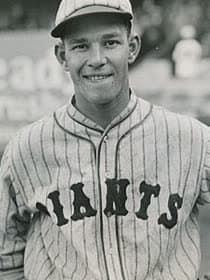
Mel Ott portrait.
Photo credit: Bain News Service via Wikimedia Commons (Public domain)
Melvin Thomas Ott reached the major leagues at 17, hit 511 home runs without ever playing for another franchise, and managed the New York Giants for seven seasons. He stood 5-foot-9 and weighed 170 pounds, and his signature batting stance involved lifting his front foot high off the ground before his swing, a move that coaches would have corrected in any other hitter. In Ott it produced one of the most prolific power careers in National League history.
Louisiana to the Polo Grounds
Ott was born in Gretna, Louisiana, on March 2, 1909. He played semipro baseball as a teenager and caught the attention of John McGraw, who brought him to the Giants for a tryout in 1925. McGraw watched the 16-year-old hit and decided immediately that no minor league manager would be allowed to tamper with that unorthodox swing. He kept Ott on the major league bench, using him as a pinch hitter and inserting him into the lineup gradually.
Ott debuted on April 27, 1926, at age 17. He became a regular outfielder by 1928 and hit .322 with 18 home runs as a 19-year-old. By 1929, he was one of the best hitters in the National League, hitting 42 home runs with 151 RBI at age 20.
The Polo Grounds and the Short Porch
Ott's power numbers benefited from the Polo Grounds, where the right field foul pole stood only 258 feet from home plate. His left-handed swing and high leg kick were tailored for that short porch. He hit 323 of his 511 career home runs at home. But the Polo Grounds did not create his talent. They amplified it. He still hit .304 lifetime and led the NL in home runs six times.
From 1929 to 1945, Ott hit 20 or more home runs in 15 of 17 seasons. He led the National League in home runs in 1932, 1934, 1936, 1937, 1938, and 1942. His 511 career home runs stood as the National League record until Willie Mays passed him in 1966.
He walked more than he struck out in almost every season, finishing with 1,708 walks against 896 strikeouts. His career on-base percentage of .414 reflected a hitter who was dangerous enough that pitchers often chose to work around him.
Three World Series
Ott played in three World Series with the Giants, in 1933, 1936, and 1937. In the 1933 Series against the Washington Senators, he hit .389 with two home runs and drove in the winning run in the decisive Game 5 with a tenth-inning home run. The Giants won the championship four games to one.
The 1936 and 1937 Series went the other way. The Giants lost to the Yankees both years, four games to two in 1936 and four games to one in 1937. Ott hit .304 in the 1936 Series and .200 in 1937, and could not overcome the Yankees' deeper lineup and pitching staff.
Player-Manager
McGraw retired as Giants manager in 1932, and Bill Terry took over. When Terry stepped down after the 1941 season, the Giants named Ott player-manager for 1942. He managed for six full seasons plus part of 1948, never finishing higher than third place. His career managerial record was 464-530.
Ott was too gentle for managing. He lacked McGraw's ruthlessness and Terry's edge. Leo Durocher, then managing the Brooklyn Dodgers, gestured toward the Giants dugout and told broadcaster Red Barber, "The nice guys are all over there, in seventh place." Sportswriters condensed it into "Nice guys finish last." The quote became one of baseball's most enduring lines.
He played his final game in 1947, finishing with a .304 career batting average, 511 home runs, 1,860 RBI, and 1,708 walks across 22 seasons, all with the Giants.
Death
Ott died on November 21, 1958, in New Orleans, at age 49, from injuries sustained in a car accident. He had been working as a broadcaster. He was elected to the Hall of Fame in 1951, receiving 197 of 226 votes on the BBWAA ballot.