The Fastest Pitcher Nobody Ever Saw
Teammates, coaches, and Hall of Famers swore Steve Dalkowski threw harder than anyone in history, but baseball never measured it on the record.
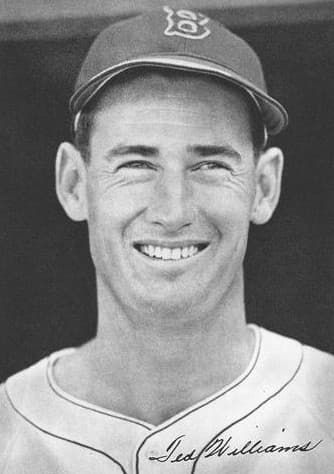
Ted Williams portrait, 1947.
Photo credit: Unknown author via Wikimedia Commons (Public domain)
Steve Dalkowski may have thrown harder than any human being who ever lived. Nobody can prove it. There were no radar guns in the late 1950s, no Statcast cameras, no archived footage of his delivery. There is only testimony. And the testimony, from people who went on to the Hall of Fame and people who spent their lives in the game, is unanimous.
Ted Williams stepped into a batting cage to face Dalkowski during spring training, took one pitch, and stepped out. He told reporters Dalkowski was the fastest pitcher he had ever seen. Earl Weaver, who managed Dalkowski in the minors and later managed the Baltimore Orioles for 17 years, said the same thing. Cal Ripken Sr. estimated Dalkowski's fastball at 115 mph. Tom Seaver, asked by The Sporting News to name the fastest pitcher who ever lived, said "Steve Dalkowski," then added, "But I never saw him pitch."
Dalkowski was born in 1939 in New Britain, Connecticut. He was 5-foot-11 and 170 pounds, not built like a power pitcher, but he had a whip-like delivery that generated velocity nobody could explain. The Baltimore Orioles signed him out of high school in 1957.
His minor league numbers are unlike anything in baseball history. In nine seasons, he struck out roughly 1,396 batters and walked 1,354 in 995 innings, though exact totals vary across databases because of inconsistent minor league record-keeping from the era. He averaged more than 17 strikeouts per nine innings in his first season. In one game for Kingsport in 1957, he struck out 24 batters, walked 18, hit four batters, and threw six wild pitches. He lost the game 8-4.
The stories are endless, and separating fact from legend is nearly impossible. He reportedly threw a pitch that tore part of a batter's ear off. He broke an umpire's mask in three places with an errant fastball, sending the man to the hospital for three days with a concussion. He threw a ball through a wooden outfield fence on a bet, winning five dollars. Fans in some minor league parks reportedly refused to sit behind home plate when he pitched. Teammate Herm Starrette described a typical outing as "seven innings, 18 strikeouts, 15 walks."
Every coach who worked with Dalkowski believed they would be the one to fix his control. Harry Brecheen tried. Billy DeMars tried. Earl Weaver came the closest. Under Weaver's coaching at Elmira in 1962, Dalkowski put together his best minor league season. In the spring of 1963, he was sharp enough in big league camp that the Orioles expected to put him on the major league roster. He was fitted for his Orioles uniform.
On March 23, 1963, in one of the final spring training games, Dalkowski came in to pitch against the New York Yankees. He struck out Roger Maris and Elston Howard. Then, while throwing to either Phil Linz or Jim Bouton (sources disagree on the batter), something popped in his left elbow. His arm never recovered. When he came back in 1964, his fastball sat around 90, indistinguishable from dozens of other minor league pitchers. He was out of professional baseball by 1965, without having pitched a single regular-season inning in the major leagues.
What followed was worse. Dalkowski had struggled with alcohol throughout his playing career. Without baseball, the drinking consumed him entirely. He became a migrant worker in California's Central Valley. He had a rap sheet at the Bakersfield police station that one writer described as "14 feet long." He spent decades in and out of institutional care, eventually living in a nursing home in his hometown of New Britain. He died on April 19, 2020, at 80, from complications of COVID-19.
Ron Shelton, who had played in the Orioles' minor league system shortly after Dalkowski, based the character of Nuke LaLoosh in Bull Durham on the stories he had been told about the left-hander from New Britain. The movie made Dalkowski a cultural reference point, even though most people who watched it had never heard his real name.
Baseball will never see another Steve Dalkowski. Not because no one will ever throw that hard again, but because the game no longer has room for myth. There are too many cameras, too many databases, too many measurements. Dalkowski existed in the last era when a man could throw a baseball so fast that his speed became a matter of faith rather than fact, and the faith was unanimous.