Profile
Catfish Hunter
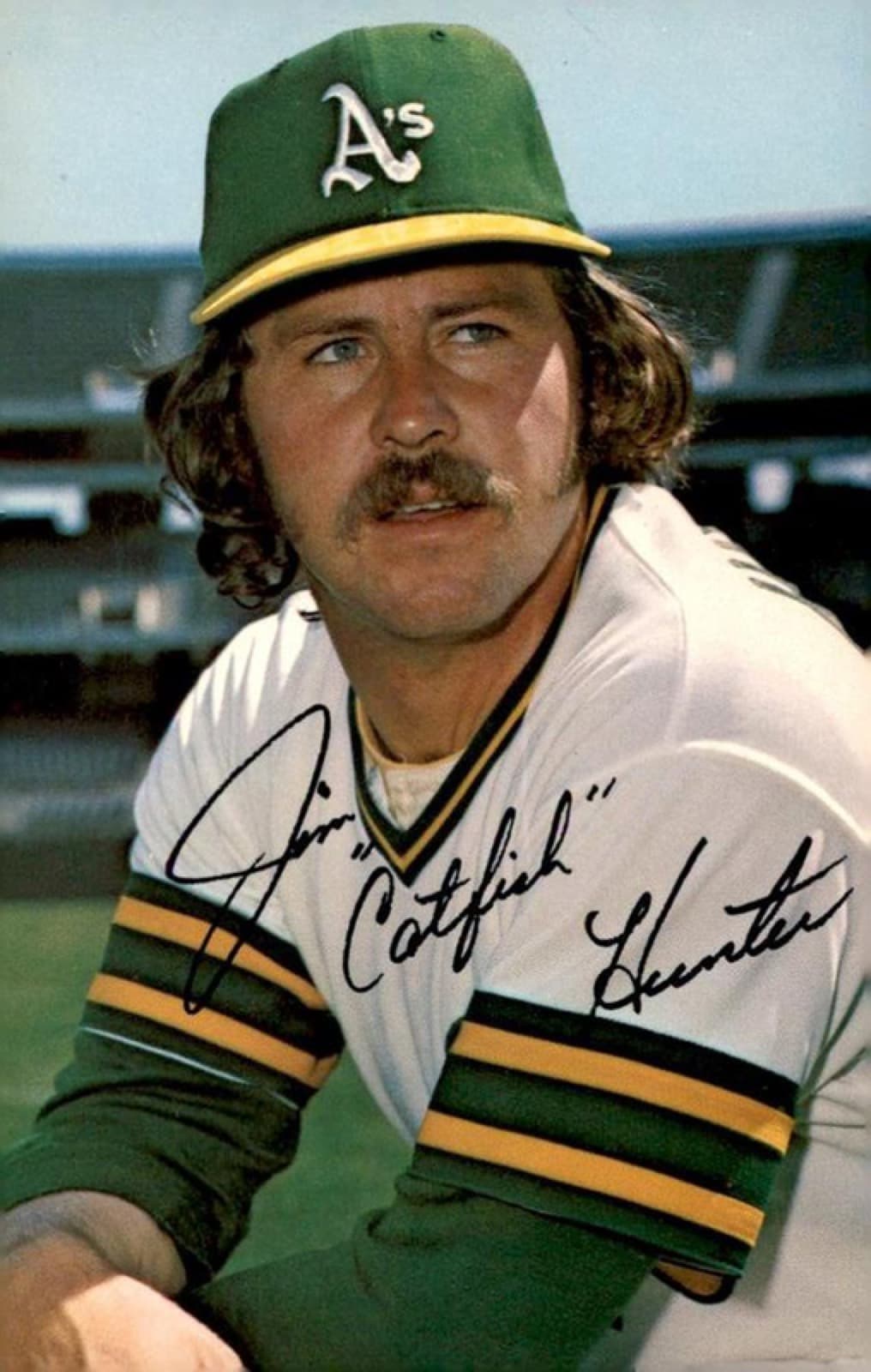
Catfish Hunter with the Oakland Athletics.
Photo credit: Doug McWilliams via Wikimedia Commons (Public domain)
James Augustus Hunter grew up on a 30-acre farm near Hertford, North Carolina, caught frogs and sold them to local restaurants to earn money for baseballs, and pitched so well in high school that owner Charlie Finley signed him to the Kansas City Athletics at 18 for a $75,000 bonus and a nickname the pitcher never wanted. Finley invented "Catfish" because he thought his new prospect needed something flashier than Jimmy, and he fabricated a backstory about a six-year-old running away from home to go fishing. None of it was true. Hunter's family and his hometown of Hertford called him Jimmy for the rest of his life. He won 224 games with a 3.26 ERA, threw a perfect game in 1968, won the 1974 Cy Young Award, appeared in six World Series, won five championships between the Athletics and the Yankees, and became the first major free agent in baseball history when an arbitrator voided his Oakland contract in December 1974 and 23 of 24 teams lined up to bid. "The sun don't shine on the same dog's ass all the time," Hunter said. The BBWAA elected him to the Hall of Fame in 1987 on 76.3 percent of the ballot.
Hertford
Hunter was born on April 8, 1946, the youngest of eight children on a tenant farm worked by his father Abbott and mother Millie. His four older brothers taught him to pitch, and the rules were simple. "If you don't throw strikes to your brothers, you don't play," Hunter said. "It was that simple." He went 26-2 across his final two high school seasons and threw five no-hitters as a senior, leading Perquimans County High School to the 1963 state championship. On Thanksgiving Day 1963, his brother Pete's shotgun accidentally discharged and struck Hunter's right foot, taking off his small toe and lodging roughly 45 pellets in the flesh. Only six were removed. The rest stayed in his foot for the rest of his career. "My brother still doesn't know what happened," Hunter said. "Then he had the nerve to faint on me. I had to slap his face to wake him up."
Finley signed Hunter on June 8, 1964, and he debuted on May 13, 1965, at 19. On May 8, 1968, at Oakland-Alameda County Coliseum, Hunter threw a perfect game against the Minnesota Twins, retiring all 27 batters with 11 strikeouts and contributing three hits at the plate, driving in three of Oakland's four runs. It was the ninth perfect game in major league history and the first in the American League since 1922. Catcher Jim Pagliaroni had disagreed with only two pitch calls all night, and Hunter rewarded him with an inscribed gold watch.
Oakland
Hunter won 21 games in four consecutive seasons from 1971 through 1974, and in 1974 he went 25-12 with a 2.49 ERA to win the Cy Young Award. Reggie Jackson said, "I would give Cat the Cy Young Award, the Most Valuable Player Award, the Academy Award, and the kitchen sink." Hunter pitched for three consecutive World Series champions in Oakland from 1972 through 1974, compiling a 4-0 record in those Series. In Game 7 of the 1972 World Series against the Reds, he won in relief, throwing 2 2/3 innings with three strikeouts. In Game 3 of the 1974 Series against the Dodgers, he threw 7 1/3 innings and allowed one earned run.
Before the 1974 season, Hunter signed a two-year contract with Oakland worth $100,000 per year, with half deferred into insurance annuities. Finley refused to make the annuity payments after discovering the tax implications, and Hunter filed a grievance. On December 16, 1974, arbitrator Peter Seitz ruled in Hunter's favor and declared him a free agent, setting off the most frenzied bidding war baseball had seen. Twenty-three of 24 teams pursued him. Hunter signed with the New York Yankees for approximately $3.35 million over five years, the richest contract in the game at that point, and chose New York in part because scout Clyde Kluttz, who had signed him as a teenager, was working for the Yankees. "I don't think I would have signed with the Yankees if anybody but Clyde had contacted me for them," Hunter said. "We don't belong to anybody," he told his wife Helen. Sparky Anderson called it "the beginning of the end of the old order." "It all started with a fellow named Catfish Hunter," Anderson said. "He showed the world how foolish some owners can be."
New York
Hunter led the league with 23 wins, 328 innings, and 30 complete games in his first Yankee season, the most complete games by a Yankee pitcher since 1921 and the last time any major league pitcher reached 30 in a season. He won two more World Series rings with New York in 1977 and 1978.
The 1979 season broke him. In three months, Hunter lost three people who had been close to him. Scout Clyde Kluttz died of a blood clot on May 12. His father Abbott died of cancer on July 26. Teammate Thurman Munson died in a plane crash on August 2. "Dealing with three deaths in a span of three months was beyond belief," Hunter said. "Lord, it's a lot to ask of a man." He finished the season 2-9, held a farewell ceremony at Yankee Stadium on September 16, and retired at 33. "When I signed my contract with the Yankees, I told them I would play these five years," he said. "Fifteen years is enough."
Hertford Again
Hunter went home to the farm outside Hertford, where he raised corn, soybeans, peanuts, and cotton on a thousand acres. In the winter of 1997, he noticed his arms growing weak while hunting and had difficulty raising his rifle. In September 1998 he was diagnosed with amyotrophic lateral sclerosis, the same disease that killed Lou Gehrig. George Steinbrenner said, "Catfish Hunter was the cornerstone of the Yankees' success. He exemplified class and dignity and taught us how to win." Reggie Jackson said, "He was a fabulous human being. He was a man of honor. He was a man of loyalty." Hunter died on September 9, 1999, at his home in Hertford, at 53. He is buried at Cedarwood Cemetery, directly behind the high school diamond where he first pitched. His Hall of Fame plaque shows him wearing a cap with no logo, because he could not choose between the Athletics and the Yankees and honored both by choosing neither.