Profile
Reggie Jackson
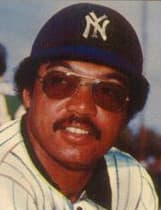
Reggie Jackson with the New York Yankees.
Photo credit: Unknown author via Wikimedia Commons (Public domain)
Reginald Martinez Jackson hit 563 home runs and struck out 2,597 times, 13 more strikeouts than hits, and the gap between those two numbers contains the entirety of who he was as a ballplayer. Jackson won five World Series championships, earned the 1973 AL MVP unanimously, hit three home runs on three consecutive first-pitch swings in Game 6 of the 1977 World Series to cement a nickname that Thurman Munson gave him with a mixture of sarcasm and grudging admiration, and spent 21 seasons making himself the center of every room he entered. "I didn't come to New York to be a star," Jackson said after signing with the Yankees as a free agent. "I brought my star with me." Jim Palmer offered the counterpoint. "I would say Reggie Jackson was arrogant. But the word arrogant isn't arrogant enough." The BBWAA elected Jackson to the Hall of Fame in 1993 on 93.6 percent of the ballot.
Wyncote
Jackson was born on May 18, 1946, in Wyncote, Pennsylvania, a largely white suburb north of Philadelphia. His father Martinez ran a dry-cleaning business and played second base for the Newark Eagles of the Negro Leagues. His mother Clara left the family when Reggie was six, taking three of the children with her. Jackson attended Cheltenham High School, where he lettered in four sports, and went to Arizona State on a football scholarship to play defensive back. Baseball coach Bobby Winkles steered him toward the diamond, and the Athletics drafted him second overall in 1966, signing him for an $85,000 bonus.
Jackson debuted on June 9, 1967, at 21, and by 1969 he hit 34 home runs by July 5 before fading in September and finishing with 47. From 1972 through 1974, Oakland won three consecutive World Series titles, and Jackson won the 1973 MVP unanimously after hitting .293 with 32 home runs and 117 RBI. He tore his hamstring scoring the tying run in Game 5 of the 1972 ALCS against Detroit, feeling it "give 20 feet from home," and missed the entire World Series. The Athletics won without him. In the 1973 World Series against the Mets, Jackson hit .310 with six RBI and won the Series MVP.
Mr. October
Jackson signed with the Yankees as a free agent before the 1977 season for $2.96 million over five years and detonated a clubhouse war that lasted the length of the contract. In the June 1977 issue of Sport magazine, Jackson was quoted saying, "This team, it all flows from me. I'm the straw that stirs the drink. Maybe I should say me and Munson, but he can only stir it bad." The quote ignited a feud with Munson, the Yankees captain, that simmered for the rest of the season. On June 18, in a nationally televised game at Fenway Park, manager Billy Martin pulled Jackson from right field in the middle of an inning for loafing on a Jim Rice fly ball, and the two men nearly came to blows in the dugout while NBC's cameras rolled. Coaches Yogi Berra and Elston Howard physically restrained Martin.
The chaos resolved itself in October. In Game 6 of the 1977 World Series against the Dodgers, at Yankee Stadium, Jackson hit three home runs on three consecutive first-pitch swings against three different pitchers. The first, off Burt Hooton, was a high, arching drive into the lower deck in right field. The second, off Elias Sosa, was another line shot to right. The third, off Charlie Hough's knuckleball, was a towering drive estimated at 475 feet into the black batter's eye seats in dead center. Jackson drove in five runs in an 8-4 victory that clinched the championship. He set a record with 25 total bases for the Series, breaking Babe Ruth's mark of 22. Munson, who resented Jackson's salary, his ego, and his presence in the Yankee clubhouse, directed reporters toward Jackson after the game. "Go ask Mister October," Munson said, and the nickname stuck.
On April 13, 1978, Opening Day at Yankee Stadium, the Reggie Bar was distributed free to fans. Jackson homered in his first at bat, and more than 500 fans threw the candy bars onto the field, delaying the game. Catfish Hunter summarized the product. "When you unwrap a Reggie Bar, it tells you how good it is."
Anaheim
Jackson won consecutive World Series with the Yankees in 1977 and 1978, played through the devastating loss of Munson in an August 1979 plane crash, and signed with the California Angels as a free agent in 1982. He hit his 500th home run on September 17, 1984, off Bud Black at Anaheim Stadium, the 13th member of the 500 club and the first player to reach 100 home runs with three different franchises. He returned to Oakland for a final season in 1987 at 41.
On June 20, 2024, MLB held its first regular-season game at Rickwood Field in Birmingham, Alabama, as a tribute to the Negro Leagues, two days after Willie Mays died at 93. During the FOX pregame broadcast, Jackson delivered an emotional account of the racism he endured as a minor leaguer with the Birmingham A's in 1967. He described his manager Johnny McNamara's efforts to protect him, recalled staying on a teammate's couch for weeks until the apartment complex received threats because of his presence, and told a national audience, "Coming back here is not easy." The speech was widely regarded as one of the most powerful live moments in recent sports broadcasting.
Jackson chose to appear on his Hall of Fame plaque wearing a Yankees cap. "I'm best remembered for what I did in New York," he said, "and being linked to Mantle, Ford, DiMaggio, Ruth, Gehrig is a good thing." Both the Yankees (number 44, a tribute to Hank Aaron) and the Athletics (number 9) retired his jersey.