Profile
Mickey Mantle
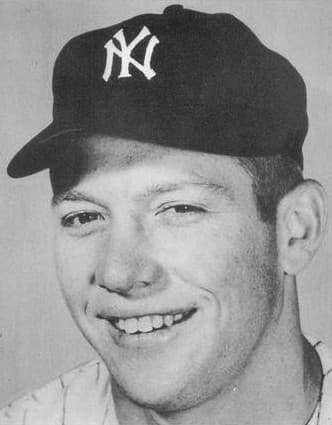
Mickey Mantle portrait with the New York Yankees, 1957.
Photo credit: Unknown author via Wikimedia Commons (Public domain)
Mickey Charles Mantle played 18 seasons on one good leg, hit 536 home runs from both sides of the plate, won the Triple Crown, played in 12 World Series, and spent every day after his father's death at 40 expecting to die young himself. He did not die young. He died at 63 after decades of drinking that wrecked his liver, his family, and the career that might have been the greatest in baseball history if he had taken care of it. In the final summer of his life, he stood at a podium and said, "This is a role model: Don't be like me." Casey Stengel called him the best he ever managed. Bob Costas, delivering the eulogy, drew the distinction Mantle had spent his last year learning to accept: "The first, he often was not. The second, he always will be."
Commerce
Mantle was born on October 20, 1931, in Spavinaw, Oklahoma, and grew up in Commerce, a lead and zinc mining town in the northeastern corner of the state. His father, Elvin Charles "Mutt" Mantle, worked in the mines and played semipro baseball with enough skill to dream of the major leagues and enough sense to know he wouldn't reach them. He named his son after Mickey Cochrane, the Hall of Fame catcher, and later expressed relief that he hadn't used Cochrane's real first name, Gordon.
Mutt began teaching Mickey to switch-hit as a small child, pitching right-handed himself while Mickey's grandfather pitched left-handed. The family's men died young. Mutt's father and two of his uncles died of cancer in their 30s and 40s, a pattern the family attributed to genetics but that mining dust likely caused. The expectation of an early death settled into Mickey before he was old enough to question it and stayed with him for the rest of his life.
At 14, Mantle was kicked in the left shin during high school football practice at Commerce High School. The injury developed into osteomyelitis, a bone infection. Doctors at the local hospital recommended amputation. A second opinion at Crippled Children's Hospital in Oklahoma City treated him with the then-new drug penicillin, and he kept the leg. The condition left him classified 4-F by the draft board, rejected three times for military service during the Korean War. Fans sent hate mail accusing him of being a draft dodger.
He played semipro ball with the Baxter Springs Whiz Kids while still in high school. Yankees scout Tom Greenwade signed him in 1949 for a $1,500 bonus. In 1950, assigned to the Joplin Miners of the Class-C Western Association, Mantle won the league batting title with a .383 average, 26 home runs, and 136 RBI. That winter he worked in the zinc mines alongside his father for the last time.
The Succession
Mantle wore number 6 when he debuted on April 17, 1951, at 19 years old, the number chosen to signal the succession from Babe Ruth's 3, Lou Gehrig's 4, and Joe DiMaggio's 5. He hit .267 with 13 home runs and showed enough speed and power that the expectations felt almost cruel. By July, he was pressing badly enough that Stengel sent him down to Kansas City. He went 0-for-22 and called his father, ready to quit. Mutt drove to Kansas City and told him, "If that's all the guts you have, you might as well come home and work in the mines." Mantle started hitting. He was recalled and given number 7, which he wore for the rest of his career.
In Game 2 of the 1951 World Series, chasing a Willie Mays fly ball in right-center field, Mantle caught his spikes on a drainage pipe cover and tore cartilage and ligaments in his right knee. His father, who had traveled to New York for the game, collapsed while helping Mickey into a cab and was diagnosed with Hodgkin's disease at the hospital. Father and son were hospitalized at the same time. Mutt died the following May at 40. Mantle played his remaining 17 seasons on a knee that never healed. He never had the torn ACL repaired.
He married Merlyn Johnson on December 23, 1951, in Picher, Oklahoma. They had four sons.
The Triple Crown
The injuries accumulated. He tore cartilage from his left knee in 1953 and had it removed. He played through pain so constant that teammates described him barely able to walk some mornings, wrapping both legs from ankle to mid-thigh before each game. He once said that simply swinging the bat caused pain. The numbers he produced despite this remain difficult to reconcile with the body that produced them.
In 1955, he led the American League in home runs with 37 and began the run of seasons that defined his prime. In 1956, at 24, he won the Triple Crown with a .353 batting average, 52 home runs, and 130 RBI, leading both leagues in all three categories. He was the only switch-hitter in history to win the Triple Crown. He won the AL MVP unanimously, the first Yankee to do so, and was named AP Male Athlete of the Year. In Game 5 of the World Series against Brooklyn, he made a running catch in the fifth inning that preserved Don Larsen's perfect game.
He won a second consecutive MVP in 1957, batting .365 with 34 home runs and reaching base more times (319) than he made outs (312). A torn shoulder tendon in a World Series collision with Red Schoendienst affected his left-handed swing for the rest of his career. In 1958, he led the league with 42 home runs. In 1960, he hit 40 and led the league again. His 1960 World Series against Pittsburgh was arguably his finest postseason: .400 with three home runs, 11 RBI, and nine walks, though the Yankees lost on Bill Mazeroski's Game 7 walk-off. Mantle wept in the clubhouse afterward.
The Home Run Race
In 1961, Mantle and teammate Roger Maris chased Ruth's single-season record of 60 home runs. By September 10, Maris had 56 and Mantle had 53. The public preferred Mantle, the established star, to break the record, and the diverging affections took a toll on both men. In September, Mantle received a shot from Dr. Max Jacobson for fatigue. The injection, later revealed to contain amphetamines, caused a severe hip abscess that forced Mantle out of the race. Jacobson was stripped of his medical license in 1975. Mantle finished the season with a .317 average and 54 home runs, then the switch-hitter single-season record, and watched from his hospital bed as Maris hit number 61 on October 1.
He won a third MVP in 1962, batting .321 with 30 home runs in 123 games, and earned the only Gold Glove of his career. His salary reached $100,000, making him the fifth player to hit that mark. In 1963, he hit the right-field facade at Yankee Stadium off Bill Fischer, a drive estimated at 504 feet if unimpeded. Weeks later he broke his foot crashing into a chain-link fence in Baltimore and missed 61 games.
The Tape-Measure Home Run
On April 17, 1953, batting right-handed against left-hander Chuck Stobbs at Griffith Stadium in Washington, Mantle drove a ball over the left-center field wall, over the 55-foot bleachers, and out of the ballpark entirely. Yankees publicity director Red Patterson tracked down the ball after a boy named Donald Dunaway found it in a yard at 434 Oakdale Place. Patterson walked off the distance and declared it 565 feet. Patterson never actually used a tape measure, but the event coined the term. Modern estimates place the true distance between 506 and 538 feet, aided by a strong tailwind. The ball and the borrowed bat (from teammate Loren Babe) were sent to the Hall of Fame.
His longest left-handed home run traveled an estimated 643 feet at Tiger Stadium on September 10, 1960, based on the measured landing site. He hit home runs from both sides of the plate in the same game 10 times during his career.
October
Mantle played in 12 World Series and won seven championships with the Yankees. He holds the all-time World Series records for home runs (18), RBI (40), runs scored (42), extra-base hits (26), walks (43), total bases (123), and games played (65). In Game 3 of the 1964 Series against the Cardinals, he hit a walk-off home run for his 16th World Series homer, breaking Ruth's record. He finished with 18.
The 1964 Series was his last.
The End
On May 14, 1967, Mantle hit his 500th home run off Stu Miller at Yankee Stadium, becoming the sixth member of the 500 Home Run Club and the first switch-hitter to reach the milestone. His final season in 1968 produced a .237 average and 18 home runs. In his last at-bat at Yankee Stadium on September 25, the crowd stood and would not stop. He retired on March 1, 1969, with 536 career home runs, third all-time behind Ruth and Mays.
On June 8, 1969, more than 60,000 fans filled Yankee Stadium for Mickey Mantle Day. The Yankees retired number 7. Mantle stood at the microphone and said, "I always wondered how a man who knew he was going to die could stand here and say he was the luckiest man in the world. Now I think I know how Lou Gehrig felt."
After the Game
The drinking that had defined his social life since the minor leagues continued and deepened. He, Whitey Ford, and Billy Martin had been Stengel's "Whiskey Slicks," famous for closing bars from New York to Kansas City. The stories were funny when he was young. They stopped being funny.
His wife Merlyn also struggled with alcoholism. His son Billy died of a heart attack at 36 in March 1994. His son Mickey Jr. was an alcoholic who sought treatment. Mantle himself entered the Betty Ford Center on January 7, 1994, at the urging of friend Pat Summerall. He emerged saying that without alcohol, "he would have been a better player and a better man."
In early 1995, he was diagnosed with cirrhosis, hepatitis C, and liver cancer. He received a liver transplant on June 8 at Baylor University Medical Center in Dallas. During surgery, doctors discovered the cancer had already spread. The rapid transplant, after two days on the waiting list, drew public criticism, though doctors maintained standard medical criteria were followed.
In July 1995, he held a press conference and told the country not to follow his example. He established the Mickey Mantle Foundation to promote organ donation awareness. He died on August 13, 1995, at 2:10 a.m. at Baylor, with Merlyn and his son David at his bedside. He was 63. Bobby Richardson, the former teammate who had become a Baptist minister, presided at the funeral. Eddie Layton, the Yankee Stadium organist, played "Somewhere Over the Rainbow."
The Numbers
In 18 seasons he accumulated 2,401 games, 2,415 hits, 536 home runs, 1,509 RBI, 1,733 walks, and a .298 batting average with a .421 on-base percentage and .557 slugging percentage. He was a 20-time All-Star, a three-time MVP, a Triple Crown winner, and a seven-time World Series champion. He batted .330 from the right side and .281 from the left.
The BBWAA elected him to the Hall of Fame in 1974 with 88.2 percent of the vote on the first ballot. His plaque at Sparkman-Hillcrest Memorial Park in Dallas reads, "A Great Teammate." Whitey Ford, who knew him better than almost anyone, put it more precisely: "A superstar who never acted like one."