A Field Guide for Sorting, Valuing, and Selling Attic Baseball Finds
In 2012, two cousins found roughly 700 pristine 1910 baseball cards under a dollhouse in a Defiance, Ohio attic. The collection sold for around $3 million. Most attic finds produce nothing close to that, but a disciplined triage process can separate common keepsakes from items worth grading, authentication, or consignment.
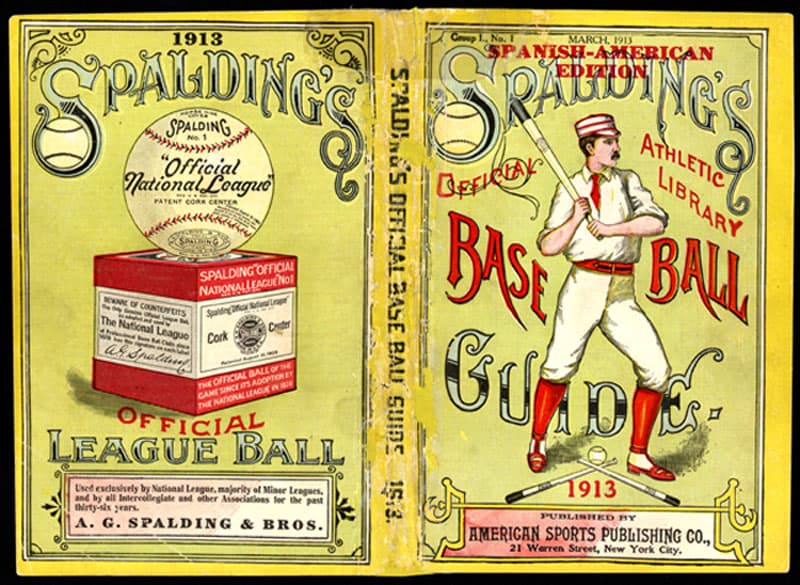
Cover of Spalding's Official Base Ball Guide, Spanish-American edition, March 1913.
Photo credit: A.G. Spalding & Bros. via Library of Congress
In 2012, Karl Kissner found a cardboard box under a dollhouse in the attic of his grandfather's house in Defiance, Ohio. Inside were roughly 700 baseball cards from 1910, part of the E98 "Set of 30" issue, a candy-card set featuring seventeen Hall of Famers in four color variations. His grandfather, Carl Hench, had owned Hench's Meat Market & Sausage Works in Defiance and apparently stashed the surplus cards in the attic, where they sat untouched for a century. The total collection brought an estimated $3 million at Heritage Auctions, with individual highlights including a Honus Wagner graded PSA Gem MT 10 that sold for $239,000.
That discovery, known in the hobby as the Black Swamp Find after the region of northwest Ohio where Defiance sits, is real but wildly unrepresentative. Most attic collections contain mass-produced cards from the 1980s and 1990s, worn programs, unsigned equipment, and family keepsakes with sentimental value but little market demand. The useful skill is knowing how to sort what you have, preserve its condition, identify anything with real potential, and avoid the mistakes that destroy value before you even get to market.
Preserve Condition Before You Touch Anything Else
The single most expensive error in estate finds is "improving" an item before understanding it. Don't clean cards, trim edges, erase pencil marks, iron creased paper, polish metal, or re-ink faded autographs. Every one of those actions can reduce a grade, eliminate provenance clues, or signal tampering to an experienced buyer.
A longwave ultraviolet light, commonly called a black light, costs under $20 and can immediately reveal modern reprints, re-backed cards, and chemical cleaning on vintage paper. Original ink and paper from the early twentieth century fluoresce differently than modern reproductions. If you own pre-war material, this is the first tool to buy.
Set up an intake station before you handle anything.
- A clean, dry table under indirect lighting. Direct sunlight and overhead fluorescents create glare that hides surface defects.
- Nitrile gloves for glossy photographs, chrome-finish cards, and any paper that feels fragile. Cotton gloves leave fibers; bare hands leave oils.
- Penny sleeves and semi-rigid toploaders for cards. Acid-free folders or Mylar sleeves for programs, scorecards, and documents. Never use rubber bands, which leave compression marks, or PVC-based holders, which can leach plasticizer onto card surfaces over time.
- A labeling system that tracks each item to its original container. Something like BOX1-CARD-001 or SHOEBOX2-TICKET-003 works. This sounds tedious. It saves hours later when you need to group items by provenance for a consignment submission.
Photograph every candidate item front and back with a phone camera at arm's length. Capture any identifying marks such as card numbers, back text, ticket dates, program cover years, bat stampings, glove model tags, jersey manufacturer labels, and any authentication stickers or certificates already present. Record the original storage arrangement before disturbing it. A shoebox full of cards found in a specific order, or a scrapbook with items mounted on period-correct pages, can itself serve as provenance evidence.
Identify What You Have
Identification comes before valuation. You cannot price something you have misidentified, and the most common identification errors in attic finds involve confusing reprints for originals and confusing common issues for scarce ones.
Cards, Distinguishing Originals From Reprints
Baseball cards have existed since the 1880s, when tobacco companies began inserting player likenesses into cigarette packs. The National Baseball Hall of Fame's Shoebox Treasures exhibit in Cooperstown, which opened in May 2019, displays more than 2,000 cards from the museum's collection of nearly 200,000 and traces the full arc from nineteenth-century tobacco cards through modern glossy issues. Understanding how card formats changed across eras prevents the most damaging identification errors.
The key sets that appear in attic finds, roughly by period.
Pre-War Tobacco and Candy Cards (1880s-1930s)
These include the T206 White Border set (1909-1911), issued across sixteen different American Tobacco Company brands, and the E-series candy cards like the E98 set from the Black Swamp Find. T206 cards use thin, off-white card stock that transmits light when held up to a lamp. Under magnification, the original lithographic printing shows irregular, watercolor-like ink patterns rather than the fine dot matrix of modern printing. The back of a genuine T206 card carries an advertisement for one of sixteen tobacco brands and a small-print factory designation at the bottom. A missing factory number is a common sign of a fake.
Post-War Bowman and Early Topps (1948-1955)
Bowman produced the first major modern card sets in 1948. Topps entered the market in 1951 and dominated after absorbing Bowman in 1956. The 1952 Topps set, with its oversized format and vivid color portraits, produced the most famous card in the hobby, Mickey Mantle card #311. In August 2022, an SGC 9.5 example of that card sold at Heritage Auctions for $12.6 million, at that time the highest price ever paid for a sports card. But condition variance across the same card can be enormous. In early 2026, a PSA 3 (Very Good) example of the same 1952 Topps Mantle sold for $240,000 at Huggins & Scott, and an SGC 3.5 brought $101,475 at Robert Edward Auctions. Same card, same year, same player. The grade determined a 100x price spread.
The Mass-Production Era (1981-Present)
Topps lost its exclusive license in 1981, and Fleer and Donruss entered the market. Production volumes exploded through the late 1980s and early 1990s. Cards from this era were printed in such quantities that most commons have negligible resale value regardless of condition. If your attic find is mostly 1987 Topps, 1989 Fleer, or 1991 Donruss, expect very little financial return. The exceptions are specific rookie cards of Hall of Famers in high grade, certain error cards, and limited insert sets.
Topps regained an exclusive MLB license starting in 2010 and held it until Fanatics acquired Topps' sports and entertainment division in January 2022.
Tickets and Programs Without Printed Dates
Many professional baseball teams didn't print dates on regular-season tickets before 1974. SABR researchers have documented methods for dating undated stubs using printer logos, team logos, ticket-back language, ticket prices, game numbers, and the names of general managers or team presidents printed on the ticket face. A federal war tax imposed to offset World War I costs appears on some stubs from 1919 through the early 1920s, with "War Tax" printed directly on 1921 World Series tickets from the Yankees-Giants series. These details can place an undated stub within a narrow window if you know what to look for.
Programs and scorecards follow similar logic. Harry Stevens, the concessionaire who built the modern ballpark food and scorecard business at the Polo Grounds starting in the 1890s, developed the illustrated scorecard format that became standard across baseball. Programs evolved from simple scorecards into substantial publications with advertising, player photographs, and editorial content. The value of a given program depends on the event (World Series programs command premiums over regular-season issues), the teams involved, the condition, and whether the scorecard inside was filled in during an actual game. A scored program from a significant game can be worth more than a pristine blank one.
Equipment and Uniforms
Bats carry stampings from the manufacturer (Hillerich & Bradsby for Louisville Slugger, Adirondack, etc.) and often include a player's name, model number, and date code. Gloves have interior tags or stampings with model numbers and sometimes endorsement names. Jerseys carry manufacturer tags with size, style codes, and sometimes year indicators.
None of these markings prove game use. They establish what the item is. Game-use claims require a separate authentication process.
Assess Condition Using Grading Criteria
Every major grading company evaluates cards on the same four attributes, which are centering, corners, edges, and surface. Understanding these criteria lets you estimate a card's likely grade before spending money on professional submission.
Centering measures how evenly the printed image sits within the card's borders. Graders express centering as a ratio comparing opposite border widths. PSA requires 55/45 or better on the front and 75/25 or better on the back for a Gem Mint 10. Centering is the most common reason cards fail to reach a 10.
Corners are examined under magnification. A Gem Mint card shows corners that are perfect to the naked eye and virtually flawless under intense scrutiny. Any rounding, fraying, or layering visible under a loupe drops the grade. Corners are the most vulnerable part of any unslabbed card and the area most damaged by rubber bands, shuffling, and storage in overpacked boxes.
Edges are checked for chipping, rough cuts, and color breaks along the card border. Factory cutting irregularities on vintage cards can affect edge grades, and some vintage sets are known for inconsistent cuts.
Surface defects include print spots, scratches, wax stains (common on cards stored in original wax packs), creases, and color registration errors. PSA's Gem Mint 10 standard requires a surface "devoid of staining of any kind" with no print spots and flawless color.
Beckett Grading Services (BGS) publishes all four sub-grades on every card, making it the only major grading company that shows how each attribute contributed to the final number. PSA reports only the overall grade. Both systems use a 1-10 scale, but their standards differ slightly at each level, and the market prices their holders differently. A PSA 10 typically commands a premium over an equivalent BGS 9.5 at resale, ranging from 10-20% on lower-value modern cards to multiples on high-profile vintage issues. PSA holds the largest market share among grading companies, and its holders trade with greater liquidity in the secondary market.
If you are evaluating a card for the first time, use flat, indirect lighting and a 10x loupe. Examine all four attributes and write down what you see before looking up prices. First-time sellers consistently overestimate condition. A card that looks "perfect" to an untrained eye often grades a 7 or 8 due to centering drift, a single soft corner, or a surface scratch visible only under magnification.
Price With Completed Sales, Not Asking Prices
An active listing on eBay or any other marketplace represents what a seller hopes to receive. It proves nothing about what a buyer will pay. You need completed sale data.
On eBay, search for the card by exact description, then filter to "Sold Items" using the left sidebar. This shows only listings where a transaction completed. Match your comparables tightly.
- Same card, same year, same set, same card number.
- Same condition status, meaning raw (ungraded) versus graded.
- If graded, same grading company and same numeric grade. A PSA 8 and a BGS 8 don't trade at identical prices.
- Recent sales over old ones. A comp from 2023 may not reflect 2026 market conditions.
- Multiple transactions, not a single outlier. Build a range from at least five to ten sold listings and use the median, not the highest sale, as your baseline.
Dedicated tools like 130point.com aggregate eBay sold data and make this process faster for high-volume research. For high-value vintage cards, Heritage Auctions and Robert Edward Auctions publish full price-realized archives searchable by set and player.
The 1952 Topps Mantle illustrates why strict comp matching is essential. The card exists in every condition from Poor to Gem Mint, and the price range spans from a few thousand dollars to $12.6 million. A PSA 3 sold for $240,000 in early 2026. A PSA 1 of the same card might bring $30,000-50,000. Just saying "I have a 1952 Mantle" tells a dealer nothing about value. "I have a 1952 Topps #311 Mantle, raw, approximate PSA 4-5 with a centering issue on the front" is the beginning of a price.
Decide Whether Professional Grading Justifies the Cost
Grading seals a card in a tamper-evident plastic holder (a "slab") with a numeric grade and a unique serial number. The slab creates buyer confidence and liquidity. But grading costs real money, involves real wait times, and doesn't automatically increase a card's value.
Fee structures differ across the four major services.
- PSA's Value Bulk tier starts at roughly $25 per card with an estimated 95 business day turnaround. Faster tiers run $50-150 per card, and walk-through service (same-day grading at PSA's Santa Ana facility) costs $599 per card.
- BGS (Beckett) standard grading runs about $25 per card with 20-30 business day turnaround. Express ($50) delivers in 5-10 days, Walk-Through ($250) offers same-day service, and BGS includes sub-grades on every card at no extra cost.
- SGC's standard tier runs $18-20 per card with turnaround times consistently faster than PSA, often around six weeks. The Immediate tier ($40) returns cards in 1-2 business days, the fastest widely available turnaround in the industry.
- CGC, the newest entrant, offers a Bulk tier at $17 per card. It built credibility in comics grading and is expanding into sports cards.
Grade a card when all of these conditions apply. The card has recognized demand in the market, the raw card appears clean enough that a strong grade could meaningfully increase its sale price, and the grading fee plus shipping is small relative to the expected value gain. A $25 grading fee on a card worth $40 raw and $60 in a PSA 8 slab represents a reasonable bet. The same $25 fee on a card worth $3 raw and $5 slabbed is a loss.
Skip grading when the card is a common issue with little price spread between grades, when heavy wear makes a low grade certain, or when you intend to keep the card as a family keepsake. A slabbed card can no longer be handled, displayed in a binder, or given to a child. Grading is a market transaction, not a preservation service.
Authenticate Autographs and Game-Used Items Separately
Autographs and game-used claims require their own verification process, separate from card grading. An unsigned card can be evaluated on its physical attributes alone. A signed ball, bat, or photograph depends on whether the signature is genuine, and forgery in the autograph market is widespread.
Autograph Authentication
The three dominant authentication services are James Spence Authentication (JSA), PSA/DNA, and Beckett Authentication Services (BAS). Each employs handwriting experts who compare submitted signatures against proprietary databases of known exemplars (confirmed authentic signatures collected over decades). PSA/DNA also uses forensic techniques including ink analysis and video spectral comparators to detect alterations. Authenticated items receive a tamper-evident sticker or card with a unique serial number verifiable through the company's online database.
Authentication fees typically range from $20-50 per item for standard service, with faster turnaround options at higher prices. For a valuable autograph, the fee is small relative to the price gap between an authenticated and unauthenticated signature.
Before you submit anything, document the provenance chain, recording who obtained the autograph, where, when, and under what circumstances. Keep any original envelopes, photographs, letters, or notes that accompanied the item. A ball signed at a spring training facility in 1958 with a family photograph showing the player at that facility adds context that an authentication expert can weigh alongside the handwriting analysis. Don't retrace faded ink or clean a smudged signature. Both actions can make authentication impossible.
Game-Used Equipment and the MLB Authentication Program
MLB launched its Authentication Program in 2001 after Tony Gwynn discovered forged autographs in the Padres team store at Qualcomm Stadium, prompting an FBI investigation (Operation Bullpen) that uncovered nationwide memorabilia forgery rings. The program now employs roughly 250 authenticators, all current or former law enforcement personnel, who work in teams of at least two at every MLB game. They tag and log every ball removed from play, switch out bases between innings during significant games, and authenticate jerseys and equipment immediately after use. Each authenticated item receives a tamper-proof hologram manufactured by cybersecurity firm OpSec. The hologram contains a unique alphanumeric code traceable through MLB's online database, and the sticker self-destructs if someone attempts to remove it. Since 2001, the program has authenticated over 10.5 million items.
If you find modern MLB equipment with an intact hologram, look up the serial number on MLB.com before doing anything else. The database will tell you the item's identity, the game or event where it was authenticated, and the authenticator who tagged it. That chain of custody is the item's primary value driver. Protect it.
For pre-2001 equipment, or items from minor leagues and amateur play, no comparable authentication infrastructure exists. Game-use claims on older bats, gloves, and uniforms depend on documentation quality. Relevant evidence includes letters from the player or team, photographs showing the item in use, sales receipts from team equipment managers, and chain-of-custody records from prior collectors. Without documentation, a "game-used" bat is an unverified bat, and buyers will price it accordingly.
Choose a Sale Channel That Fits the Item
Different items belong in different markets. Selling a $50 card through a major auction house wastes the consignor's time and the house's resources. Selling a $50,000 card through a quick eBay listing leaves money on the table.
Direct Marketplace Listing (eBay, COMC, MySlabs)
This channel fits common-to-mid-tier items where comparable sales data runs deep and the item needs no special marketing. You control the listing, set your price or accept auction results, and pay the platform's seller fees (eBay charges roughly 13% on sports cards including payment processing). Include complete photographs, specific identification (year, set, card number, grade if slabbed), transparent condition notes if raw, and exact shipping details.
Consignment to a Dealer or Auction House
Consignment fits items valued above $500 where professional photography, cataloging, and access to a serious collector audience can drive competitive bidding. Heritage Auctions, the largest sports collectibles auctioneer, charges sellers a 10% commission on live Signature Auctions and 15% on weekly internet auctions. Their minimum consignment value is $5,000, which can be cumulative across multiple items. Robert Edward Auctions, Lelands, and Goldin operate on similar models. Settlement typically arrives 45 days after the auction closes.
Major Auction Consignment
For rare items with strong provenance and documented significance, the major houses provide extensive cataloging, marketing to a global bidder pool, and credibility that can elevate realized prices. The Black Swamp Find E98 cards went through Heritage Auctions. Shohei Ohtani's authenticated 50/50 home run ball sold for $4.39 million through the same channel. If you believe you hold something scarce, a consignment evaluation from a major house costs nothing and carries no obligation.
The Family Archive
Some items carry historical or sentimental weight that outstrips their market value. A program from a grandparent's first game, a ball signed by a childhood hero, a scorecard filled out in a child's handwriting. These are worth keeping. Store them properly (acid-free materials, controlled temperature and humidity, away from direct light) and document their story for the next generation.
Avoid the Errors That Destroy Value
These mistakes cost real money and happen to first-time sellers regularly.
Cleaning Vintage Paper
Erasing pencil marks, washing stains, or ironing creases on a pre-war card or program removes evidence of originality and can lead a grading company to mark the item as altered. An altered card receives a "Trimmed," "Cleaned," or "Evidence of Tampering" designation instead of a numeric grade, which drops its value by 50-90%.
Breaking Up Matched Sets
A complete run of cards from a single set, or a group of items traceable to a single provenance source, is often worth more intact than the sum of individual sales. Document the group as a unit before splitting anything.
Pricing From Active Listings
A card listed for $500 on eBay with zero bids is an unsold card with a $500 hope attached. Use completed sales data only.
Grading Everything
Submitting a stack of common 1989 Topps cards for grading at $20-25 each produces a pile of slabbed $2 cards and a grading bill larger than the collection's total resale value.
Selling Before Documenting Provenance
Once items leave your hands, the opportunity to record their history, the family connection, the storage context, the original grouping, leaves with them. A buyer who knows a card came from a sealed box found in a specific attic has more confidence than one buying the same card with no backstory.
A Practical 48-Hour Workflow
If a collection is sitting in your house right now, this sequence keeps the process organized and prevents rushed decisions.
Spend Day 1 on stabilizing, photographing, and identifying.
- Move everything to a clean, dry workspace. Don't start cleaning, sorting, or researching prices.
- Photograph each item front and back with consistent lighting.
- Log items with a simple ID system tied to their original container.
- Sort into four tiers, including common/low-risk, mid-tier, high-upside, and needs-authentication.
- Run a black light across any pre-war paper items to catch reprints.
Spend Day 2 on research, pricing, and decisions.
- Pull sold comps for every item in the high-upside tier. Build a spreadsheet with item ID, description, comp range, and recommended action (keep, grade, sell raw, consign).
- For items in the needs-authentication tier, identify the appropriate service (PSA/BGS/SGC for cards, JSA/PSA-DNA/BAS for autographs, MLB Authentication database for modern game-used items) and estimate fees versus expected value.
- Draft a keep/grade/sell list. Set it aside overnight before acting on it.
The overnight pause serves a purpose. Estate finds carry emotional weight, and urgency is the enemy of good decisions. A card that survived a century in an attic can survive another week while you research it properly.
Sources
- PSA - The Black Swamp Find
- PSA - Grading Standards
- Beckett - Card Grading Standards
- Heritage Auctions - 1952 Topps Mickey Mantle $12.6M Sale
- ESPN - Inside MLB's Authentication Process
- MLB Official Information - Authentication Program
- Baseball Hall of Fame - Shoebox Treasures Exhibit
- SABR - Identifying Undated Ticket Stubs
- All Vintage Cards - Spotting Fake T206 Cards
- Heritage Auctions - Sports Consignment