Profile
Whitey Ford
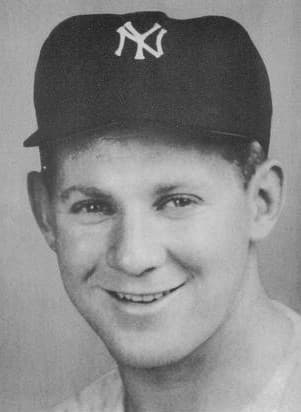
Whitey Ford portrait with the New York Yankees, 1957.
Photo credit: Unknown author via Wikimedia Commons (Public domain)
Edward Charles Ford grew up a few miles from Yankee Stadium and spent 16 seasons pitching there, winning 236 games with a .690 winning percentage, the highest among 200-game winners in the modern era. He won the 1961 Cy Young Award at 32 with a 25-4 record, broke Babe Ruth's World Series consecutive scoreless innings streak, and held all-time October records for wins, starts, innings, and strikeouts. He also admitted, after retirement, to doctoring baseballs with mud, a sharpened ring, and his catcher's shin guard buckle. "I didn't cheat when I won the twenty-five games in 1961," he said. "I didn't cheat in 1963 when I won twenty-four games. Well, maybe just a little." Casey Stengel put it without the comedy: "If you had one game to win and your life depended on it, you'd want him to pitch it."
Astoria
Ford was born on October 21, 1928, in New York City and grew up on 34th Avenue in Astoria, Queens, a few miles from the Triborough Bridge and Yankee Stadium beyond it. His father Jim worked at Consolidated Edison. His mother Edna was a bookkeeper at A&P. He attended the Manhattan School of Aviation Trades beginning in 1942, not because of any interest in aviation but because the local Bryant High School had no baseball program.
He played first base in high school, batting around .350, and began pitching as a senior. In April 1946, he attended a Yankees tryout at Yankee Stadium. Scout Paul Krichell noticed his arm strength and taught him a curveball on the spot. That summer, Ford won 18 games without a loss for the Thirty-fourth Avenue Boys, a semipro team, and pitched the championship game, a 1-0 win in 10 innings. He received the Lou Gehrig Trophy as tournament MVP. The Yankees signed him for $7,000. The Red Sox had offered $1,000.
He moved through the minors quickly, going 13-4 at Butler in Class-C, 16-8 at Norfolk in Class-B, and 16-5 with a 1.61 ERA at Binghamton in Class-A, where he led the Triplets from last place to the Eastern League championship. Between the 1948 and 1949 seasons, he played winter ball in Mexico and nearly died of amoebic dysentery. He reached the Kansas City Blues of the American Association in 1950 and was called up to the Yankees on July 1.
The Chairman of the Board
Ford won his first nine major league decisions and finished his rookie season 9-1 with a 2.81 ERA. He pitched the clinching Game 4 of the 1950 World Series sweep of the Phillies, holding them to two unearned runs in the ninth. The Army drafted him in late November 1950, and he served two years in the Signal Corps at Fort Monmouth, New Jersey. He returned in 1953 and went 18-6.
Stengel handled Ford cautiously, starting him every fifth, sixth, or seventh day rather than the standard four-day rotation, and often skipping him in favor of second-division matchups. The restraint cost Ford an estimated five to eight starts per season and kept him below 255 innings every year. It may also have kept him healthy through his twenties. The most consequential decision came in the 1960 World Series against Pittsburgh, when Stengel held Ford out of Game 1. Ford pitched shutouts in Games 3 and 6, blanking the Pirates 10-0 and 12-0, but Stengel had no chance to use him in Game 7 on proper rest. Bill Mazeroski's walk-off home run won the Series for Pittsburgh, and the question of what might have happened with Ford on the mound in Game 1 (and potentially Game 7) lingered for decades. Stengel was fired five days later.
Ralph Houk replaced Stengel and moved Ford to a four-day rotation for the first time in his career. The results arrived immediately. In 1961, Ford went 25-4 with a 3.21 ERA, led both leagues in wins, starts, and innings pitched (283), and won the Cy Young Award. He went 12-0 in games following a Yankee loss. Three of his four defeats came by one-run margins. Reliever Luis Arroyo, who saved 29 games that season including 13 of Ford's 25 wins, was part of the formula. Houk also gave Ford the unique privilege of helping to decide when he should be removed from a game, a right no other pitcher on the staff shared.
In the 1961 World Series against Cincinnati, Ford shut out the Reds in Game 1 on two hits and extended his scoreless streak in Game 4, breaking Ruth's record of 29 and two-thirds consecutive scoreless World Series innings. The streak eventually reached 33 and two-thirds innings across the 1960, 1961, and 1962 October. After a season in which Maris also broke Ruth's home run record, Ford offered the summary: "It's been a bad year for the Babe."
He went 24-7 with a 2.74 ERA in 1963, and 17-6 with a 2.13 ERA and eight shutouts in 1964. His final World Series appearance came in Game 1 of the 1964 Series against the Cardinals, when his left arm went numb in the sixth inning. Doctors diagnosed a clogged artery, and he underwent a sympathectomy that winter. He could no longer sweat on his left side. He delayed 15 to 20 seconds between pitches to allow blood to reach his arm, and required warm weather to pitch effectively. He still won 16 games in 1965, surpassing Red Ruffing's franchise record of 231 Yankee wins on the final day of the season.
Bypass surgery ended his 1966 season in August. He made five strong starts in 1967 before bone spurs were diagnosed. He retired on May 30 at Yankee Stadium. "I came in wearing a $50 suit," he said, "and I'm going out wearing a $200 suit, so that's pretty good."
The Mud Ball
Ford admitted to doctoring baseballs after he retired, though he insisted he didn't start until late in his career, "when I needed something to help me survive." The methods were inventive. At Yankee Stadium, groundskeepers would wet an area near the catcher's box. Catcher Elston Howard would pretend to lose his balance, press the ball against the ground, coat one side with mud, and throw it back. Ford also wore a ring fitted with a rasp surface, which he used to gouge the ball until Mudcat Grant spotted the scuff marks during a May 1964 game in Cleveland. Umpire John Rice confronted Ford, who convinced Rice it was just his wedding ring and quietly removed it. Howard also sharpened a buckle on his shin guard and used it to scuff the ball before returning it to the mound. Ford would additionally obscure the pitching rubber with dirt and start his motion a few inches forward of it.
The most brazen instance came at the 1961 All-Star Game at Candlestick Park. Ford and Mickey Mantle had run up $1,200 in charges at Giants owner Horace Stoneham's country club. Stoneham promised to cover the tab if Ford got Willie Mays out. Ford threw a spitball and retired him. He later told Mays, "I'm sorry, Willie, but I had to throw you a spitter."
The Whiskey Slicks
Ford met Mantle when Mantle attended Ford's wedding on April 14, 1951. The two became lifelong friends, and together with Billy Martin they formed what Stengel called the "Whiskey Slicks." Ford and Mantle were inseparable for more than 40 years. "Line up all the pitchers in the world in front of me, and give me first choice, and I'd pick Whitey," Mantle said.
On the night of May 16, 1957, the group celebrated Martin's 29th birthday at the Copacabana nightclub in Manhattan with Yogi Berra, Hank Bauer, Johnny Kucks, and their wives. They were there to see Sammy Davis Jr. perform. A group of drunk bowlers from the Bronx began heckling Davis, a brawl erupted, and a man named Edwin Jones left with a broken nose and jaw. Hank Bauer was publicly accused of throwing the punch but denied it, and Jones later lost his lawsuit. The players were fined $1,000 each. GM George Weiss used the incident as justification to trade Martin to Kansas City on June 15, removing what Weiss considered a bad influence on Mantle.
Despite the nightlife, Ford never went out the evening before a start. He was disciplined about the thing that counted and frank about everything else. "It was righteous living, you know," he said. "Don't drink everything in the bottle. Leave some for the next guy."
The Numbers
In 16 seasons he accumulated 498 games, 236 wins, 106 losses, a 2.75 ERA, 156 complete games, 45 shutouts, and 1,956 strikeouts across 3,170 innings. In 11 World Series he went 10-8 with a 2.71 ERA, and his 22 starts, 10 wins, 94 strikeouts, and 146 innings are all October records. He won six championships. His .690 winning percentage is the highest among any pitcher with 200 or more wins in the modern era.
The BBWAA elected him to the Hall of Fame in 1974 with 77.8 percent of the vote on the second ballot, alongside Mantle. The Yankees retired his number 16, the first Yankee pitcher so honored. Ford died on October 8, 2020, at his home in Lake Success, Long Island, at 91, while watching the 2020 ALDS. Dementia had affected him for several years. He was the last surviving member of the 1956 World Champion Yankees.
Ted Williams called him one of the toughest pitchers he ever faced. Walt Dropo said he was "like a master chess player who used his brain to take the bat out of my hands." Ford preferred the simplest version of the compliment. "You need arm, heart and head," he said. "Arm and heart are assets. Head is a necessity."