Profile
Jim Palmer
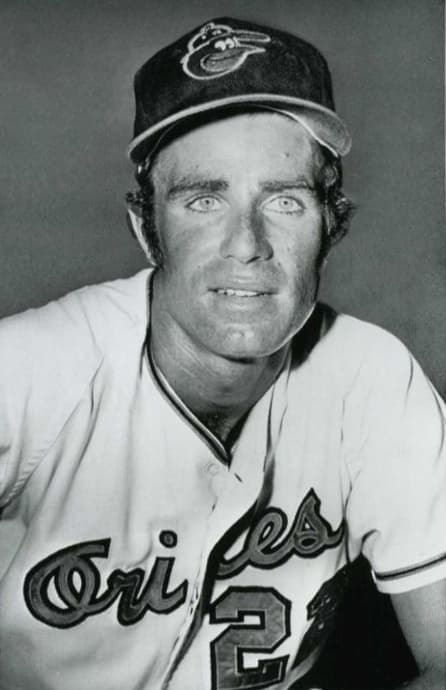
Jim Palmer portrait, 1972.
Photo credit: Unknown (Associated Press) via Wikimedia Commons (Public domain)
James Alvin Palmer was born in Manhattan, adopted two days later by a Park Avenue couple, lost his adoptive father to a heart attack at nine, moved to Beverly Hills with his mother's second husband (a character actor who worked on Dragnet), grew up in Scottsdale, Arizona, turned down basketball scholarships from UCLA and USC to sign with the Baltimore Orioles for $50,000, and shut out Sandy Koufax and the defending champion Dodgers in Game 2 of the 1966 World Series at 20 years old, nine days before his 21st birthday. Palmer won 268 games with a 2.86 ERA across 19 seasons, earned three Cy Young Awards, threw 53 shutouts, started games in six World Series across three decades, and never surrendered a grand slam in 3,948 innings. He also fought with his manager Earl Weaver for 14 consecutive years and modeled Jockey underwear for 20 more. "The only thing Earl knows about big-league pitching," Palmer said, "is that he couldn't hit it." The BBWAA elected Palmer to the Hall of Fame in 1990 on 92.6 percent of the ballot.
Scottsdale
Palmer's biological parents were Irish immigrants in New York, and his adoptive father Moe Wiesen was a wealthy dress designer who lived on Park Avenue. When Moe died of a heart attack in 1955, Palmer's mother Polly moved the family to Beverly Hills and married Max Palmer, a character actor, who adopted Jim and his sister Bonnie. Palmer attended Scottsdale High School in Arizona, earned All-State honors in baseball, basketball, and football while carrying a 3.4 GPA, and signed with the Orioles in 1963 after farm director Harry Dalton watched him pitch. He won his first major league game on May 16, 1965, at 19, pitching in relief against the Yankees and hitting a home run off Jim Bouton in the same game.
The 1966 World Series made Palmer famous. In Game 2 he threw a four-hit shutout against the Dodgers, beating Koufax 6-0 and becoming the youngest pitcher in Series history to throw a complete game shutout. It turned out to be Koufax's final game. The Orioles swept the Series, and their pitching staff set a record with 33 consecutive scoreless innings.
Then Palmer's arm broke down. He injured his shoulder using a paint roller at his Baltimore home, spent most of 1967 and all of 1968 in the minor leagues, and was left unprotected in the 1968 expansion draft. Neither the Kansas City Royals nor the Seattle Pilots claimed him. He considered quitting baseball entirely. During winter ball in Puerto Rico, pitching for the Santurce Crabbers under Frank Robinson, a pharmaceutical rep suggested he try an anti-inflammatory called Indocin. His fastball came back to 95 miles an hour. "It was a miracle," Palmer said.
Weaver
Palmer returned in 1969 and won 16 games. By 1970 the Orioles had the best pitching staff in baseball, and in 1971 Palmer was one of four Baltimore starters to win 20 games, alongside Mike Cuellar, Dave McNally, and Pat Dobson, the last rotation in major league history to accomplish the feat. Palmer won his first Cy Young Award in 1973 with a 22-9 record and a league-leading 2.40 ERA, his second in 1975 with a 23-11 record and a 2.09 ERA and 10 shutouts, and his third in 1976 with a 22-13 record. He threw a no-hitter against Oakland on August 13, 1969, won World Series games in the 1960s, 1970s, and 1980s (the only pitcher to span three decades), and gave up 303 home runs to 173 different hitters.
The feud with Weaver, who managed the Orioles from 1968 through 1982 and again in 1985-86, was part theater and part genuine friction. Palmer thought Weaver lacked understanding of pitching. Weaver thought Palmer was a hypochondriac who invented injuries to avoid pitching when he lacked his best stuff. "He was Mr. Perfection," Weaver said. "When things don't go right, you've got to accept it. He didn't want to." Paul Blair, a teammate who watched them fight for years, believed Weaver forced Palmer to develop as a pitcher by refusing to let him leave games early. Palmer acknowledged the dynamic years later. "The bottom line is we were out there trying to do the same thing." They won six pennants and three World Series together.
Ray Miller, the Orioles pitching coach, explained why Palmer's 303 home runs allowed were less damaging than they appeared. "He makes them beat him on a single and one run at a time. Most of the homers he gives up are solos because he only works to their power when the bases are empty."
Baltimore
Palmer became a national celebrity beyond baseball through his Jockey underwear campaigns, which ran from the late 1970s through the late 1980s and included billboards in Times Square. He donated all proceeds from poster sales to the Cystic Fibrosis Foundation. Teammate Mike Flanagan offered the definitive assessment. "Cakes has won two hundred forty games, but it took a picture of him standing in his underwear to get nationally known." The nickname "Cakes" came from Palmer's habit of eating pancakes on days he pitched.
In early 1982, after Palmer posted a 6.84 ERA in five starts, GM Hank Peters said he would never start another game in an Orioles uniform. Weaver moved Palmer to the bullpen, then back to the rotation in June, and Palmer went on an 11-game winning streak and finished 15-5 with a 3.13 ERA, placing second in the Cy Young vote at 36. His final major league victory came in relief in Game 3 of the 1983 World Series against the Phillies.
In 1991, at 45, Palmer attempted a spring training comeback. An assistant coach at the University of Miami told him, "I don't know how to say this, but for a guy who's going to be in the Hall of Fame, your mechanics are awful." Palmer replied, "I'm already in the Hall of Fame." The comeback ended when he tore his hamstring during warm-ups. Palmer moved into broadcasting and has called Orioles games for roughly 37 years since, a second career nearly as long as his first.