Profile
Doug Harvey
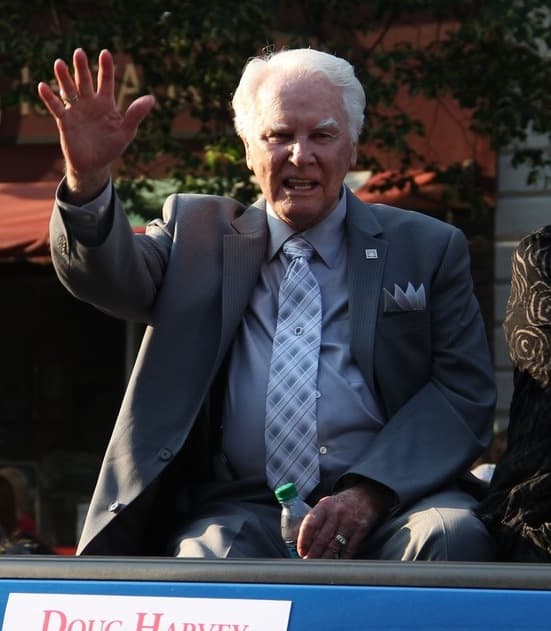
Doug Harvey portrait, 2011.
Photo credit: Unknown photographer via Wikimedia Commons
Doug Harvey umpired with such certainty that players took to calling him God, and he did not entirely discourage them. He worked 31 seasons in the National League, knew the rulebook better than the men who filled out the lineups, and built his reputation on getting calls right by waiting a beat longer than anyone else before he made them. He became the ninth umpire elected to the Hall of Fame, one of the few honored for the way he worked a game rather than the way he played it. The Veterans Committee elected him in 2010.
The Son of an Umpire
Harvey was born Harold Douglas Harvey on March 13, 1930, in South Gate, California, the son of a man who umpired well enough that opposing teams asked for him behind the plate even when his own boys were playing. "I knew I wanted to be an umpire when I was six years old," Harvey said. "My dad was an umpire, and a damn fine one." He worked his way up through the low minor leagues without ever attending umpire school, the last man the major leagues would hire that way, and he reached the National League in 1962, calling his first game at the opening of Dodger Stadium.
Slow Down and Get It Right
Early in his career, working the plate behind Don Drysdale, Harvey rang up Stan Musial on a pitch four inches outside, and Musial handed him a piece of advice he kept for the rest of his life. Calm down, the old hitter told him, and slow down. Harvey had already learned from the veteran umpire Jocko Conlan that anticipating a call was how umpires got them wrong. "In those days, it was common to anticipate the call," Harvey said. "Everything was called too quickly." He built his whole style on the opposite, waiting until he was sure, and it made him the most trusted set of eyes in the league.
The Twenty-Second Rule
Harvey let managers argue, up to a point. He gave every man a fixed window to vent and then closed it, a method he worked out in a shouting match with Gene Mauch and used for 30 years. "I gave every man 20 seconds to let him vent," he said. "After that, I'd tell him, I've listened to you and you haven't changed my mind." He drew the line at personal abuse and threw a man out the moment he crossed it, but he ejected only 58 people in 31 seasons, a low number that measured how much room he gave them. He carried himself as the last word on the field, white-haired and certain, his strike call a hard jab of the arm that left no doubt.
God
The nickname came from more than one place. The most-told version credits the Padres catcher Terry Kennedy, who watched Harvey inspect a soaked field during a rain delay and cracked that God must know more weather was coming, and Harvey took it as a compliment. Others traced it to a manager snapping, "Who do you think you are, God?" The sportswriter Jerome Holtzman gave the simplest explanation, writing that players and managers called him God because in 22 years he had yet to make a wrong call. A 1999 study ranked him the second-greatest umpire in history, behind only Bill Klem.
The Big Moments
Harvey worked the field for some of the era's defining scenes. He was umpiring at second base in 1972 when Roberto Clemente lined his 3,000th hit, the last of Clemente's regular-season career, and he congratulated him on the spot. He stood in the middle of the 1965 brawl when Juan Marichal swung a bat at John Roseboro, helping pull his crew chief out of the pile. He worked five World Series and stood behind the plate in 1988 when Kirk Gibson limped around the bases on his walk-off home run. For 31 years, if a National League game mattered, there was a fair chance Harvey was working it.
A Lifetime in the Rulebook
What set Harvey apart was authority earned the hard way. A 1974 poll of players rated him the only National League umpire worth an excellent grade, and the men who argued with him respected him precisely because he was so rarely wrong and so willing to explain himself when he was. "You always respected him because he came out to his job and did it with a lot of class," Joe Torre said. "He was very consistent, and that's the highest compliment you can pay anybody." Harvey did not pretend to perfection. Asked about his mistakes, he once said he had gone until the 28th of August one year before he kicked a play at second base.
What the Tobacco Did
For decades Harvey chewed tobacco on the field, and it nearly killed him. A cancer of the mouth and throat, diagnosed in 1997, cost him much of his voice through radiation and the strokes that followed, and it turned the rest of his life into a warning. He spent his retirement telling young players and kids what the habit had done to him, urging them off smokeless tobacco wherever the game would have him speak. The voice that had barked out 30 years of calls was nearly gone by the time Cooperstown came calling.
The Ninth Umpire
Only eight umpires had reached the Hall of Fame before him when the Veterans Committee elected Harvey in 2010 with 15 of 16 votes, making him the ninth. His damaged voice forced him to record his induction speech in advance, and he sat in the Cooperstown crowd while it played, a man who had given the game 31 years and asked for nothing but the chance to get the calls right. He died on January 13, 2018, in Visalia, California, at 87, remembered as one of the two or three best umpires who ever lived.