Profile
Jocko Conlan
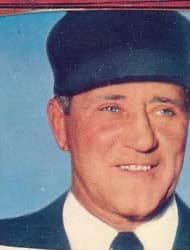
Jocko Conlan portrait card image.
Photo credit: Bowman Gum via Wikimedia Commons (Public domain)
John Bertrand Conlan became a major league umpire because it was 114 degrees in St. Louis and the home plate umpire collapsed. He wore a polka-dot bow tie for 25 years, called strikes with his left fist thrown back like an engineer pulling a throttle, kicked Leo Durocher in the shins and got kicked back, and ejected 137 men from ballgames while insisting he never once cursed a player. At 12 years old he had stolen Kid Gleason's glove from the White Sox clubhouse, traded it for $2 and a left-handed model, and confessed the whole thing when they met again 15 years later. Gleason forgave him. Most people did. "He was the nicest guy you'd ever want to work with," said fellow umpire Augie Donatelli. "He helped all the young umpires. And there was no one better off the field."
Chicago
Conlan was born on December 6, 1899, in Chicago, the youngest of nine children. His father was a Chicago policeman who died at 49 when Jocko was three. His mother raised all nine children alone and lived to 88. His middle name came from Sister Mary Bertrand, a nun and family friend. His brother Joe was a semipro pitcher who claimed Babe Ruth hit the longest home run ever off him in a 1920 spring training game. Joe later became a policeman like their father.
Conlan grew up near the site that became Comiskey Park. He attended All Saints Parochial School, where his teammate was a future Giant named Freddie Lindstrom, and played outfield at De La Salle High School. He was an amateur boxer before he was a ballplayer and later a licensed boxing referee before he was an umpire. Restlessness was a constant. He played for the Wichita Jobbers of the Western League beginning in 1920, jumped the team mid-season and was suspended, returned, was suspended again, and finally settled in when the hitting took over. He batted .311 in 1923 with 204 hits and went on to hit .300 or better in seven minor league seasons across stops at Rochester, Newark, Toledo, and Montreal.
At Toledo in 1930, his manager was Casey Stengel. Conlan broke his ankle sliding into third on a triple but stayed in the game and scored on a sacrifice fly. Stengel had promised $1,000 bonuses to anyone who hit .300. Conlan was batting .292 at the time of the injury. Stengel awarded him half the bonus anyway and later joked: "And as a reward for the $500 bonus I once gave him, he used to chase me oftener than any other manager in the league."
The Doubleheader
The White Sox signed Conlan in 1934, and he played two seasons as a left-handed platoon outfielder, batting .263 in 128 games. His best day as a player came on August 20, 1935, when he went 4-for-4 with a double and two stolen bases (including a steal of home) in the first game of a doubleheader against the Athletics, then 3-for-4 with three RBI in the nightcap.
Three weeks earlier, everything had changed. On July 28, 1935, during a White Sox-Browns doubleheader in St. Louis, the temperature reached 114 degrees. Conlan had a thumb injury from wrestling with teammate Ted Lyons and was unavailable to play. When home plate umpire Red Ormsby collapsed from the heat and was carried off the field, only one umpire remained. Conlan volunteered. "I'll umpire," he said. "I can't play anyway." Both managers, Jimmy Dykes and Rogers Hornsby, agreed, and Conlan worked third base in his White Sox uniform while Ollie Bejma, a Browns reserve, umpired first base in his. The Browns won 4-3. Conlan umpired again the next day and was paid $50 for the two-day stint.
He recalled the experience years later: "I can remember thinking that I didn't want to show any favoritism to my own team, but when I called my teammate, Luke Appling, out at first on a close play, I not only had a helluva argument with Appling, but I also had a fight with my own manager."
The White Sox released him in November 1935. GM Harry Grabiner offered to help him become an umpire and explained the pension system. Conlan started in the New York-Penn League in 1936, moved to the American Association by 1938, and spent five years learning the craft. Tommy Connolly, the AL umpire supervisor, watched him work in Columbus and called him a "finished performer." When the American League passed him over in 1941, telling him he was "just a bit too short," Conlan never forgave Connolly, noting he was half an inch taller than Connolly himself. The National League had no such reservations. Ford Frick offered him a job on the night before his birthday in December 1940, and Conlan accepted.
The Bow Tie
Conlan umpired in the National League from 1941 through 1964, with a 17-game return in 1965 to fill in for the ailing Tom Gorman at the request of NL President Warren Giles. He worked 3,623 regular season games, five World Series, six All-Star Games, and all four NL pennant playoffs held during his tenure, including Bobby Thomson's "Shot Heard 'Round the World" on October 3, 1951. He was behind the plate for Gil Hodges's four-homer game on August 31, 1950, and for Willie Mays's four-homer game on April 30, 1961.
The polka-dot bow tie became his trademark early and stayed for the duration. He was the last NL umpire to wear the large balloon-style chest protector over his clothes, having broken both collarbones during his career and received special permission to keep the larger model. The bow tie sat above the chest protector and was visible from every seat in the park. His left-handed strike call, a clenched fist thrown up and back, was described as "the most picturesque distinctive gesture in calling strikes."
He considered Bill Klem his mentor and governed his games by a code that was equal parts principle and temperament. "I never cursed a ballplayer," he said. "If a player cursed me, he was out. When an umpire walks onto the field, he must have respect and it must be continued throughout the game." He ejected 137 men over 25 seasons. His advice on blown calls was pragmatic: "If you know in your heart that you called one wrong, you just try to call the next one right. Never 'even up.' That just makes two wrong decisions."
Durocher
Leo Durocher was the longest-running argument of Conlan's career. Durocher liked to invite celebrities, including entertainer Danny Kaye, into the dugout during pregame activities. Conlan insisted they leave once the game started. The friction never stopped.
On April 16, 1961, at the Los Angeles Memorial Coliseum, a Norm Larker popup fell near the first-base line, dropped fair, and bounced foul without being touched. Conlan correctly called it a foul ball. Durocher, then a Dodgers coach under Walter Alston, argued that the catcher had touched the ball, threw a towel onto the field, and was ejected. During the ensuing argument, Durocher kicked Conlan in the shins. Conlan kicked him back. A photographer captured the sequence. "I got kicked twice, and so did he," Conlan said. Conlan was wearing umpire's shin guards, so Durocher took the worse end of it.
Conlan called Durocher "king of the complainers, troublemakers, arguers, and moaners" but added: "As little as I think of Durocher, there is no question in my mind but that he always was a first-class manager. If only he had behaved better, he would have gone down in baseball history as one of the great managers of all time." After Conlan's death, Durocher returned the assessment: "We had our battles on the field but we were good friends off the field. That's where it counts. He was a fine umpire and a fine man."
Scottsdale
Conlan retired to Scottsdale, Arizona, after the 1964 season. The Veterans Committee elected him to the Hall of Fame in 1974, the fourth umpire inducted and the first former major league player to enter as an umpire. His son John Bertrand Conlan Jr. attended Harvard Law School and served as a U.S. Congressman from Arizona from 1973 to 1977. Three months after his induction, Conlan suffered a coronary occlusion while watching the first game of the 1974 World Series in Los Angeles. He underwent open-heart surgery and recovered, though his activity slowed afterward.
He died on April 16, 1989, in Scottsdale, at 89. He was buried at Green Acres Memorial Park, near the spring training complex where he had spent his retirement watching young umpires work. His autobiography, Jocko, written with Robert W. Creamer, had been published in 1967. He was the only Hall of Famer buried in Arizona.
Upon his retirement, Giles had said, "I know of no one more dedicated to his profession, more loyal to the game." Conlan, in a quieter moment, offered his own version: "You think you've been an important figure in the game over the years, and all of a sudden you're out of it. You're not important. You're not even a part of it any more." He had been a part of it for 50 years, starting with a stolen glove and a 114-degree afternoon.