Profile
Warren Giles
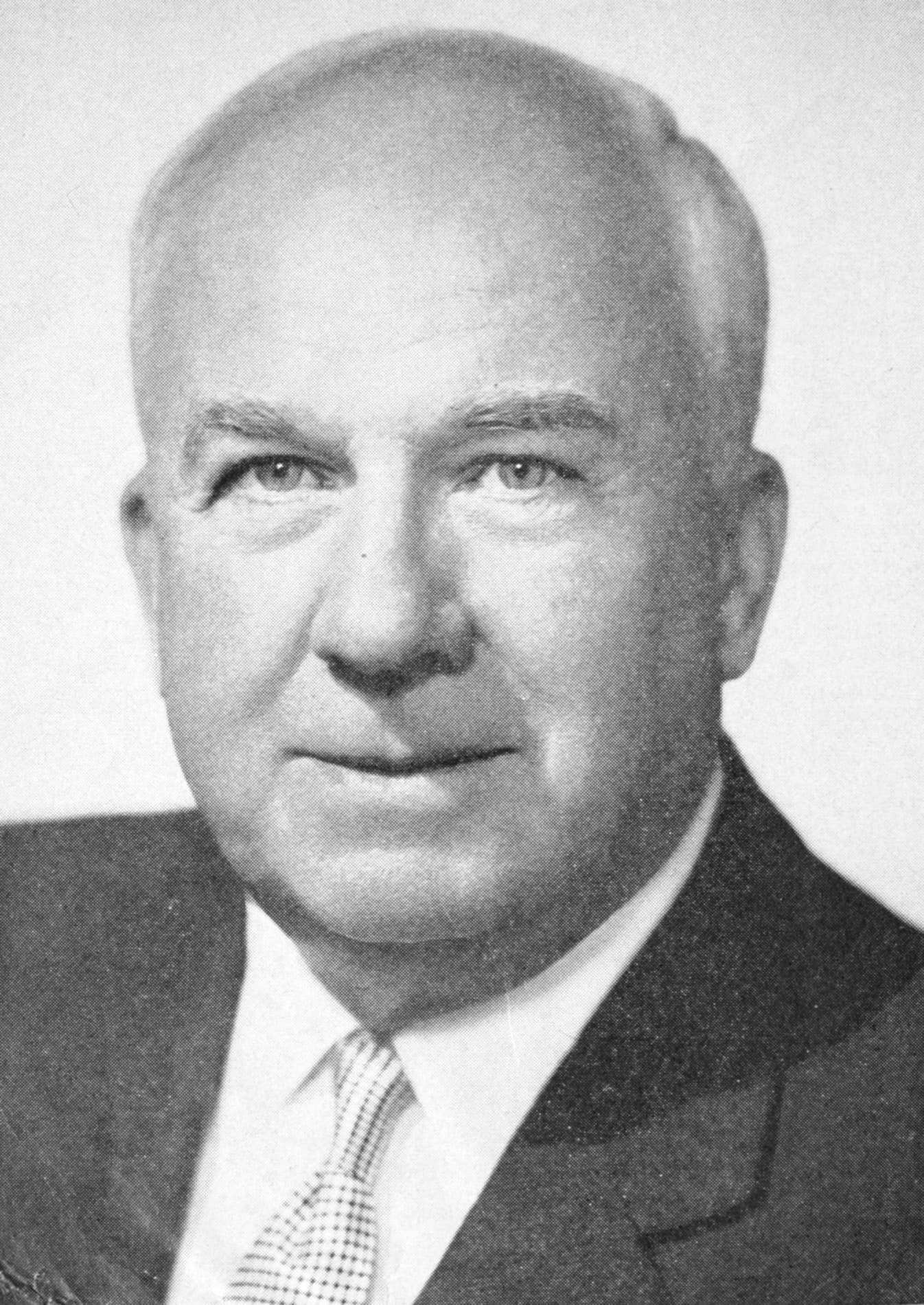
Warren Giles portrait from 1962 Baseball Guide.
Photo credit: The Sporting News / Unknown author via Wikimedia Commons (Public domain)
Warren Crandall Giles ran the Cincinnati Reds through two pennants and a World Series championship, then presided over the National League for 18 years during the most turbulent period of franchise movement and expansion in baseball history. The league grew from eight teams to twelve under his watch. The Braves moved from Boston to Milwaukee, the Dodgers left Brooklyn for Los Angeles, and the Giants crossed the country to San Francisco, and Giles approved every relocation. "You must prune dead or dying wood," he said. When critics asked who would represent the National League in New York after the Dodgers and Giants departed, Giles was widely quoted as responding, "Who needs New York?" The Veterans Committee elected him to the Hall of Fame in 1979.
Tiskilwa
Giles was born on May 28, 1896, in Tiskilwa, Illinois, the third of five children and the only son. His father William was a general contractor. Giles attended Staunton Military Academy in Virginia, where he excelled at football, basketball, and baseball, and spent a year at Washington and Lee University before enlisting in the Army in 1917. Giles was commissioned as a second lieutenant, promoted to first lieutenant, and served in France with a replacement mortar regiment. He was discharged in March 1919.
After the war Giles worked as a painter, owned a small football team in Moline, Illinois, and refereed football and basketball games in the Missouri Valley Conference. In 1919, at 23, he was elected president of the Moline Plowboys of the Three-I League, an unpaid position. Giles hired Earle Mack, Connie Mack's son, as manager and took the team from last place to the league championship within two years.
Cincinnati
Giles worked his way through the minor league executive ranks in St. Joseph, Syracuse, and Rochester, where he won four consecutive International League pennants from 1928 through 1931 as president of the Cardinals' top farm club. Branch Rickey recommended Giles to Reds owner Powel Crosley for the general manager's job in November 1936.
Giles inherited a team that won 56 games in 1937 and finished last. He hired Bill McKechnie as manager, acquired Bucky Walters from the Phillies, and built the Reds into champions within two years. In 1939 Cincinnati won 97 games and its first pennant since 1919, though the Yankees swept the World Series. The 1940 Reds won 100 games and defeated the Detroit Tigers in seven games for the franchise's second championship in modern history. Giles won the Sporting News Executive of the Year Award in 1938 for the turnaround.
The National League
After Commissioner Happy Chandler was forced out in 1951, Giles was among the leading candidates to replace him alongside Ford Frick, Dwight Eisenhower, and Douglas MacArthur. After 16 ballots reached a stalemate, Giles withdrew. "My first interest in baseball is the welfare of baseball itself," he said. Frick was elected Commissioner, and five days later Giles became president of the National League.
Giles moved the league offices from New York to Cincinnati and oversaw the most significant franchise upheaval since the founding of the American League. The Braves left Boston for Milwaukee in 1953, the first modern franchise relocation. The Dodgers and Giants moved to California in 1958. In 1962 the league expanded for the first time, adding the New York Mets and the Houston Colt .45s. In 1969 the league added the Montreal Expos and San Diego Padres, adopted divisional play, and played its first National League Championship Series.
Giles took particular pride in the All-Star Game, where he exhorted NL players in clubhouse meetings to uphold the league's honor. Under his presidency the National League won 16 of 22 All-Star Games, a dominance that Giles attributed to the league's advantage in signing black and Latin American players during the 1950s and 1960s. The talent edge produced a three-decade run of NL superiority that extended well beyond Giles's tenure.
Giles described his most difficult decision as the suspension of Juan Marichal for eight games and a $1,750 fine after Marichal hit catcher Johnny Roseboro with a bat on August 22, 1965. Giles retired after the 1969 season at 73. The National League Championship Series trophy bears his name.
Giles married Jane Mabel Skinner in 1931. Jane was the great-granddaughter of John Deere, the inventor of the steel plow. Warren underwent an emergency appendectomy in June 1943, and days after his discharge Jane suffered a cerebral hemorrhage and died on July 10. Giles never remarried. Their son Bill became president of the Philadelphia Phillies. Giles died on February 7, 1979, in Cincinnati, from cancer, at 82. Leonard Koppett wrote that "even those who disagreed found him warm, fair-minded, civilized, and decent."