Profile
Happy Chandler
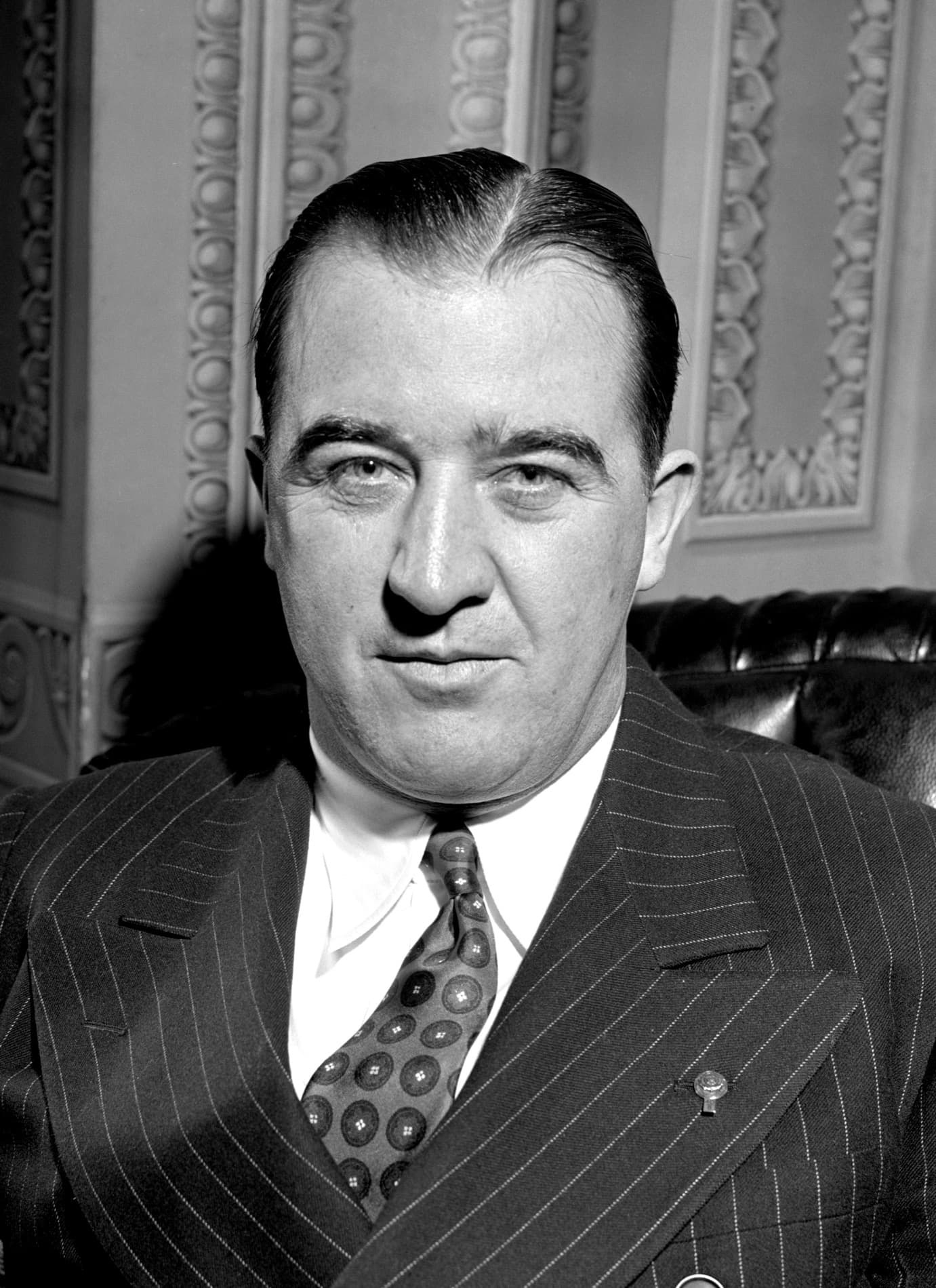
Happy Chandler portrait.
Photo credit: Harris & Ewing via Wikimedia Commons (Public domain)
Albert Benjamin Chandler was the governor of Kentucky, a United States senator, and the second Commissioner of Baseball, and the thing he did that outlasted all three offices was approve Jackie Robinson's contract when the other owners wanted Robinson kept out. "I figured that someday I'd have to meet my maker," Chandler said at his Hall of Fame induction, "and he'd ask me why I didn't let that boy play. I was afraid that if I told him it was because he was black, that wouldn't have been sufficient. I told Rickey to bring him on." The owners fired Chandler for it, among other transgressions, and the Veterans Committee elected him to the Hall of Fame in 1982.
Corydon
Chandler was born on July 14, 1898, in Corydon, Kentucky, in Henderson County. His father Joseph was a farmer. His mother Callie abandoned the family when Chandler was about three, and his brother Robert died at 13 after falling from a cherry tree. Chandler acquired the nickname "Happy" at Transylvania College in Lexington for his perpetual smile and gregarious nature. He captained the baseball and basketball teams, played quarterback on the football team, and graduated in 1921. Chandler spent a year at Harvard Law School before running out of money and finishing his law degree at the University of Kentucky in 1924.
Chandler pitched for the Lexington Reds in Class D and played alongside future Hall of Famer Earle Combs. He pitched a season for Grafton, North Dakota, going 7-1 with a game in which he allowed no hits. Politics pulled him from baseball. Chandler served in the Kentucky State Senate, became lieutenant governor in 1931, won the governor's office in 1935 at 37 as the youngest governor in the country, and was appointed to the U.S. Senate in 1939.
The Commissioner
Kenesaw Mountain Landis died in November 1944, and the owners chose Chandler as his replacement on April 24, 1945, largely through the lobbying of Larry MacPhail, the Yankees' co-owner. Chandler delayed taking office until November 1 so he could vote on the Bretton Woods Agreement and the United Nations Charter in the Senate. His salary was $50,000 a year, roughly five times a senator's pay.
Chandler moved the Commissioner's office from Chicago to Cincinnati, which angered the Eastern press and earned him nicknames like "Kentucky windbag" and "preening politician." He was known for singing "My Old Kentucky Home" at public events and for a warmth that the owners found charming at first and intolerable later.
Branch Rickey signed Robinson to the Montreal Royals in October 1945 and brought him to the Brooklyn Dodgers for the 1947 season. Chandler approved Robinson's contract. Robinson wrote to Chandler in 1956 that he would "never forget your part in the so called Rickey experiment." Don Newcombe said Chandler cared for black players "when it wasn't fashionable."
Chandler suspended Leo Durocher for the entire 1947 season for "conduct detrimental to baseball," a decision rooted in Durocher's gambling associations and his involvement with married actress Laraine Day. Chandler also fined MacPhail and the Brooklyn club $2,000 each for the dispute over Dodgers coaches who were signed while still under contract.
When players began jumping to Jorge Pasquel's Mexican League in 1946 for higher salaries, Chandler imposed five-year bans on 18 players who left. Danny Gardella, a Giants outfielder, filed an antitrust lawsuit that threatened to unravel baseball's legal exemption. Chandler lifted the bans nearly two years early and settled the Gardella case for $60,000. Chandler also negotiated the broadcast contracts that established the first player pension fund, selling World Series radio rights for $475,000 in 1947 and securing a seven-year deal worth $4.37 million with Gillette and Mutual Broadcasting in 1949.
The Vote
The owners turned on Chandler for reasons they debated among themselves for decades. He investigated Del Webb and Fred Saigh for gambling connections, voided a trade between the Yankees and White Sox that angered Webb, fined the White Sox general manager for signing a high school player illegally, and raised umpire pay without consulting the league presidents. Chandler himself cited the voided trade as the decisive factor. Historians have pointed to his investigations of owners and his habit of siding with players over management. Chandler claimed his support for Robinson's integration cost him the job, but historian John Paul Hill noted that some of Chandler's strongest allies opposed integration while some owners who integrated early voted against him.
In December 1950, the owners voted 9-7 in favor of renewing Chandler's contract, three votes short of the 75 percent supermajority they required after changing the rules following Landis's death. "It's the first time I ever won a majority but lost an election," Chandler said. Ted Williams said, "I know the players are strong for Chandler. Chandler has always been good to me." Chandler agreed to stay until July 1951. Ford Frick replaced him.
Versailles
Chandler returned to Kentucky, won the governor's office again in 1955, and spent much of his second term enforcing school integration. On September 4, 1956, Chandler called in more than 900 National Guard troops and several M47 Patton tanks to Sturgis, Kentucky, after 500 opponents blocked nine black students from entering the local high school. "We regret it is necessary to use this means of guaranteeing equal rights to our citizens," Chandler said, "but that we must do." Chandler also established the University of Kentucky medical school, which he called his proudest achievement as governor.
Chandler ran unsuccessfully for governor twice more and sought the Democratic presidential nomination in 1956 and 1960 without success. In April 1988, during a University of Kentucky Board of Trustees meeting, Chandler used a racial epithet while discussing African investments, sparking protests and calls for his removal. Chandler apologized.
Chandler died of a heart attack on June 15, 1991, in Versailles, Kentucky, at 92. His wife Mildred, whom he married in 1925, said, "He had a most satisfactory life and accomplished many, many things, a lot of things the general public doesn't know about."