Profile
Earle Combs
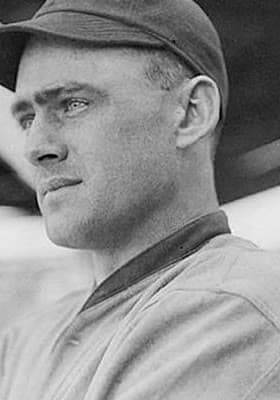
Earle Combs portrait.
Photo credit: Unknown author via Wikimedia Commons (Public domain)
Earle Combs batted leadoff for the 1927 Yankees, the team that many consider the greatest in baseball history, and he set the table for Babe Ruth and Lou Gehrig with a consistency that made the lineup behind him even more dangerous than it already was. He batted .325 over 12 seasons, all with the Yankees, collected 1,866 hits, and led the American League in triples three times. He was the quiet man in front of the loudest lineup in baseball, and his career ended when he fractured his skull running into an outfield wall in St. Louis. The Veterans Committee elected him to the Hall of Fame in 1970.
Kentucky
Earle Bryan Combs was born on May 14, 1899, in Pebworth, Kentucky, a rural community in Owsley County in the eastern part of the state. He grew up on a farm, attended Eastern Kentucky State Normal School in Richmond, and studied to become a schoolteacher. He played baseball at the college and showed enough ability to attract the attention of professional scouts, though his path to the major leagues ran through the minor leagues first.
The Louisville Colonels of the American Association signed Combs, and he hit .344 in 1922 and .380 in 1923, two seasons that left no doubt about his readiness for the majors. The Yankees purchased his contract in January 1924 for a reported $50,000, a substantial sum for a minor leaguer at the time. He batted .400 in 24 games during his 1924 debut before a broken ankle ended his rookie season. He became the everyday center fielder in 1925, hit .342 in his first full year, and established himself immediately as the kind of player Miller Huggins built his lineups around.
Murderers' Row
Combs's job on the great Yankees teams of the late 1920s was to get on base. Batting first in a lineup that included Mark Koenig, Ruth, and Gehrig behind him, he transformed singles and walks into scoring opportunities that the middle of the order converted at historic rates. In 1927, he led the American League with 231 hits and 23 triples, batted .356, and scored 137 runs. The Yankees went 110-44 that season and swept the Pittsburgh Pirates in the World Series, and Combs batted .313 in the four games.
He led the league in triples again in 1928 with 21 and in 1930 with 22, and he hit .300 or better in eight of his nine full seasons. His career on-base percentage of .397 reflected a patient approach built on sharp contact, selective swing decisions, and the speed to make infielders pay for anything hit on the ground. He was not a power hitter during an era dominated by power, but his value at the top of the order was understood by everyone who watched the Yankees play. Ruth hit 60 home runs in 1927 in part because Combs was so often standing on base when Ruth came to the plate.
Combs played on four pennant-winning teams and three World Series champions, in 1927, 1928, and 1932. The 1932 Yankees, now managed by Joe McCarthy after Huggins's death in 1929, swept the Chicago Cubs in four games. Combs was a quiet, modest presence on rosters dominated by larger personalities, and his teammates respected him for the professionalism and consistency he brought to the ballpark every day. Huggins reportedly said that if he could have a team full of players like Combs, he would never lose a night's sleep, because Combs never caused trouble and always gave everything he had.
The Wall
On July 24, 1934, Combs crashed into the outfield wall at Sportsman's Park in St. Louis while chasing a fly ball. He fractured his skull, broke his shoulder, and injured his knee, a combination of injuries severe enough that his life was initially in danger. He was 35 years old. He spent weeks recovering and attempted a comeback in 1935, appearing in 89 games, but he broke his collarbone during the season and could not sustain the level of play he had maintained for a decade. He retired after the 1935 season with no bitterness and no public complaints about the injury that had ended his career prematurely.
His career totals included a .325 batting average, 1,866 hits, 154 triples, and 632 RBI across 12 seasons. The triples total reflected his speed and his willingness to run hard on every ball he hit, qualities that served him throughout his career until the wall in St. Louis took them away.
Coaching
Combs returned to baseball as a coach after his playing career ended. He worked on the staffs of the Yankees, St. Louis Browns, Boston Red Sox, and Philadelphia Phillies across more than a decade of coaching, passing along the knowledge he had accumulated during the dynasty years. He coached Bill Dickey and other catchers as a first-base coach for the Yankees and helped develop younger players across every organization he joined.
He returned to Kentucky after leaving coaching and lived quietly in Richmond for the rest of his life. He died on July 21, 1976, at age 77. The Veterans Committee had elected him to the Hall of Fame six years earlier, honoring the center fielder who had batted in front of Ruth and Gehrig and never once let the opportunity go to waste.