Profile
Eddie Murray
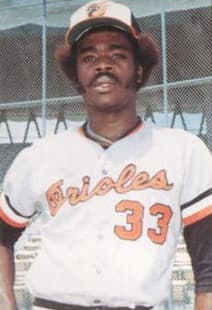
Eddie Murray portrait in Baltimore Orioles uniform, 1983.
Photo credit: Unknown photographer via Wikimedia Commons (Public domain)
Eddie Clarence Murray was the eighth of 12 children raised in a house in East Los Angeles where the backyard doubled as a baseball diamond and the garage served as a batting cage. Four of his brothers signed professional contracts. None of them made it the way Eddie did. He played 21 major league seasons, collected 3,255 hits and 504 home runs as a switch-hitter, drove in 1,917 runs (the most by any switch-hitter in history), won the 1977 AL Rookie of the Year, hit two home runs to clinch the 1983 World Series, and became only the third player after Hank Aaron and Willie Mays to reach both 3,000 hits and 500 home runs. Bill James wrote of him, "His best year was every year. He never won an MVP Award, but he was an MVP candidate every year." The BBWAA elected him to the Hall of Fame in 2003 with 85.3% of the vote.
Los Angeles
Murray was born on February 24, 1956, in Los Angeles, California. His father Charles and mother Carrie Bell raised 12 children, five boys and seven girls, in a neighborhood near Watts where gangs operated on the surrounding blocks. Charles and Carrie kept the children close to home and built a playing field in the yard. Eddie's brother Rich signed with the San Francisco Giants in 1975 and played first base for two seasons in the majors. Brothers Leon, Venice, and Charles Jr. all signed minor league contracts. None reached the big leagues.
Murray attended Alain Leroy Locke High School, where coach Art Webb said of him, "He's got all the equipment to make it in the big leagues and a real good attitude as well." The Baltimore Orioles selected him in the third round of the June 1973 draft.
Baltimore
Murray reached the Orioles in 1977, hit .283 with 27 home runs and 88 RBI as a 21 year old, and won the American League Rookie of the Year. He served primarily as the designated hitter in his first season, starting 110 games at DH, before moving to first base full time in 1978. He made his first All-Star team that year and hit .285 with 27 home runs again.
Murray produced at a level so consistent that the numbers began to blur together. He drove in 99 runs in 1979, 116 in 1980, 78 in the strike-shortened 1981, 110 in 1982, 111 in 1983, 110 in 1984, and 124 in 1985. He batted .316 with 32 home runs in 1982 and finished second in MVP voting to Robin Yount. He batted .306 with 33 home runs in 1983 and finished second again, this time to teammate Cal Ripken Jr. Thomas Boswell of the Washington Post wrote in 1982, "Few great hitters have ever stepped up under pressure with such a sense of flexibility and enjoyment."
The Orioles reached the World Series in 1979 and lost to the Pittsburgh Pirates in seven games. Murray hit a home run in Game 2 but finished 4-for-26 for the series. In 1983 the Orioles returned and beat the Philadelphia Phillies in five games. Murray hit two home runs and drove in the winning runs in the clinching Game 5, a 5-0 victory that gave Baltimore its third championship. "That is the only time I actually got to win the World Series," Murray said. "It's awesome when you win."
On August 26, 1985, Murray hit three home runs in his first four at bats against the California Angels in Anaheim. His father Charles was in the stands. Reggie Jackson called it "the best performance anyone's seen in baseball in the last 10 years." That year Murray signed a five-year, $13 million extension, the richest contract in baseball at the time, and donated roughly $500,000 to establish the Carrie Murray Outdoor Recreational Campus in Baltimore's Leakin Park, honoring his mother, who died in December 1984.
Murray won three Gold Gloves and three Silver Sluggers during his 12 seasons in Baltimore. He made eight All-Star teams and finished in the top five of MVP voting six times without winning. The Orioles retired his number 33 in 1989.
Steady Eddie
Murray was traded to the Los Angeles Dodgers before the 1989 season. He hit a career-high .330 in 1990 with 26 home runs, then moved to the New York Mets in 1992 and hit his 400th home run off Marvin Freeman of the Atlanta Braves on May 3. On June 6, 1992, he drove in two runs to pass Mickey Mantle's career RBI total of 1,509, becoming the all-time leader among switch-hitters.
Murray signed with the Cleveland Indians in 1994 and helped the franchise reach the 1995 World Series. On June 30, 1995, at the Metrodome in Minneapolis, Murray singled off Mike Trombley of the Minnesota Twins in the sixth inning to collect his 3,000th hit. He entered the game with 2,999 and pulled the ball through the right side with Albert Belle standing on second base.
The Indians traded Murray back to Baltimore in July 1996. On September 6, 1996, at Oriole Park at Camden Yards, exactly one year after Ripken broke Lou Gehrig's consecutive games record on the same field, Murray hit his 500th home run off Felipe Lira of the Detroit Tigers in the seventh inning. The standing ovation lasted nearly nine minutes. Murray tipped his cap on three curtain calls. He became the 15th member of the 500 home run club and only the third player, after Hank Aaron and Willie Mays, to reach both milestones. "It's a neighborhood you don't know if you belong in yet," Murray said. "The third guy to do that? It's still hard to see yourself mentioned in that same company."
Murray played his final season in 1997, splitting time between the Anaheim Angels and the Dodgers. His last home run, the 504th of his career, came on May 30, 1997, off Bob Tewksbury.
The Quiet One
Murray stopped speaking to reporters regularly after an unflattering article appeared before the 1979 World Series, and the silence defined his public image for the rest of his career. Writers portrayed him as sullen during the Orioles' decline in the late 1980s. Teammates saw a different man. Ripken said at his own Hall of Fame induction, "When I got to the big leagues, there was a man, Eddie Murray, who showed me how to play this game, day in and day out." Claire Smith of the New York Times described Murray as "a quiet supporter of children and their support organizations, an ambassador for his team who rarely says no." Murray's own explanation was simple. "For me, to focus a lot on the individual, that's not the way I learned to play the game," he said. "Baseball is a team game."
Murray finished with 3,255 hits, 560 doubles, 504 home runs, 1,917 RBI, and a .287 batting average across 3,026 games and 21 seasons. He played 2,413 games at first base (the most in major league history) and recorded 1,865 assists at the position (also a record). He hit 19 grand slams, second on the all-time list at his retirement behind only Lou Gehrig's 23. He remains the only switch-hitter in baseball history with both 500 home runs and 3,000 hits.
The BBWAA elected him to the Hall of Fame in 2003 on his first ballot. His sister Tanya died of kidney disease on January 2, five days before the election results were announced. Her funeral fell on January 7, the same day the vote was made public. Murray's four surviving brothers, five surviving sisters, wife Janice, and daughters Jordan and Jessica attended the induction ceremony in Cooperstown on July 27, 2003.