Profile
Cal Ripken Jr.
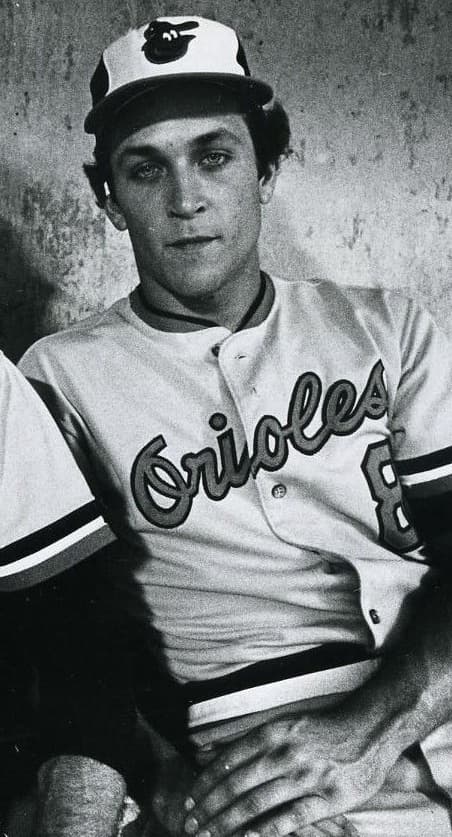
Cal Ripken Jr. portrait, 1982.
Photo credit: Unknown photographer via Wikimedia Commons
Calvin Edwin Ripken Jr. grew up in Aberdeen, Maryland, the son of a minor league catcher who became an Orioles coach and then an Orioles manager, and spent 21 years proving that showing up was the foundation everything else was built on. He played 2,632 consecutive games, shattering Lou Gehrig's record of 2,130 that stood for 56 years. He collected 3,184 hits, hit 431 home runs, won the AL Rookie of the Year in 1982 and the AL MVP in 1983 and 1991, made 19 consecutive All-Star teams, and redefined the shortstop position at 6'4" and 225 pounds, proving that a man his size could play the position and hit for power. The night he broke Gehrig's record, September 6, 1995, is widely credited with helping restore baseball's relationship with its fans after the strike that canceled the 1994 World Series. An MLB fan poll ranked it the most memorable moment in the sport's history. The BBWAA elected him to the Hall of Fame in 2007 with 98.53% of the vote, the third-highest percentage at the time, alongside Tony Gwynn.
Aberdeen
Ripken was born on August 24, 1960, in Havre de Grace, Maryland, and raised in Aberdeen. His father Cal Sr. spent 36 years in the Orioles organization as a minor league catcher, minor league manager, major league coach, and major league manager. Cal Jr. grew up in clubhouses, shagging flies during batting practice, and absorbing the game the way other children absorbed television. His brother Billy joined the Orioles in 1987 and played second base alongside Cal, forming a brother infield combination. His sister Ellen and brother Fred rounded out the family.
The Orioles drafted Ripken in the second round of the 1978 draft for a $20,000 bonus. He debuted on August 10, 1981, as a pinch runner, and established himself at shortstop the following spring.
The Streak
Ripken played his first consecutive game on May 30, 1982. The streak reached 2,130 on September 5, 1995, tying Gehrig. The crowd at Camden Yards gave him a four-minute standing ovation.
The following night, September 6, Ripken broke the record against the California Angels. He hit a home run in the fourth inning, and when the game became official in the top of the fifth, the ovation lasted more than 22 minutes. Bobby Bonilla and Rafael Palmeiro pushed him out of the dugout. "Hey, if you don't do a lap around this thing, we'll never get the game started," they told him. Ripken circled the warning track at Camden Yards, shaking hands with fans, greeting both dugouts, and meeting dignitaries. President Bill Clinton and Vice President Al Gore attended. Hank Aaron, Johnny Unitas, and Joe DiMaggio (Gehrig's former teammate) were part of the ceremony. Ripken's children Rachel and Ryan threw ceremonial first pitches. The Orioles won 4-2. More than 5.1 million households watched on television.
"Tonight I stand here, overwhelmed, as my name is linked with the great and courageous Lou Gehrig," Ripken said. "I'm truly humbled to have our names spoken in the same breath."
Ripken surpassed Sachio Kinugasa's world record of 2,216 consecutive games on June 14, 1996. The streak reached 2,632 before Ripken voluntarily asked to be removed from the lineup on September 20, 1998, ending it on his own terms. He surpassed Gehrig by 502 games.
The Numbers
Ripken won the AL Rookie of the Year in 1982, hitting .264 with 28 home runs and 93 RBI, and became the first player in major league history to follow the Rookie of the Year with an MVP the next season, batting .318 with 27 home runs, 102 RBI, and 211 hits in 1983. The Orioles won the World Series that fall, defeating the Philadelphia Phillies in five games.
Ripken won his second MVP in 1991, hitting .323 with 34 home runs and 114 RBI. He won the All-Star Game MVP that year and again in 2001, his final season. He also won the Home Run Derby in 1991, hitting 12 home runs in 22 swings (seven consecutive), the first shortstop to win the contest.
At 6'4", Ripken shattered the archetype of the small shortstop. He hit 345 home runs at the position, breaking Ernie Banks' record of 277 on July 15, 1993. His success opened the door for the generation of power-hitting shortstops that followed, including Alex Rodriguez, Nomar Garciaparra, and Miguel Tejada. Ripken compensated for less raw speed with meticulous preparation, studying batters from the dugout and attending pitcher-catcher strategy sessions to optimize his positioning.
Ripken moved to third base in 1997 and played there through his final season. He collected his 3,000th hit on April 15, 2000, at the Metrodome, a single off Hector Carrasco of the Minnesota Twins. Eddie Murray, serving as the Orioles' first-base coach, was the first to congratulate him. Ripken played his final game on October 6, 2001, at Camden Yards against the Boston Red Sox. He won 19 consecutive All-Star selections from 1983 through 2001, two Gold Gloves, eight Silver Sluggers, and one World Series ring.
2,632
Ripken finished with 3,184 hits, 603 doubles, 431 home runs, 1,695 RBI, and a .276 batting average across 3,001 games and 21 seasons, all in an Orioles uniform. The franchise retired his number 8 in 2001. His Hall of Fame induction on July 29, 2007, drew a record crowd of roughly 82,000 to Cooperstown.
Murray, in his own Hall of Fame speech four years earlier, said of Ripken, "When I got to the big leagues, there was a man, Eddie Murray, who showed me how to play this game, day in and day out." Ripken said the same of Murray in return. The two men defined what it meant to play for the Baltimore Orioles across two decades. "I have talent, no doubt," Ripken said. "My advantage is that I know the game well. But am I a superstar? Oh, no. I don't think I stack up with the great players." The 98.53% vote said otherwise.
Ripken founded Ripken Baseball after retiring, building youth sports complexes in Aberdeen, Myrtle Beach, and Pigeon Forge, Tennessee, and owning the Aberdeen IronBirds, the Orioles' minor league affiliate. He joined the Orioles' ownership group in January 2024. The US State Department named him a Special Sports Envoy in 2007. He co-founded the Cal Ripken Sr. Foundation with his brother Billy in 2001, serving underprivileged children through baseball. "I'm not in the business of script-writing," Ripken said of the night he broke the record, "but if I were, this would have been a pretty good one."