Profile
Tony Gwynn
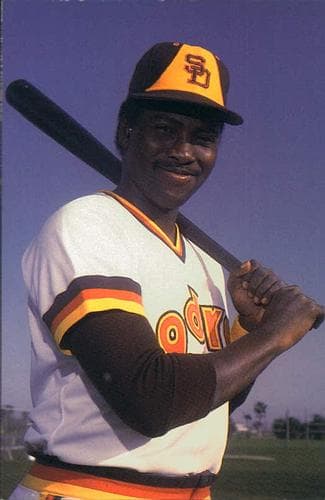
Tony Gwynn portrait, 1983.
Photo credit: Unknown photographer via Wikimedia Commons
Anthony Keith Gwynn Sr. played point guard at San Diego State, set the school record for assists, was drafted by the San Diego Clippers of the NBA and the San Diego Padres of Major League Baseball on the same day, chose baseball, and then spent 20 years proving that nobody in the National League could get him out. He collected 3,141 hits, batted .338 for his career (the highest average since Ted Williams retired), won eight NL batting titles to tie Honus Wagner's league record, struck out only 434 times in 9,288 at bats across two decades, and batted .394 in the strike-shortened 1994 season while chasing .400. Tommy Lasorda said of him in 1984, "How do you defend a hitter who hits the ball down the left-field line, the right-field line, and up the middle?" Greg Maddux called him "easily the toughest hitter for me. His holes are just very small." The BBWAA elected him to the Hall of Fame in 2007 with 97.6% of the vote, the seventh-highest percentage in history at the time. He died on June 16, 2014, of salivary gland cancer, at 54.
Long Beach
Gwynn was born on May 9, 1960, in Los Angeles, California. His father Charles worked as a warehouse manager. His mother Vendella worked for the postal service. The family moved to Long Beach, where Gwynn attended Long Beach Polytechnic High School. His younger brother Chris also played in the major leagues.
Gwynn enrolled at San Diego State University on a basketball scholarship, majoring in recreation. He played point guard, set school records for assists in a game (18), a season (221), and a career (590), and earned two All-WAC Second Team selections. He was the first WAC athlete to earn all-conference honors in two sports. On the baseball diamond he batted .398 across three varsity seasons, earned two All-American selections, and hit .416 with 11 home runs as a senior. On June 9, 1981, the Padres drafted him in the third round and the Clippers drafted him in the 10th round of the NBA draft. Gwynn chose baseball. He married his wife Alicia, whom he met in elementary school, and reported to the minor leagues.
San Diego
Gwynn debuted on July 19, 1982, against the Philadelphia Phillies and went 2-for-4 with an RBI. He won his first batting title in 1984 at .351 with 213 hits and helped the Padres reach the World Series, where they lost to the Detroit Tigers in five games. He won four batting titles between 1984 and 1989, hitting .370 in 1987 (the highest NL average since 1948) and .313 in 1988 (the lowest winning average in NL history).
Gwynn pioneered the use of video to study his at bats and opposing pitchers beginning in 1983, earning the nickname "Captain Video" and crediting the practice with saving his career. He was an aggressive contact hitter who swung at pitches outside the zone and still rarely struck out. His 434 career strikeouts across 9,288 at bats amounted to roughly one strikeout per week over 20 seasons. His hands were small enough that he needed thin-handled bats, 32 to 33 inches long and 30 to 31 ounces, and he generated line drives through timing and bat control rather than strength.
Gwynn won five Gold Gloves, seven Silver Sluggers, and made 15 All-Star teams. He drove in a career-high 119 runs in 1997 while batting .372, and he hit .500 in the 1998 World Series against the Yankees, including a two-run homer off David Wells at Yankee Stadium, though the Padres were swept in four games. "That's the biggest game in the world, a World Series game," Gwynn said of the homer. "And the fact that it was in New York, in Yankee Stadium. I'll remember that forever."
.394
Gwynn entered August 1994 batting .394 and climbing. Over his final 29 games before the players' strike, from July 10 through August 11, he batted .426 with 49 hits in 115 at bats, 17 multi-hit games, and only four strikeouts. His last game was a 3-for-5 performance against the Houston Astros at the Astrodome on August 11, raising his average from .391 to .394. The strike began the next day and canceled the remaining 45 Padres games.
Gwynn later told his son Tony Jr. that he believed he would have reached .400. He needed 71 hits in roughly 170 remaining at bats, a .418 pace, and he was hitting .426 over his final month. But the strike was about something larger than one man's batting average, and Gwynn understood that. "People look at it this way as individuals not having a chance to break records," he said, "but guys have sacrificed careers to make things better. Getting an agreement is more important than hitting .400."
Gwynn won four more consecutive batting titles from 1994 through 1997, giving him eight overall. He collected his 3,000th hit on August 6, 1999, a single off Dan Smith of the Montreal Expos. The first base umpire was Kerwin Danley, Gwynn's college teammate at San Diego State.
Mr. Padre
Gwynn retired after the 2001 season with 3,141 hits, 543 doubles, 135 home runs, 1,138 RBI, 319 stolen bases, and a .338 batting average across 2,440 games, all in a Padres uniform. The Padres retired his number 19 in 2004. He coached baseball at San Diego State from 2002 until his death, compiling a 363-363 record, earning Mountain West Coach of the Year in 2004, and developing future major leaguers Stephen Strasburg and Justin Masterson.
Gwynn started chewing tobacco at 17 during his freshman year at SDSU and continued throughout his playing career and into coaching. He described himself as "a tobacco junkie" who consumed up to two tins of Copenhagen daily. In 2010, doctors found a malignant tumor in his parotid gland, the large salivary gland in his right cheek, in the exact spot where he always placed his dip. Surgery removed the tumor and lymph nodes, but the cancer returned in 2012, requiring a 14-hour surgery and another round of treatment. When it came back a third time in 2013, Gwynn declined further treatment. "I'm dying," he told those close to him. "I'm gonna go out my way."
SDSU announced a contract extension for Gwynn on June 11, 2014. He died five days later, on June 16, at his home in Poway, California, at 54. His death accelerated legislative action against smokeless tobacco in baseball. Boston, Chicago, Los Angeles, New York City, and San Francisco passed local bans at ballparks, California implemented a statewide ban, and the MLB collective bargaining agreement was amended to prohibit players from possessing smokeless tobacco during games and interviews. Players Stephen Strasburg and Addison Reed, both of whom Gwynn coached or influenced, publicly quit after his death.
"People put a premium on home-run hitters," Gwynn said. "I know what I am. I'm a contact hitter and not a home-run hitter. I'm not going to try to be something I'm not." His .338 career average was something nobody else in the National League had been since Honus Wagner played his last game in 1917.