Profile
Ernie Banks
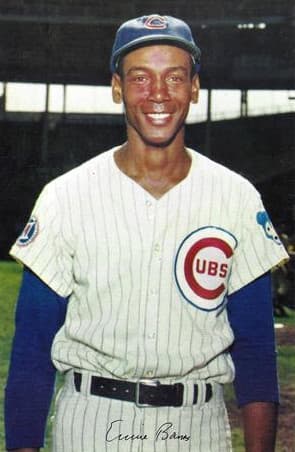
Ernie Banks portrait, 1969.
Photo credit: Unknown author via Wikimedia Commons (Public domain)
Ernest Banks played 2,528 games for the Chicago Cubs and never appeared in the postseason, a record that should have produced bitterness but instead produced a man who wanted to play doubleheaders every day. He hit 512 home runs, won back-to-back National League MVP awards in 1958 and 1959 on a team that finished below .500 both years, and became "Mr. Cub" by treating Wrigley Field's afternoon sunshine as a personal gift from the baseball gods. "It's a beautiful day for a ballgame," he would say. "Let's play two." The BBWAA elected him to the Hall of Fame in 1977 on 83.8 percent of the ballot.
Dallas
Banks was born on January 31, 1931, in Dallas, Texas, the second of twelve children. His father Eddie worked as a warehouse porter for 25 years and played catcher for the Dallas Black Giants after the First World War. Eddie introduced his son to baseball at age eight with a glove and a ball, paying nickels and dimes for each good catch. Banks lettered in basketball, football, and track at Booker T. Washington High School but never played organized baseball there because the school didn't have a team. He played fastpitch softball for a church league instead.
Banks joined the Dallas Black Giants as a semipro at 17 and caught the attention of Kansas City Monarchs scouts. Banks signed with the Monarchs in 1950 for $300 a month and played shortstop under Buck O'Neil, who recognized immediately what he had. Banks hit .255 his first year and then left for the Army, serving as a private first class with the 45th Anti-Aircraft Artillery Battalion at Fort Bliss and in Germany. He sustained the knee injury during his service that would bother him for the rest of his career. When he returned to the Monarchs in 1953 he hit .347, and the Cubs purchased his contract for $20,000.
Wrigley Field
Banks made his major league debut on September 17, 1953, going directly from the Negro Leagues to the Cubs without a day in the minors. Jackie Robinson visited him during his first game and told him to "just listen and learn." Gene Baker, who arrived the same week, became his roommate and double-play partner, forming the first all-black middle infield combination in major league history.
Banks hit 19 home runs as a rookie in 1954 and broke out the following year with 44, a single-season record for shortstops. He also set a major league record with five grand slams in 1955 and finished third in MVP voting. Ralph Kiner said Banks "would lightly rap his fingers on the bat; he looked like he was playing the flute." At five-eleven and 180 pounds, Banks generated his power from his wrists and forearms, and he swung with a compact stroke that rarely missed. Robin Roberts, who faced him often, said, "He doesn't take many bad pitches; he swings at them."
In 1958 Banks hit 47 home runs with 129 RBI, led the league in slugging, and won the National League MVP award despite the Cubs finishing 72-82. He repeated as MVP the following year with 45 home runs and a league-leading 143 RBI, becoming the first National League player to win the award in consecutive seasons and the first in either league to win it on a losing team. The Cubs raised his salary from $33,000 to $50,000. Ebony magazine reported that Banks never made more than $65,000 in any season.
Banks won a Gold Glove at shortstop in 1960 and led the league in home runs again with 41. The following June, the chronic knee injury from his Army service flared after he banged his knee on the wall at Candlestick Park, ending his 717-game consecutive streak. The Cubs moved him briefly to left field, where he said, "Only a duck out of water could have shared my loneliness," and then to first base, where he spent the remainder of his career.
The Collapse
Banks and the Cubs came closest to the postseason in 1969, when a team that included Billy Williams, Ron Santo, and Ferguson Jenkins held a nine-and-a-half-game lead in August. The Mets swept a two-game series at Shea Stadium and went 18-5 down the stretch while the Cubs went 8-12, and Chicago finished eight games behind. Banks was 38 years old and three home runs short of 500. Leo Durocher, who managed the Cubs from 1966 onward, admitted the team "played horseshit in the last few weeks" and privately called Banks a player with an "unfailing instinct for doing the wrong thing" while acknowledging he "had to play the man or there would have been a revolution in the street."
Banks hit his 500th home run on May 12, 1970, off Atlanta's Pat Jarvis at Wrigley Field in front of 5,264 fans under dark clouds. He was the ninth player in major league history to reach the milestone. "The riches of the game are in the thrills, not in the money," he said afterward, thinking about his mother and father. Banks played his final game on September 26, 1971, and retired at 40.
Mr. Cub
Banks held the Cubs franchise records for games, at-bats, home runs, RBI, runs, extra-base hits, and total bases when he retired. Banks coached first base for the Cubs in 1973 and 1974, scouted the minor leagues, and served on the team's board of directors. The Cubs retired his number 14 in 1982, the first in franchise history, and unveiled a statue outside Wrigley Field on Opening Day 2008.
President Barack Obama presented Banks with the Presidential Medal of Freedom in 2013. "That's Mr. Cub," Obama said, "the man who came up through the Negro Leagues, making $7 a day, and became the first black player to suit up for the Cubs." Banks brought Jackie Robinson's bat to the ceremony.
Banks died of a heart attack on January 23, 2015, in Chicago, eight days before his 84th birthday. The procession from his memorial service at Fourth Presbyterian Church passed Wrigley Field on the way to Graceland Cemetery, where he was buried. He closed his Hall of Fame induction speech with the line that defined him. "We've got the setting," he said. "Sunshine, fresh air, the team behind us. So let's play two."