Profile
Pete Rose
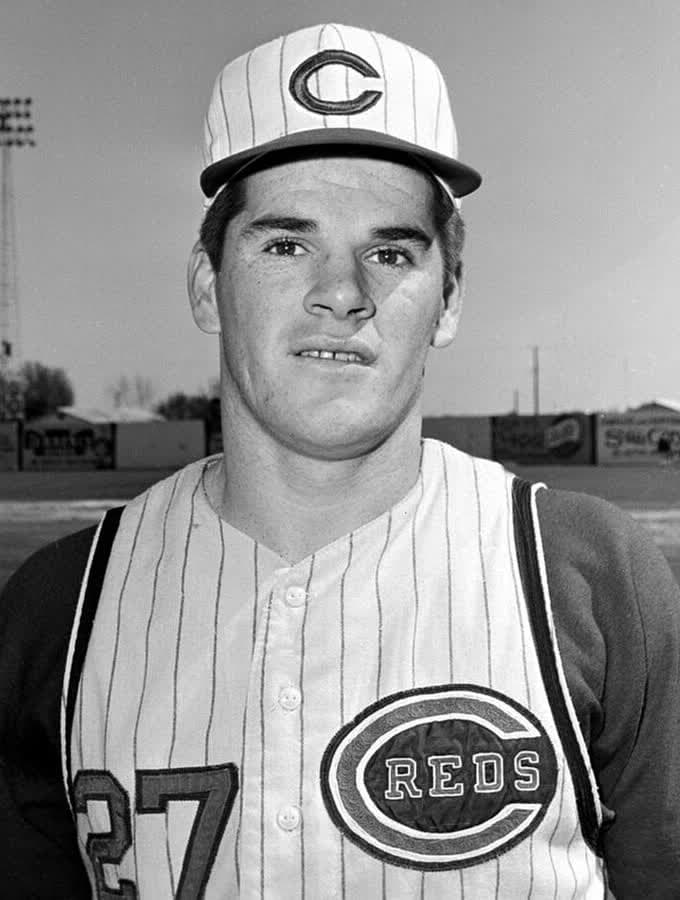
Pete Rose portrait.
Photo credit: Unknown photographer via Wikimedia Commons (Public domain)
Peter Edward Rose Sr. collected 4,256 hits over 24 major league seasons, more than any player in the history of professional baseball. He won three batting titles, made 17 All-Star teams at five different positions, and played on three World Series champions. He was banned from baseball for life on August 24, 1989, after an investigation concluded that he had bet on games, including games involving his own team. The ban made him permanently ineligible for the Hall of Fame ballot.
Cincinnati
Rose was born on April 14, 1941, in Cincinnati, Ohio. His father, Harry Francis Rose, was a bank employee and semipro athlete who pushed his son relentlessly toward baseball. Rose attended Western Hills High School, where he was not considered a top prospect. The Reds signed him as an amateur free agent in 1960, and he reached the majors in 1963.
He won the National League Rookie of the Year award in 1963, hitting .273 with 170 hits. His hustle was conspicuous from the start. He sprinted to first base on walks, slid headfirst into bases, and played every game as if elimination were one loss away. Yankees pitcher Whitey Ford, watching Rose run to first on a spring training walk, reportedly said, "Charlie Hustle." Rose wore the nickname with pride for the rest of his career.
The Big Red Machine
Rose hit .312 in 1965 and .335 in 1968, winning his first batting title. He hit .348 in 1969 to win his second. In 1973, he won his third, batting .338 with 230 hits. That same year, he won the NL MVP award, leading the Reds to the National League Championship Series against the New York Mets. The series produced a bench-clearing fight at second base between Rose and Mets shortstop Bud Harrelson in Game 3 that became one of the decade's signature baseball moments.
The Reds won the World Series in 1975 and 1976, the two championship seasons of the Big Red Machine. The 1975 team featured Rose, Johnny Bench, Joe Morgan, Tony Perez, Dave Concepcion, Ken Griffey Sr., and George Foster. Rose hit .370 in the 1975 World Series against the Red Sox, a seven-game series widely regarded as one of the best ever played. He was named World Series MVP. The 1976 Reds swept the Yankees, and Rose hit .188 in the Series but had already contributed a .323 regular season with 215 hits.
4,192
Rose signed with the Philadelphia Phillies as a free agent after the 1978 season. He helped the Phillies win the 1980 World Series, their first championship. He returned to Cincinnati in 1984, now 43, chasing Ty Cobb's career hit record of 4,191.
On September 11, 1985, at Riverfront Stadium, Rose singled to left-center field off San Diego Padres pitcher Eric Show for hit number 4,192. The game stopped. The crowd stood. Rose wept at first base. He was 44 years old.
He played through the 1986 season and retired with 4,256 hits, 160 home runs, a .303 career batting average, and 3,562 games played. He also held records for at-bats (14,053), singles (3,215), and seasons with 200 or more hits (10).
The Ban
Rose had been managing the Reds since 1984. In early 1989, reports surfaced that he had bet on baseball games. Commissioner A. Bartlett Giamatti appointed lawyer John Dowd to investigate. The Dowd Report, released in June 1989, concluded that Rose had bet on Reds games while managing the team, placing bets through associates and bookmakers. Rose denied everything.
On August 24, 1989, Rose agreed to a permanent ban from baseball. The agreement, negotiated between Rose and Giamatti, did not include a formal finding that Rose had bet on baseball, a detail Rose seized on for years afterward. Giamatti, at the press conference announcing the ban, stated plainly that he believed Rose had bet on games. Giamatti died of a heart attack eight days later.
Rose maintained his denials for 15 years. In January 2004, in his autobiography, he admitted for the first time that he had bet on baseball, including on Reds games. He framed the confession as a step toward reinstatement. Reinstatement never came. Every commissioner who followed Giamatti upheld the ban. In 2015, additional evidence from the Dowd investigation's notebooks was made public, showing that Rose had also bet on games as a player, not only as a manager.
In 1991, the Hall of Fame adopted a rule making anyone on baseball's permanently ineligible list ineligible for the ballot. The rule was widely understood to have been written with Rose in mind.
After Baseball
Rose lived in Las Vegas for years, signing autographs for pay outside casinos and at memorabilia shows. He made occasional public appearances and continued to lobby for reinstatement. He died on September 30, 2024, in Las Vegas, at age 83.
His career record stands unchallenged. No active player is within 1,000 hits of his total. The record, the ban, and the question of whether the two can be separated have followed him past his death and will follow his name for as long as baseball keeps its records.