Profile
Bruce Sutter
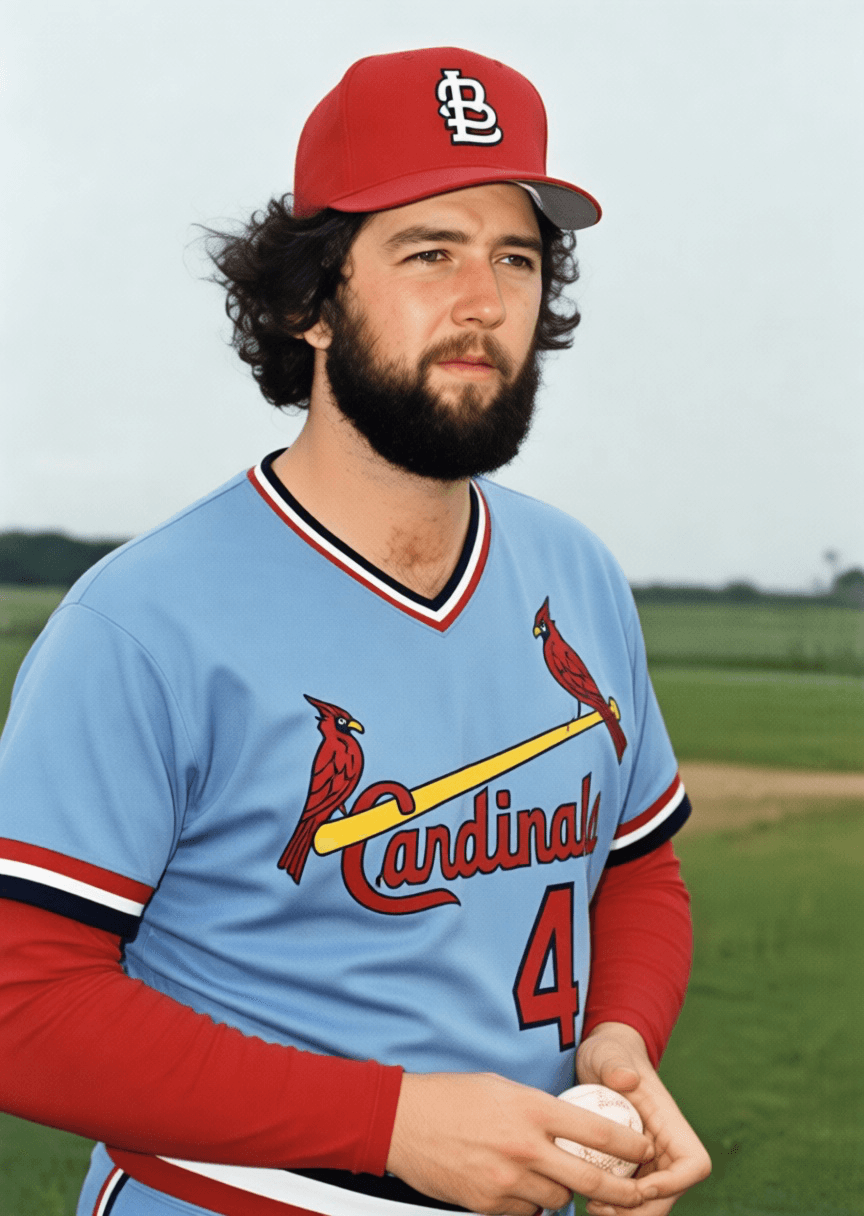
Bruce Sutter portrait in St. Louis Cardinals uniform (cleaned version).
Photo credit: Unknown photographer via Wikimedia Commons MediaSearch
Howard Bruce Sutter signed with the Chicago Cubs as a free agent for $500 a month and a $500 bonus, learned a pitch that no one in the major leagues had ever thrown before, and spent 12 seasons closing games with a ball that dove out of the strike zone as though someone yanked it on a string. He saved 300 games, won the 1979 NL Cy Young Award, struck out Gorman Thomas to end Game 7 of the 1982 World Series, and became the first pitcher elected to the Hall of Fame who never started a major league game. Herman Franks, his manager in Chicago, said, "He's the greatest relief pitcher that I've seen in my 45 years in baseball." Whitey Herzog, his manager in St. Louis, went further. "To me, Bruce is the best there ever was." The BBWAA elected him in 2006 with 76.9% of the vote, on his 13th ballot. He died on October 13, 2022, in Cartersville, Georgia, at 69.
Lancaster
Sutter was born on January 8, 1953, in Lancaster, Pennsylvania, the fifth of six children. His father Howard managed a Farm Bureau warehouse in nearby Mount Joy. Sutter attended Donegal High School, where he quarterbacked and captained the football team, captained the basketball team, and helped win a county baseball championship. He enrolled briefly at Old Dominion University before leaving for professional baseball. The Cubs signed him on September 9, 1971, and assigned him to the lowest levels of their minor league system. His fastball was ordinary, his curveball worse. Nothing in his repertoire suggested a major league future.
Fred Martin
In spring training 1973, at the Cubs' Class A affiliate in Quincy, Illinois, minor league pitching instructor Fred Martin changed Sutter's career and the trajectory of relief pitching. Martin, a former Cardinals pitcher, had developed a modified forkball that he called the split-finger fastball, a pitch that looked like a fastball out of the hand but dove sharply downward as it reached the plate. Martin spent years searching for a pupil with hands large enough to grip the ball properly. Sutter's hands were the right size, and his elbow had recently been operated on for a pinched nerve, leaving his other pitches diminished. The timing was perfect.
"I'd like to tell you I worked and worked at it, but I'd be lying to you because it did come to me right away," Sutter said. "The first day I threw it, I'd get it to break, not every time, but you could see the signs of it that it was going to be something special." He never adjusted his grip after the first day. The optimal velocity was 78 or 79 miles per hour. "When I throw it hard, it just won't break," Sutter explained. The ball was placed between the index and middle fingers, spread wide apart, with the thumb underneath. It spun like a fastball and then disappeared. Gary Matthews, an opponent, said the pitch "just disappeared" and that Sutter's actual fastball "looked like it was coming 100 mph" afterward.
Sutter called Martin "like a second father to me" and named his pet springer spaniel Fred Martin Jr. Martin died of lung cancer on June 11, 1979, the same year Sutter won the Cy Young.
Chicago
Sutter reached the Cubs in 1976 and saved 10 games as a rookie. By 1977 he was the best closer in the National League, posting a 1.34 ERA with 31 saves. On September 8, 1977, he struck out six consecutive batters in relief and recorded an immaculate inning on nine pitches. He made six All-Star teams between 1977 and 1984.
Sutter won the 1979 NL Cy Young Award with 37 saves (tying the league record held by Clay Carroll and Rollie Fingers), a 2.22 ERA, and 101 innings pitched in relief. He was the third reliever to win the award. Mike Krukow, a fellow pitcher, said, "He was throwing something no one had ever seen. A lot of guys tried to throw that pitch, but no one threw it better than Bruce. No one."
The Cubs traded Sutter to the St. Louis Cardinals after the 1980 season for Leon Durham, Ken Reitz, and Ty Waller.
Game 7
Sutter saved 36 games for the Cardinals in 1982 and helped them reach the World Series against the Milwaukee Brewers. St. Louis won Game 7 on October 20, 1982, at Busch Stadium. Sutter entered in the eighth inning with a 4-3 lead. He retired Paul Molitor on a grounder, struck out Robin Yount, and induced a grounder from Cecil Cooper to end the inning. The Cardinals added two insurance runs for a 6-3 lead. Sutter retired Ted Simmons and Ben Oglivie on grounders to open the ninth, bringing up Gorman Thomas. Thomas fouled off four split-finger fastballs, refusing to chase any of them out of the zone. Sutter decided the moment called for a different approach. "I had a three-run lead and nobody on," Sutter recalled, "so I gave him a fastball." Thomas swung and missed. Catcher Darrell Porter threw off his mask and charged the mound, knocking Sutter off his feet. The Cardinals won their first championship since 1967.
Sutter set a career high with 45 saves in 1984, tying Dan Quisenberry's major league record. He signed with the Atlanta Braves as a free agent that December for a six-year contract worth $4.8 million in salary and $4.8 million in deferred payments at 13% interest, an arrangement that would pay him roughly $1.3 million annually for 30 years after the contract ended. The total estimated payout exceeded $44 million, a structure frequently compared to Bobby Bonilla's later deal with the Mets. Shoulder injuries limited Sutter in Atlanta. He missed the entire 1987 season after surgery and recorded his 300th save on September 9, 1988, his final year, exactly 17 years after signing with the Cubs.
The Pitch
Sutter finished with a 68-71 record, 300 saves, 861 strikeouts, and a 2.83 ERA across 661 games and 12 seasons. He led the National League in saves five times, the only pitcher to accomplish that. At his Hall of Fame induction in 2006, he said, "I would not be standing here today if it were not for that pitch," and added that every pitcher who throws a split-finger fastball "owes a great deal of thanks to Fred Martin, because he was the first one to teach it." He also said, "I haven't played baseball for 18 years now. My kids said the first time they ever saw me cry was when I got that phone call."
MLB Commissioner Rob Manfred, upon Sutter's death, said he "was one of the key figures who foreshadowed how the use of relievers would evolve." The Cardinals retired his number 42 on September 17, 2006. Sutter died peacefully in hospice on October 13, 2022, in Cartersville, Georgia, surrounded by family. His son Chad said, "He didn't suffer. He went quick and he went peacefully."