Profile
Paul Molitor
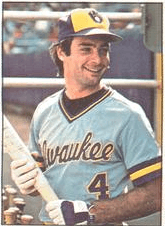
Paul Molitor portrait.
Photo credit: Unknown photographer via Wikimedia Commons (Public domain)
Paul Leo Molitor grew up in St. Paul, Minnesota, five years behind Dave Winfield and playing on the same Oxford playground, one of eight children raised by an accountant father who worked for the Burlington Northern Railroad. He played 21 major league seasons, collected 3,319 hits while battling injuries that limited him to the designated hitter role for the second half of his career, maintained a 39-game hitting streak in 1987 that was the longest in the American League since Joe DiMaggio hit in 56 in 1941, became the first player to collect five hits in a World Series game, won the 1993 World Series MVP with the Toronto Blue Jays, and reached his 3,000th hit with a triple. Ted Williams watched him play and said, "I see Joe DiMaggio." Sparky Anderson said, "Paulie had a way about him where if you gave him a chance, he could always beat you. He's what I call a winning player, like Joe Morgan. They're just winners." The BBWAA elected him to the Hall of Fame in 2004 with 85.2% of the vote.
St. Paul
Molitor was born on August 22, 1956, in St. Paul, Minnesota. His father Richard was an accountant for the Burlington Northern Railroad. His mother Kathleen raised eight children, six girls and two boys. Molitor attended Cretin High School, a Catholic military preparatory school, where he lettered in soccer, basketball, and baseball, earned all-state honors in both baseball and basketball, and listed his ambition in the yearbook as "to play pro baseball and work with people."
Molitor accepted a scholarship to the University of Minnesota, where he batted .375 as a freshman, .406 in Big Ten play as a sophomore (earning First Team All-American), and .325 as a junior. Dick Siebert, his college coach, called him "the most exciting player I have ever coached." The Milwaukee Brewers selected him third overall in the 1977 draft.
Milwaukee
Molitor debuted in 1978 as a 21-year-old shortstop, hit .273 with 30 stolen bases, and finished second in AL Rookie of the Year voting to Lou Whitaker. George Bamberger, his first manager, said, "He had tremendous instincts, and you could see right away he was a talented athlete. Not only physically but mentally, too. He played the game like he had been up here for years."
Molitor's career was defined by extraordinary production interrupted by relentless injuries. He tore rib muscles in 1980, hurt his ankle in 1981, needed Tommy John surgery in 1984, suffered three separate hamstring tears in the first six weeks of 1986, and endured fractured thumbs, sprained shoulders, and surgical procedures on his elbow, forearm, and shoulder across a decade. The injuries pushed him from the infield to the designated hitter role by 1991, and the DH kept his bat in the lineup for the final eight years of his career.
The 1982 Brewers reached the World Series against the St. Louis Cardinals. Molitor set a World Series record in Game 1 on October 12 by going 5-for-6, all five hits singles, off three pitchers. No one matched the record until Albert Pujols collected five hits in Game 3 of the 2011 World Series. Molitor batted .355 for the series, but the Brewers lost in seven games. Whitey Herzog, the Cardinals' manager, offered a dismissive assessment of Game 1, "I ain't runnin' down Molitor. He's a heck of a ballplayer, but he had only one line drive. He had three infield singles and a broken-bat bloop."
39
Molitor's 39-game hitting streak ran from July 16 through August 25, 1987, the fifth longest in modern baseball history. It ended on August 26 at County Stadium when Cleveland rookie John Farrell, making his second major league start, held Molitor to an 0-for-4 night with a strikeout, a groundout into a double play, and a groundout to shortstop Julio Franco. Molitor reached on a Pat Tabler error in the eighth but never batted again. The Brewers won 1-0 in the 10th on Rick Manning's single. Molitor was in the on-deck circle when the winning run scored. Fans booed Manning for ending the game and denying Molitor a final at bat.
Molitor batted .353 that season (second in the AL to Wade Boggs), led the league with 41 doubles and 114 runs, stole 45 bases, and posted a 1.003 OPS in only 118 games. "When you start a streak like this, you're preparing for the end anyway," Molitor said. "Initially I'll be disappointed. It's a unique opportunity to have a streak go on like this. But it shouldn't take me long to get over it."
Toronto
Molitor signed with the Toronto Blue Jays as a free agent before the 1993 season at 36, leaving Milwaukee after 15 years. He chose the number 19, Robin Yount's number with the Brewers, as a tribute to his longtime teammate. Molitor batted .332 with 211 hits and 111 RBI, becoming the oldest player ever to record his first 100-RBI season.
The Blue Jays reached the World Series against the Philadelphia Phillies. Molitor went 12-for-24 (.500) with two home runs, two doubles, two triples, eight RBI, and 10 runs scored. He became the first player in World Series history to collect at least two home runs, two doubles, and two triples in a single series. In Game 6 he tripled on the first pitch to drive in a run, scored on a sacrifice fly, and homered in the fifth inning. In the ninth he singled, and Joe Carter followed with the three-run homer that clinched the championship.
Molitor wept on the field. "This would be number one for me," he said. "My first World Series championship."
3,000
Molitor signed with the Minnesota Twins before the 1996 season, returning to his home state at 39. He batted .341 with 225 hits that year, leading the American League in hits at 40, the oldest player to do so since Sam Rice in 1930. On September 16, 1996, at Kauffman Stadium in Kansas City, Molitor singled for hit number 2,999 in the first inning and then tripled off Jose Rosado in the fifth for number 3,000, the first player to reach the milestone with a triple. George Brett and Robin Yount attended the game. Dave Winfield reached 3,000 hits with the Twins exactly three years earlier to the day, the first two players from the same hometown to reach the milestone.
"I don't know much about that young man," Molitor said of Rosado, "but I know he did not try to avoid being the one who gave up my 3,000th hit. I know he shook off a couple of signs and threw fastballs, saying, 'If you're going to get it, you're going to get it.'"
Molitor retired after the 1998 season. He finished with 3,319 hits, 605 doubles, 114 triples, 234 home runs, 1,307 RBI, 504 stolen bases, and a .306 batting average across 2,683 games and 21 seasons. He batted .368 in 29 postseason games. The Brewers retired his number 4. The University of Minnesota retired his number 11. Dave Engle, a former teammate, captured his standing in Milwaukee, "In Milwaukee, it's God, Robin Yount, and Paul Molitor."
Molitor managed the Minnesota Twins from 2015 through 2018, winning AL Manager of the Year in 2017 after guiding the club to a Wild Card berth at 85-77. He was inducted into the Hall of Fame alongside Dennis Eckersley on July 25, 2004. "The baseball memories are great," Molitor said in his speech, "but when you think about your career, the people memories are even better."