Profile
Sam Rice
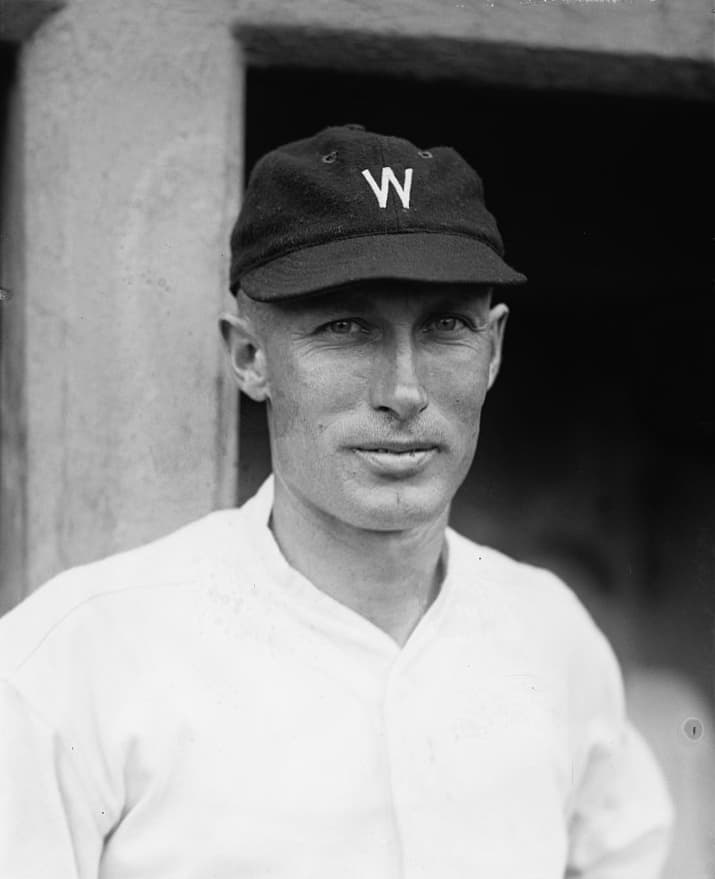
Sam Rice portrait.
Photo credit: Bain News Service / Library of Congress via Wikimedia Commons (Public domain)
Sam Rice collected 2,987 career hits over 20 seasons, 19 of them with the Washington Senators, fell 13 short of 3,000, and left behind a sealed letter about a catch he made in the 1925 World Series that nobody could resolve while he was alive. The letter was not opened until after his death, and by then the question had become more interesting than any answer could satisfy. He played until he was 44, survived a personal tragedy that would have destroyed most people permanently, and built a career defined by relentless consistency at the plate. The Veterans Committee elected him to the Hall of Fame in 1963.
Indiana
Edgar Charles Rice was born on February 20, 1890, in Morocco, Indiana, a small farming town near the Illinois border. The early part of his life contained a catastrophe that he rarely discussed and never invited questions about. In 1912, a tornado struck his family's home while he was away, killing his wife, his two children, his mother, and two of his sisters. His father survived the storm but died of his injuries nine days later. Rice was 22 years old and had lost nearly his entire family in a single afternoon.
He enlisted in the Navy shortly afterward and began playing baseball on service teams, where his hitting ability attracted the attention of professional scouts. He never spoke about the tornado publicly and refused to discuss it in interviews for the rest of his life. Whatever mechanism allowed him to compartmentalize that loss and build a 20-year baseball career on the other side of it, he kept entirely to himself.
Washington
Rice joined the Washington Senators in 1915, initially as a pitcher. Manager Clark Griffith saw enough in Rice's bat to move him to the outfield, and the conversion proved transformative. Rice became one of the most dependable hitters in the American League, batting over .300 in 13 full seasons. He had almost no power in an era that was beginning to reward it, but he sprayed line drives to all fields with a compact left-handed swing and ran the bases with intelligence that turned singles into doubles and doubles into triples. He stole 351 bases over his career and led the league in hits in 1924 with 216.
He was the leadoff hitter and right fielder on the Senators teams that won American League pennants in 1924, 1925, and 1933. The 1924 Senators, managed by 27-year-old Bucky Harris and anchored by Walter Johnson on the mound, won the franchise's only World Series title in a seven-game series against the New York Giants. Rice hit .207 in that Series but contributed in the field and on the basepaths, and the championship validated a franchise that had spent decades losing. Goose Goslin hit three home runs in that Series, and the combination of Goslin's power, Rice's consistency, and Johnson's pitching gave Washington a core that contended for three consecutive pennants.
The Catch
In Game 3 of the 1925 World Series against the Pittsburgh Pirates, Rice made a play that followed him for the rest of his life. Earl Smith hit a long drive to right-center field in the eighth inning. Rice chased the ball to the temporary bleachers in right field, reached over the low wall, and tumbled into the crowd. After several seconds, he emerged holding the ball. Umpire Cy Rigler called Smith out.
Pirates manager Bill McKechnie protested. Witnesses in the bleachers gave contradictory accounts. Some said Rice had caught the ball cleanly before falling into the crowd. Others said a fan had handed him the ball while he was lying among the spectators. Commissioner Kenesaw Mountain Landis investigated after the game and questioned Rice directly, but Rice would say only, "The umpire said I caught it."
The controversy followed Rice for the rest of his life. Reporters asked about it every year, at Old-Timers' Days and banquets, during phone calls and chance encounters. He gave the same non-answer every time and seemed to enjoy the mystery more than anyone pursuing it. In 1965, two years after his Hall of Fame induction, he wrote a letter and deposited it with the Hall of Fame in Cooperstown, with instructions that it not be opened until after his death.
2,987
Rice played his final major league game in 1934, finishing the season with the Cleveland Indians after 19 years in Washington. He was 44 years old. His 2,987 career hits, .322 batting average, and 184 triples placed him among the finest contact hitters of his generation. The missing 13 hits have generated decades of speculation about whether he might have reached 3,000 with one more productive month, but Rice showed no interest in chasing the milestone and retired without apparent regret.
He lived quietly on his farm in Maryland for four decades after leaving baseball and died on October 13, 1974, in Rossmoor, Maryland, at age 84. The Hall of Fame opened his sealed letter shortly afterward. It read, in part, "At no time did I lose possession of the ball."
The letter settled the question. It did not settle the argument.