Profile
Bill Dahlen
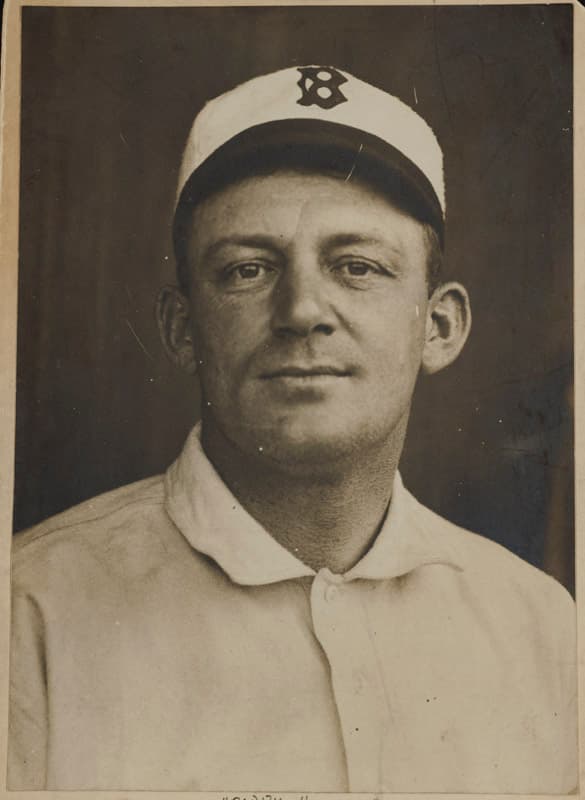
Bill Dahlen portrait.
Photo credit: Paul Thompson / Bain News Service via Wikimedia Commons (Public domain)
Bill Dahlen played 21 major league seasons, accumulated more career WAR than at least a dozen Hall of Fame shortstops, held a 42-game hitting streak that ranked as the second-longest in National League history for more than eight decades, and retired as one of the most prolific position players of the dead-ball era. He is not in the Hall of Fame. He has been considered and rejected by multiple Veterans Committees. He remains one of the strongest statistical candidates for induction who has never received a plaque, and at this point, the omission is its own kind of distinction.
A Career in Full
Dahlen was born in Nelliston, New York, and broke into the majors with the Chicago Colts (later the Cubs) in 1891 at age 21. He played shortstop with above-average range and a strong arm, hit for consistent power in an era when power was rare, and stayed in the lineup for more than two decades. He played for Chicago from 1891 to 1898, the Brooklyn Superbas (later the Dodgers) from 1899 to 1903, the New York Giants from 1904 to 1907, and the Boston Doves (later the Braves) in 1908 and 1909.
When he retired after the 1911 season, he was seventh all-time in games played with 2,443. He had 2,461 hits, 1,234 RBI, and 548 stolen bases. His career WAR, calculated retroactively, sits at approximately 75, placing him ahead of Hall of Famers like Ernie Banks and well ahead of most enshrined shortstops from his own era.
The 42-Game Streak
In the summer of 1894, Dahlen hit safely in 42 consecutive games, a streak that began on June 20 and ended on August 7. Willie Keeler surpassed the mark with 44 games in 1897, and Pete Rose tied Keeler's NL record with 44 in 1978. Dahlen's 42 remained the second-longest streak in National League history for more than eight decades.
Dahlen's streak has an oddity that makes it even more notable. On the day after the streak ended, he began a new hitting streak of 28 games, meaning he hit safely in 70 out of 71 games during the heart of the 1894 season. He finished the year batting .357 with 15 home runs and 108 RBI.
The 1904 Giants
Dahlen was the starting shortstop on the 1904 New York Giants, who won 106 games under manager John McGraw, the best record in the National League. The Giants refused to play the American League champion Boston Americans in a World Series that year because McGraw and Giants owner John T. Brush considered the American League an inferior circuit. The refusal was so poorly received by the public that it led directly to the creation of a mandatory World Series agreement the following year.
Dahlen contributed steady defense and solid offense during his years with the Giants, and McGraw regarded him as a reliable, professional shortstop. Honus Wagner outshone him in fame, but Dahlen was productive for far longer than most of his contemporaries at the position.
The Case for Cooperstown
The argument for Dahlen's induction is almost entirely statistical, which is both its strength and its problem. He played before the era of widespread media coverage, and no vivid anecdotes or signature moments have survived in popular memory. He was simply very good for a very long time at a premium defensive position, and the numbers, when examined by modern analytical methods, compare favorably to many players who are already enshrined.
Sabermetric researchers and baseball historians, including members of the Society for American Baseball Research, have championed his career and lobbied for his inclusion in multiple Veterans Committee cycles. The committees have not been persuaded. The gap between Dahlen's statistical credentials and his lack of recognition continues to widen as more analytically inclined voters enter the conversation without gaining enough influence to change the outcome.
Dahlen died on December 5, 1950, in Brooklyn, at age 80. He spent his final decades in relative obscurity, managing briefly in the minor leagues and then stepping away from the game entirely. His career sits in the public record, waiting to be read by the right committee at the right time.