Profile
Barney Dreyfuss
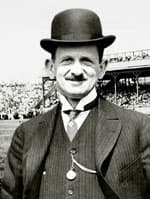
Barney Dreyfuss portrait.
Photo credit: Unknown photographer via Wikimedia Commons (Public domain)
Bernhard Dreyfuss left Freiburg, Germany, in the 1880s to avoid conscription, worked the books at his cousins' bourbon distillery in Paducah, Kentucky, organized baseball teams from the distillery workers because a doctor told him to find a hobby, and spent the next four decades building the Pittsburgh Pirates into one of the most successful franchises in the National League. Dreyfuss owned the Pirates for 32 years, initiated the first modern World Series in 1903, built Forbes Field in 1909 as one of the first concrete-and-steel ballparks in America, and won championships in 1909 and 1925. Branch Rickey said Dreyfuss "was the best judge of players he had ever seen." The Veterans Committee elected him to the Hall of Fame in 2008.
Paducah
Dreyfuss was born on February 23, 1865, in Freiburg, in the Grand Duchy of Baden, into a Jewish family. He emigrated to America around 1885 at 19 to escape German Army conscription, which the SABR biography notes "could be harsh for Jewish youth." He settled in Paducah to work for his cousins Isaac and Bernard Bernheim, who ran a bourbon distillery (the firm later known for I.W. Harper bourbon). Dreyfuss managed the books, worked six days a week, and studied English at night. A physician advised him to take up recreational activity, and Dreyfuss discovered that managing baseball teams from the distillery workforce suited him better than playing.
When the Bernheims moved operations to Louisville in 1888, Dreyfuss convinced them that baseball had "enormous profit" potential. He invested in the Louisville Colonels, then in the American Association, and by 1899 he was sole owner.
Pittsburgh
The National League voted to contract from 12 teams to eight after the 1899 season, folding Louisville, Cleveland, Washington, and Baltimore. Dreyfuss accepted a smaller settlement in exchange for the right to negotiate player transfers from Louisville to Pittsburgh and simultaneously purchased a half-interest in the Pittsburgh Pirates. On December 7, 1899, he transferred Fred Clarke (who became player-manager), Honus Wagner, Tommy Leach, and Deacon Phillippe, among others. Within a year, he borrowed from his cousins and bought out his Pittsburgh partners to become sole owner.
The move was one of the most controversial transactions of the era, criticized as syndicate baseball, but it gave Pittsburgh an instant competitive advantage. Dreyfuss successfully kept Ban Johnson's American League from placing a rival team in Pittsburgh and lost only two players to AL raids. He cemented the 1903 peace agreement that ended the NL-AL war, which led directly to the first World Series.
The 1903 World Series
As both the Pirates and the Boston Americans cruised toward their pennants in August 1903, Dreyfuss challenged Boston owner Henry Killilea to a postseason championship. They settled on a best-of-nine format. Boston won five games to three in October, with injuries weakening the Pirates pitching staff. Total attendance reached 100,429.
Dreyfuss then added his own share of the gate receipts to the Pittsburgh players' pool, a gesture of generosity that produced an absurd outcome. The losing Pirates players each received $1,316 while the winning Boston players each received only $1,182. The series resumed in 1905 (the Giants refused to play in 1904) and became a permanent institution. Dreyfuss is consistently described as the "father" of the World Series.
Forbes Field
The Pirates played at Exposition Park near the Allegheny River, which flooded so frequently that sportswriters nicknamed center field "Lake Dreyfuss." Dreyfuss purchased seven acres from the Schenley estate in Oakland, adjacent to Schenley Park, in what the SABR biography called "one of the largest real estate deals in Pittsburgh history." Critics labeled the location "Dreyfuss's Folly" because it sat three miles from downtown.
Landscape architect Charles W. Leavitt Jr. designed the park, his only baseball venue (he had previously designed Belmont Park and Saratoga racetracks). Construction began on March 1, 1909, and finished in roughly four months at an estimated cost between $1 million and $2 million. Forbes Field, named for the British general who captured Fort Duquesne in 1758, seated approximately 25,000 in a concrete-and-steel double-deck design with ramps instead of steps, elevators to rooftop boxes, and a promenade beneath the grandstand where fans could wait out rain.
Forbes Field opened on June 30, 1909, with 30,388 fans arriving as early as 9 a.m. for a 3:30 p.m. game against the defending World Champion Chicago Cubs. Pittsburgh Mayor William Magee threw the first pitch. The Cubs won 3-2. National League President Harry Pulliam attended and committed suicide less than a month later.
The Championships
The 1909 Pirates won 110 games, captured the NL pennant by 6.5 games, and defeated the Detroit Tigers in the World Series, four games to three. Rookie Babe Adams pitched three complete-game victories, and Honus Wagner outclassed Ty Cobb.
The 1925 Pirates defeated the Washington Senators in seven games, becoming the first team to recover from a 3-1 deficit in a best-of-seven World Series. Kiki Cuyler batted .357 with 18 home runs and 102 RBI during the regular season. Game 7 was played in nasty weather at Forbes Field with nearly 43,000 fans, and the Pirates rallied past Walter Johnson for a 9-7 victory. John Heydler called them the "gamest ball club" he had ever seen.
The 1927 Pirates reached the World Series again but were swept by the Yankees' Murderers' Row. Babe Ruth put on a batting practice display before Game 1 that left the Pirates "open-mouthed in wonder," sending balls into Schenley Park. Fred Lieb reported that Dreyfuss's "mortification" was "so great he had tears in his eyes as he tried to congratulate Col. Jake Ruppert." Dreyfuss never recovered from the humiliation.
Pittsburgh
Dreyfuss ran the Pirates for 32 years without bringing in outside investors. His offices were "filled with volume after volume of statistics and records." He never missed a home game and kept a detailed score of every contest. He charged the same ticket prices on opening day as during the regular season, and he offered discounted train fares to encourage attendance.
Dreyfuss turned the team presidency over to his son Samuel around 1930, but Sam died of pneumonia before the 1931 season. Dreyfuss returned for one final season, described by the SABR biography as "emotionally spent." He pushed for the creation of the Commissioner of Baseball office after the Black Sox scandal. A stone monument installed in Forbes Field's center field on June 30, 1934, commemorated his contributions, and it survives today at PNC Park's concourse behind home plate. His widow Florence resisted proposals to rename Forbes Field after him.
Dreyfuss died of pneumonia on February 5, 1932, in New York, at 66. Commissioner Kenesaw Mountain Landis, Honus Wagner, and Deacon Phillippe attended the funeral at West View Cemetery in Pittsburgh. John Heydler said, "He discovered more great players than any man in the game and his advice and counsel always were sought by his associates." Ralph Davis, the sportswriter, called him "a whole soul" and "a rooter, a dyed-in-the-wool baseball enthusiast" until the end.