The Black Sox Scandal: Eight Men Out
Eight Chicago White Sox players conspired with gamblers to lose the 1919 World Series. The scandal nearly destroyed professional baseball and produced lifetime bans that stood for more than a century.
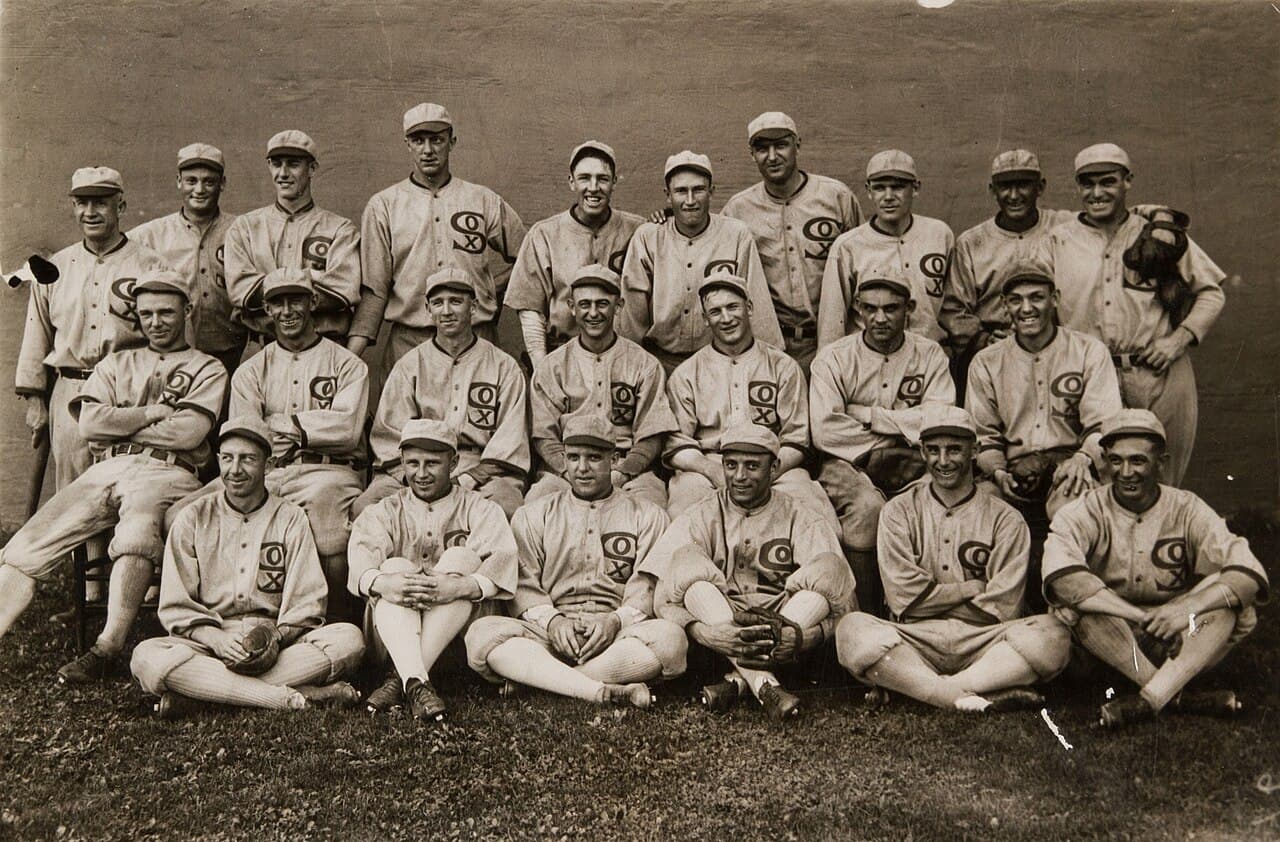
1919 Chicago White Sox team photograph, the club at the center of the Black Sox scandal.
Photo credit: Unknown news photographer via Wikimedia Commons (Public domain)
The 1919 Chicago White Sox were the best team in baseball. They had a deep pitching staff anchored by Eddie Cicotte and Lefty Williams, a lineup built around Shoeless Joe Jackson and Eddie Collins, and a defense that could turn double plays with mechanical precision. They were heavy favorites to beat the Cincinnati Reds in the World Series. And eight of their players had already agreed to lose it.
The fix grew out of years of resentment toward Charles Comiskey, the White Sox owner, whose players believed they were underpaid relative to their talent despite fielding one of the best rosters in the American League. Cicotte, who had won 29 games that season, earned a base salary around $6,000. Comiskey had allegedly promised him a $10,000 bonus for winning 30 games and then benched him down the stretch to keep him from reaching the threshold. The story may be apocryphal, but it captured the real bitterness that ran through that clubhouse.
The Conspiracy Takes Shape
Chick Gandil, the first baseman, was the organizer. Gandil had connections to the gambling underworld and approached a Boston bookmaker named Joseph "Sport" Sullivan in September 1919 with the proposition. Sullivan brought the idea up the chain. It eventually reached Arnold Rothstein, the New York financier and gambler who operated out of Lindy's restaurant on Broadway and controlled a network of bookmakers, fixers, and intermediaries across the country.
Rothstein's precise role remains contested. He may have bankrolled the fix directly or he may have simply bet on the outcome after learning about it from his associates, Abe Attell and Bill Burns. Either way, his involvement gave the scheme the financial weight it needed. The players were promised $80,000 total, split among the eight conspirators. They never received the full amount. The gamblers stiffed them repeatedly, delivering partial payments in hotel rooms and broken promises the rest of the way.
The eight players who joined the fix were Gandil, Cicotte, Williams, Jackson, Swede Risberg, Buck Weaver, Happy Felsch, and utility infielder Fred McMullin. They were not a unified group. Jackson later claimed he tried to return his $5,000 payment and was refused. Weaver attended meetings about the fix but played well throughout the Series and never accepted money. McMullin forced his way in after overhearing a conversation. The conspiracy was held together by mutual suspicion and greed rather than any shared plan.
The Series
The 1919 World Series was a best-of-nine format. In Game 1, Cicotte hit the first batter of the game, Morrie Rath, a prearranged signal to the gamblers that the fix was on. He gave up six runs in a 9-1 loss. Williams lost Game 2 by walking three batters in the fourth inning and surrendering a triple that blew the game open. The pattern continued through the early games, with the conspirators performing just badly enough to lose while maintaining enough competence to avoid immediate suspicion.
But the fix was never clean. The gamblers kept withholding payments, and some of the players started playing to win out of anger. Cicotte pitched well in Game 7, while the gamblers threatened Williams before Game 8. The Reds won the Series five games to three, but the path to that outcome was chaotic and unpredictable rather than the smooth operation the gamblers had envisioned.
Sportswriters noticed irregularities almost immediately. Hugh Fullerton of the Chicago Herald and Examiner wrote a column after Game 1 noting suspicious plays, and he spent the following year investigating. Fullerton and former pitcher Christy Mathewson had sat together during the Series and circled plays on their scorecards that looked wrong. Many of Fullerton's colleagues and the baseball establishment dismissed his reporting, because both had every incentive to suppress the story.
The Unraveling
The fix stayed hidden for nearly a year. It collapsed in September 1920 when a grand jury in Cook County, Illinois, began investigating gambling in baseball. Allegations about a fixed game between the Cubs and Phillies prompted the investigation, but it quickly expanded to the 1919 Series. Cicotte cracked first. He confessed to the grand jury on September 28, 1920, sobbing as he described his role. Jackson confessed later that same day, providing a detailed account of the payments and the scheme.
The confessions were devastating. Eight players were indicted on charges of conspiracy to defraud. But the trial, which took place in August 1921, ended in acquittal for all defendants. The original grand jury transcripts were stolen from the State's Attorney's vault, though subsequent SABR research has shown that prosecutors reconstructed them from stenographers' shorthand notes and used the reconstructions at trial. The defense did not contest their accuracy. The acquittal owed more to the weak conspiracy charges and sympathetic jurors than to missing evidence, despite the enduring myth of vanished confessions.
Landis and the Lifetime Bans
The acquittal was legally conclusive and practically meaningless. Kenesaw Mountain Landis, a federal judge who had been installed as baseball's first commissioner in November 1920 specifically to restore public confidence after the scandal, issued his ruling the day after the verdict. All eight players were banned from professional baseball for life.
Landis's statement was absolute. He declared that regardless of the jury's verdict, no player who had thrown games or conspired to throw games, or who sat in on conferences in which throwing games was discussed and did not promptly report it, would ever play professional baseball.
The ban applied equally to all eight, regardless of individual culpability. Gandil, who organized the fix and pocketed $35,000, received the same punishment as Weaver, who played hard and took nothing. This uniform severity was the point. Landis wanted to make the cost of association with gamblers so catastrophic that no player would risk it again.
The Question of Shoeless Joe
Joe Jackson's banishment has generated more debate than any other aspect of the scandal. His performance in the 1919 Series was exceptional. He batted .375 with six RBIs, hit the only home run of the Series, and committed no errors in the outfield. These numbers make it difficult to argue he was trying to lose.
Jackson was also functionally illiterate, something the other conspirators and the gamblers likely exploited. He accepted $5,000 of the promised $20,000 and later testified that he tried to meet with Comiskey to tell him about the scheme but was turned away. Jackson played in the shadow of Eddie Collins, the team's other star, who was college-educated, better paid, and part of the clean faction of the roster. The clubhouse was split along class lines well before the fix was conceived.
Jackson spent the rest of his life seeking reinstatement. He ran a dry cleaning business in Savannah, Georgia, and later a restaurant and liquor store in Greenville, South Carolina. He died on December 5, 1951, at age 64, still banned.
The case for Jackson's innocence rests on his statistics and his apparent naivety. The case against him rests on his confession, his acceptance of money, and his failure to blow the whistle when he had the chance. Both cases are strong enough that the argument has never been settled.
What the Scandal Changed
The black Sox scandal didn't invent corruption in baseball. Gambling had been entangled with the sport since the 1860s. Games had been fixed before, players had been bribed before, and the relationship between professional gamblers and professional ballplayers was well-established and widely known. What the 1919 fix did was make the problem impossible to ignore.
Landis ruled baseball with dictatorial authority for the next 24 years, and his primary mandate was keeping gamblers away from the game. The commissioner's office, which didn't exist before the scandal, became the sport's supreme governing body. Players learned that the penalty for association with gambling was professional death.
The scandal also coincided with the arrival of Babe Ruth and the dawn of the Live-Ball Era. Ruth's 54 home runs in 1920 gave fans a reason to come back to ballparks and gave sportswriters something to celebrate instead of investigate. Whether the timing was coincidental or providential, the result was the same. Baseball survived its worst crisis by outrunning it.
The eight men stayed banned for more than a century. Petitions for Jackson's reinstatement surfaced periodically, but no commissioner reversed Landis's decision until May 2025, when Commissioner Rob Manfred ruled that a person's time on MLB's permanently ineligible list ends upon death. The ruling posthumously reinstated Jackson and the other banned players, making them eligible for Hall of Fame consideration by the Historical Overview Committee. Whether any of them will be inducted remains an open question, but the ban that defined their legacies is now lifted.