Profile
Addie Joss
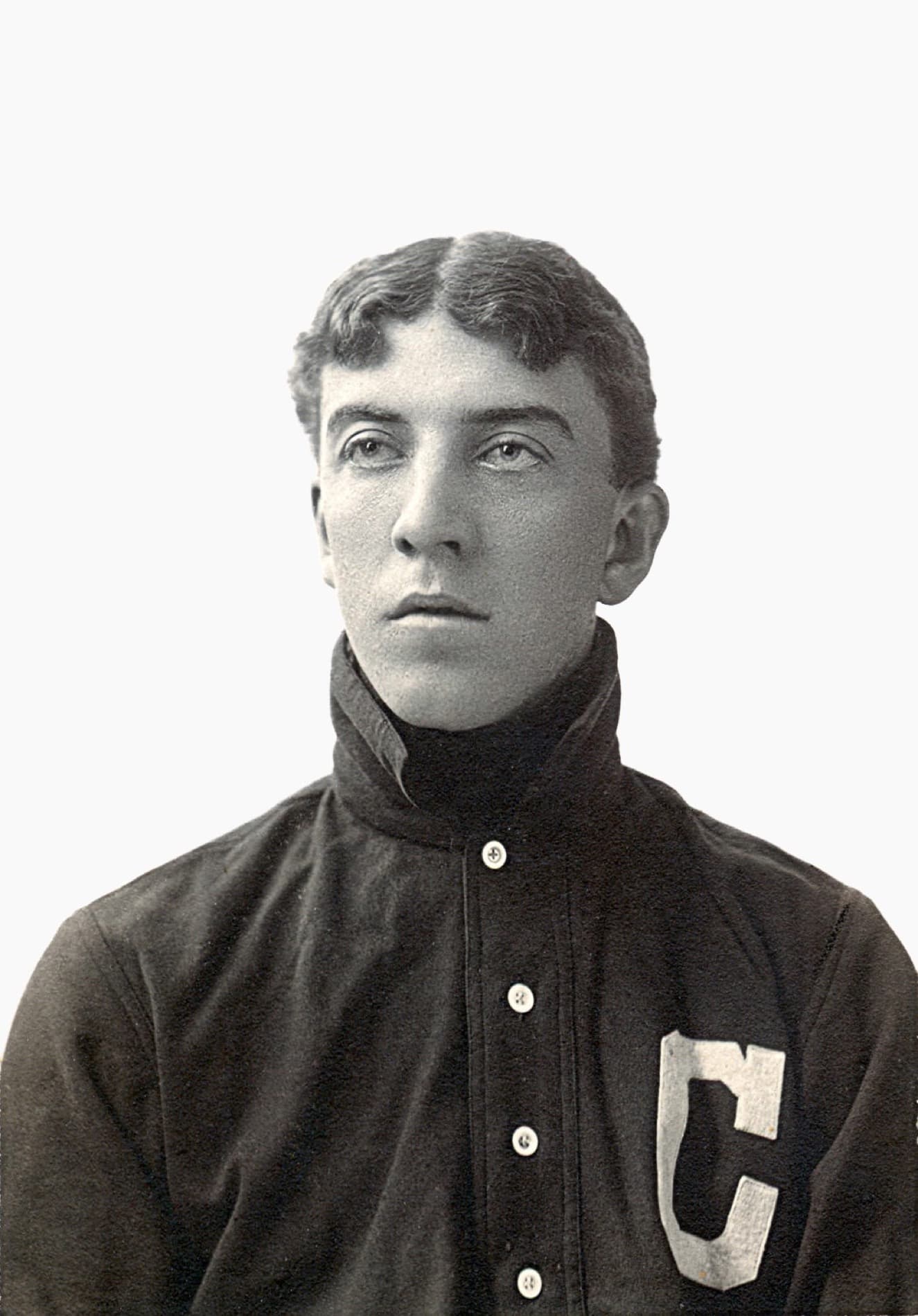
Addie Joss portrait, 1902.
Photo credit: Carl Horner via Wikimedia Commons (Public domain)
Adrian Joss pitched nine seasons for Cleveland, won 160 games, and compiled a 1.89 career ERA that remains second lowest in major league history behind only Ed Walsh. He threw two games without a hit (one a perfect game) and seven games allowing only one. He never posted a losing season. Then he collapsed during spring training in 1911, was diagnosed with tubercular meningitis, and died two days after his 31st birthday. The benefit game organized in his memory, featuring Walter Johnson, Ty Cobb, Eddie Collins, and Tris Speaker, became the first exhibition of its kind in baseball history. The Veterans Committee elected Joss to the Hall of Fame in 1978 after the Hall waived its ten-year playing requirement for the only time.
Woodland
Joss was born on April 12, 1880, in Woodland, Wisconsin. His father Jacob, a Swiss-born cheesemaker and local politician, died from liver complications of alcoholism when Addie was 10. The experience shaped his son permanently. Joss stayed sober his entire life. His mother Theresa opened a millinery shop and sewing school in Juneau, Wisconsin, to support the family. Joss attended Wayland Academy and St. Mary's College on a baseball scholarship and and later studied engineering at the University of Wisconsin during offseasons.
Joss pitched for the Toledo Mud Hens of the Inter-State League in 1900 and 1901, winning 25 games his second year and earning the nickname "the god of the Western League." Multiple major league clubs bid for his contract. Cleveland won the bidding at $500 and signed Joss in March 1902.
The Human Hairpin
Joss stood six-three and weighed 185 pounds, and his delivery was unlike anything batters saw before or after. He turned his back to the batter during his windup, hiding the ball behind his body in an exaggerated corkscrew motion, then whipped around and fired sidearm. Roger Peckinpaugh recalled that Joss "would turn his back toward the batter as he wound up, hiding the ball all the while, then whip around and fire it in." Bobby Wallace said, "One moment, you'd be squinting at a long, graceful windup and the next instant, out of nowhere, the ball was hopping across the plate, and a lot of us standing flat-footed with our bat glued to our shoulders."
Joss debuted on April 26, 1902, against the St. Louis Browns and came within one hit of a perfect game, allowing one scratch hit in a 3-0 victory. He led the American League with five shutouts as a rookie. Over the next seven seasons he won 20 or more games four times, led the league in ERA twice, and maintained a career WHIP of 0.968, the lowest in major league history. In 1908 his ERA was 1.16 and he walked only 30 batters in 325 innings.
The perfect game came on October 2, 1908, with Cleveland fighting Detroit and Chicago for the pennant. Joss faced Walsh, who struck out 15 Cleveland batters and allowed only four hits. The only run scored in the third inning on a wild pitch. Joss threw 74 pitches, the fewest known in a perfect game, and retired all 27 batters. A reporter described the tension at League Park as "a mouse working his way along the grandstand floor would have sounded like a shovel scraping over concrete." Cleveland finished the season a half game behind Detroit, as close as Joss ever came to the World Series.
On April 20, 1910, Joss pitched his second game without a hit, also against the White Sox, becoming the first pitcher to hold the same team hitless twice. A torn ligament in his right elbow ended his season in July after only 13 appearances. He was 30 years old.
Toledo
Joss was also a journalist. After the 1906 season the Toledo News-Bee hired him as a sports columnist and Sunday editor, and he covered the World Series for the News-Bee and the Cleveland Press from 1907 through 1909. An editor at the Press called him "a scholarly man, an entertaining writer, an impartial observer." The journalism gave Joss bargaining power, and he secured a $4,000 salary from Cleveland in 1907, well above the league average of $2,500.
On April 3, 1911, Joss collapsed during an exhibition game in Chattanooga while talking to his friend Rudy Hulswitt, the Chattanooga shortstop. Doctors initially diagnosed pleurisy and predicted a one-month absence. Ten days later a lumbar puncture revealed tubercular meningitis. Joss died on April 14, 1911, in his home on Fulton Street in Toledo, two days after his 31st birthday and two days after Cleveland's season opener.
The funeral on April 17 was the second largest in Toledo's history. Captain George Stovall declared, "No better man ever lived than Addie," and effectively led a team strike to force postponement of that day's game so the players could attend. Billy Sunday, the former ballplayer turned evangelist, delivered the eulogy. Nap Lajoie said, "In Joss's death, baseball loses one of the best pitchers and men that has ever been identified with the game."
On July 24, 1911, seven American League teams sent their best players to Cleveland for a benefit game to raise money for Joss's widow Lillian and their two children. Walter Johnson, Cy Young, Home Run Baker, Ty Cobb, Sam Crawford, Eddie Collins, and Tris Speaker all played. The all-stars won 5-3 before 15,270 fans and raised $12,914 for the family. Johnson said, "I'll do anything they want for Addie Joss' family."
Red Smith wrote in 1970, "Could you write a history of baseball without mentioning Joss? Nobody ever has. That ought to be the measure of a man's fitness for the Hall of Fame, the only measure." In 1977 the Hall's Board of Directors waived the ten-year playing career requirement, and the Veterans Committee elected Joss the following year. He remains the only Hall of Famer whose playing career lasted fewer than ten seasons.