Profile
Bobby Wallace
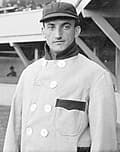
Bobby Wallace portrait.
Photo credit: Unknown author via Wikimedia Commons (Public domain)
Rhoderick John Wallace played 25 major league seasons, spent 15 of them as shortstop for the St. Louis Browns, and anchored a defense that was often the best part of otherwise mediocre teams. He began his career as a pitcher, moved to third base, and settled at shortstop, where his range, arm strength, and baseball intelligence made him the standard against which American League shortstops were measured during the Dead-Ball Era. Honus Wagner was better, but Wagner played in the National League. In the American League, Wallace had no peer. The Veterans Committee elected him to the Hall of Fame in 1953.
Pittsburgh to Cleveland
Wallace was born on November 4, 1873, in Pittsburgh, Pennsylvania. He grew up in a city that was already producing professional ballplayers and broke into the major leagues with the Cleveland Spiders in 1894 as a pitcher, going 2-1 in limited duty. He pitched over the next two seasons and played some outfield in 1896, showing enough versatility that the Spiders moved him to third base in 1897. The position change revealed a different player entirely. He hit .335 that year and displayed the range and throwing arm that would define his career for the next two decades.
He shifted to shortstop in 1899, the position where he would spend the bulk of his career, and the move coincided with one of the strangest episodes in baseball history. Spiders owners Frank and Stanley Robison purchased the St. Louis franchise before the 1899 season and transferred their best players there, including Wallace. The gutted Spiders went 20-134 that year, the worst record in major league history, and were disbanded after the season. Wallace played for St. Louis, first known as the Perfectos and then the Cardinals, from 1899 through 1901, hitting .324 in his final National League season.
The Browns
After the 1901 season, Wallace jumped to the St. Louis Browns of the fledgling American League, signing a five-year contract worth $32,500 that made him one of the highest-paid players in baseball. The contract reflected the leverage players held during the war between the two leagues, and the Cardinals sued to keep him. They lost the immediate case, though the broader dispute between the leagues contributed to the 1903 National Agreement that ended the conflict and established the two-league structure that would last for the rest of the century.
Wallace remained with the Browns for 15 seasons, playing shortstop on teams that rarely contended but always fielded respectably up the middle. His defensive reputation rested on positioning, anticipation, and a throwing arm that remained strong well into his thirties. He led American League shortstops in fielding percentage multiple times and was regarded by contemporaries as the finest defensive shortstop the junior circuit had produced. He played in an era when shortstops fielded on rock-hard dirt, wore small gloves, and absorbed bad hops with their bodies. Wallace's consistency across two decades reflected both physical durability and the kind of quiet competence that wins games without generating headlines.
His batting declined through his thirties, as it did for most players of his generation, but his glove kept him in the lineup long after his offensive numbers would have sent a lesser fielder to the bench. He finished with a .268 career batting average and 2,309 hits across 2,383 games, numbers that reflected longevity and reliability rather than peak dominance at the plate.
Managing, Umpiring, and the Long Goodbye
Wallace managed the Browns for the full 1911 season and part of 1912, compiling a 57-134 record with rosters that gave him little to work with. The experience confirmed what many great players have discovered: the skills that make a man an outstanding shortstop do not automatically transfer to the dugout. He returned to playing after giving up the managerial role and continued as a utility infielder.
In 1915, he umpired 111 American League games, one of the few major leaguers to move behind the plate after spending an entire career in front of it. The experiment lasted one season. He returned to the Browns as a coach and substitute player in 1916, then played his final major league games with the St. Louis Cardinals in 1917 and 1918, finishing at the age of 44.
Wallace remained in baseball long after his playing days. He scouted for the Cincinnati Reds for more than three decades and managed the Reds for 25 games in September 1937, a brief return to the dugout that ended without distinction. He died on November 3, 1960, one day before his 87th birthday, in Torrance, California.