Profile
Tom Seaver
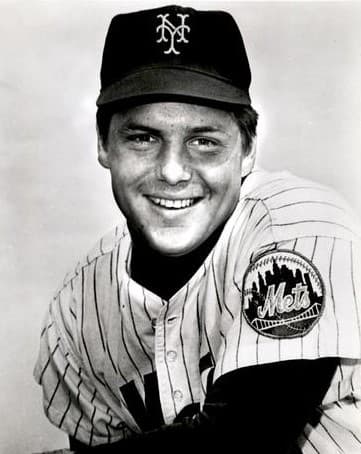
Tom Seaver with the New York Mets, circa 1971.
Photo credit: New York Mets via Wikimedia Commons (Public domain)
George Thomas Seaver arrived in New York in 1967 and gave the Mets something they had never had in their five years of existence, a reason to believe they might someday win. Before Seaver, the Mets were baseball's lovable losers, the expansion franchise that lost 120 games in its first season and treated competence as an aspiration. Seaver made competence look like an insult. He wanted dominance, and for the better part of two decades, he got it.
The Franchise Arrives
Seaver grew up in Fresno, California, and pitched at the University of Southern California. The Atlanta Braves originally drafted him in 1966, but a technicality voided the selection, and a special lottery sent him to the Mets. He won 16 games as a rookie in 1967, finished with a 2.76 ERA, and won Rookie of the Year. It was the first time a Met had won a major award, and it signaled something new.
In 1969, Seaver went 25-7 with a 2.21 ERA and won the first of his three Cy Young Awards. His performance anchored the "Miracle Mets," who rose from ninth place in 1968 to win the World Series in 1969, beating the heavily favored Baltimore Orioles in five games. The '69 Mets remain one of the most improbable champions in baseball history, and Seaver was the reason the miracle was possible. Without a legitimate ace, the story would have stayed a fairy tale instead of becoming real.
The Drop and Drive
Seaver's pitching mechanics were studied and imitated for decades. He drove off the mound with such force that his right knee scraped the dirt on every delivery, leaving a permanent grass stain and a dirty uniform. The mechanics generated exceptional velocity and movement from a compact frame. He threw a fastball, slider, and changeup, and he located all three with precision that bordered on surgical.
He struck out 200 or more batters in nine consecutive seasons from 1968 through 1976, and ten seasons overall. On April 22, 1970, he struck out 19 San Diego Padres, including the last 10 in a row, a record that stood for decades. He threw 61 career shutouts. His career ERA of 2.86 came in an era when run scoring was higher than the years that preceded it, making the number even more impressive in context.
The Midnight Massacre and After
The Mets traded Seaver to the Cincinnati Reds on June 15, 1977, in a deal that became known as the "Midnight Massacre." The trade resulted from a contract dispute between Seaver and Mets chairman M. Donald Grant, who publicly questioned Seaver's loyalty and desire. New York sportswriters sided almost unanimously with Seaver. The trade gutted the franchise for years.
Seaver pitched well in Cincinnati, winning 75 games over six seasons. He returned to the Mets briefly in 1983, then moved to the Chicago White Sox, where he won his 300th game on August 4, 1985, at Yankee Stadium, beating the Yankees 4-1. He finished his career with 311 wins, 3,640 strikeouts, and a winning percentage of .603.
The Record Vote
In 1992, Seaver was elected to the Hall of Fame with 98.84% of the vote, the highest percentage any player had received at that time. Only five of the 430 ballots left him off. The near-unanimous support reflected a career that combined excellence with consistency and competitiveness with professionalism. He was inducted as a Met.
Seaver was diagnosed with dementia and Lyme disease in 2019 and withdrew from public life. He died on August 31, 2020, at his home in Calistoga, California, at age 75. The Mets renamed their home address 41 Seaver Way, after his uniform number, and the street sign outside Citi Field became a quiet landmark for fans who remembered what Seaver had meant to a franchise that had nothing before he arrived.