Mariano Rivera and One Pitch
Mariano Rivera built a Hall of Fame career on a cutter everyone knew was coming, then proved in October that predictability and dominance can live in the same inning.
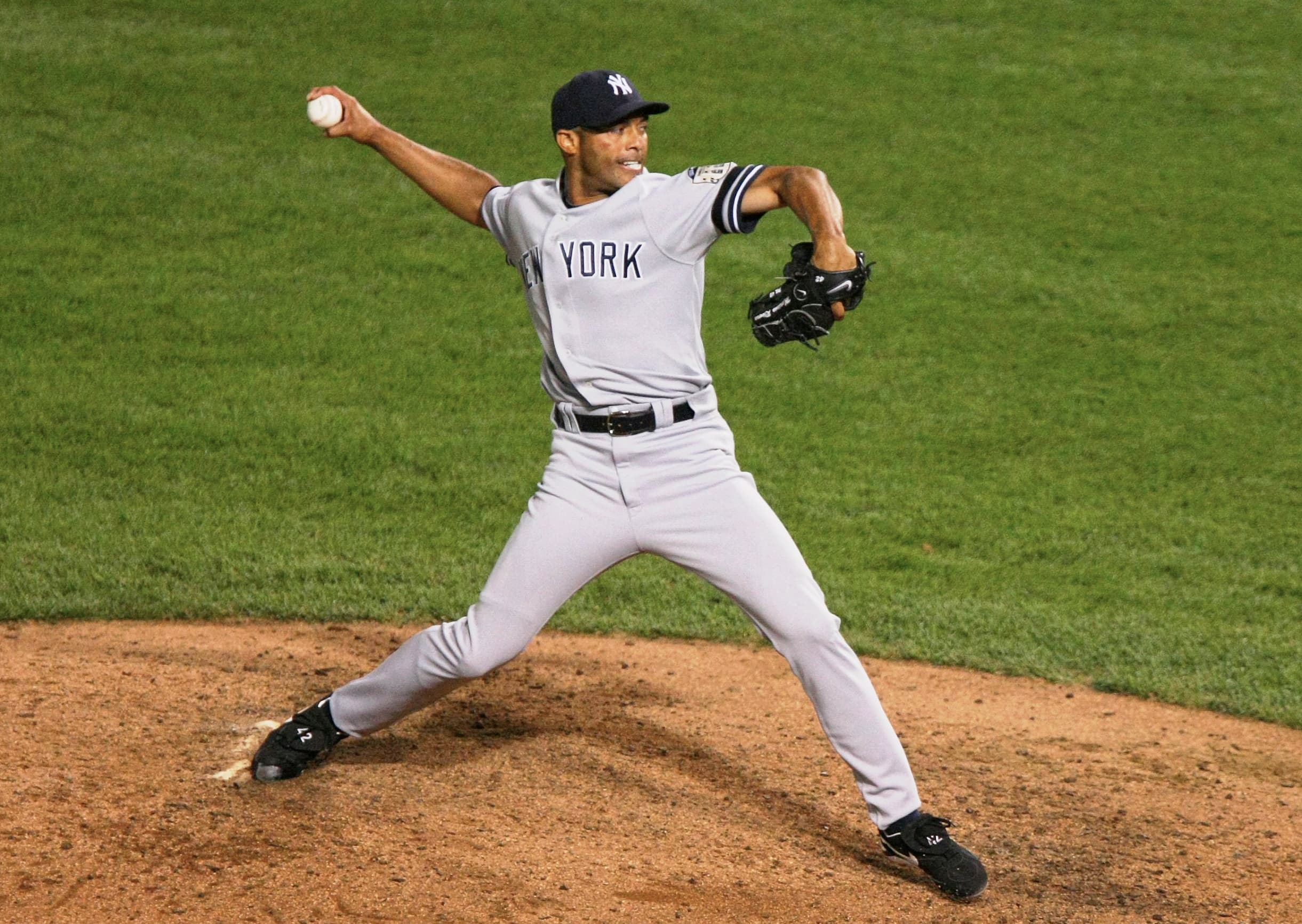
Mariano Rivera pitching for the Yankees in Baltimore, 2008.
Photo credit: Keith Allison via Wikimedia Commons (CC BY-SA 2.0)
Mariano Rivera threw one pitch for 19 seasons and retired as the most effective reliever in baseball history. The cutter came in late, moved hard to the hands of left-handed hitters, and broke bats so frequently that lumber companies could have tracked his starts.
Everyone in the ballpark knew what was coming. It did not help.
From Panama to the Bronx
Rivera was born on November 29, 1969, in Panama City, Panama, and grew up in the fishing village of Puerto Caimito, where his father worked long days as a captain on a fishing boat. Rivera played soccer competitively as a child and came to baseball without career aspirations, improvising with baseballs wound from fish nets and electrical tape.
He signed with the Yankees as an amateur free agent in 1990 and reached the major leagues in 1995. His early career was unremarkable. He started games, posted a high ERA, and did not yet throw the pitch that would define him.
The cutter emerged during the 1997 season. Rivera has described it as something that arrived rather than something he engineered. The ball began cutting sharply to his glove side, and once it did, the rest of his career followed.
The Record Book
Baseball-Reference credits Rivera with 652 career saves, a 2.21 ERA, and a 1.00 WHIP across 1,115 appearances, all with the New York Yankees. He struck out 1,173 batters. When he retired after the 2013 season, his ERA and WHIP were the lowest in the live-ball era among qualified pitchers.
In October the numbers became harder to believe. Rivera recorded 42 postseason saves with a 0.70 ERA, both records. In the World Series alone, he posted a 0.99 ERA and 11 saves. He won five championships with the Yankees in 1996, 1998, 1999, 2000, and 2009, and earned the 1999 World Series MVP award.
The Exception
The 2001 World Series provided the one visible crack. The Yankees won Game 6 to force a seventh game against Arizona. Rivera entered in the eighth inning to protect a 2-1 lead and struck out three. In the ninth, the sequence unraveled. Mark Grace singled. Rivera fielded a bunt and threw wildly to second base trying to get the lead runner. Tony Womack slapped a double to right that tied the game. Then Luis Gonzalez, facing the cutter, hit a broken-bat bloop single over the drawn-in infield to win the series for the Diamondbacks.
Rivera had converted his previous 23 consecutive postseason save opportunities. The failure sharpened the scale of everything he had done before and would do after.
Enter Sandman
Beginning around 1999, Yankee Stadium played Metallica's "Enter Sandman" when Rivera jogged in from the bullpen. The entrance became one of baseball's most recognizable rituals. By the time he reached the mound, most games felt decided.
Rivera did not need deception to create that feeling. He needed command at an elite level, repeatable mechanics, and complete trust in one pitch. The lesson for the sport was direct. Unpredictability is one path to dominance. It is not the only one.
The Last Season and the Vote
Rivera announced before the 2013 season that it would be his last. He saved 44 games that year with a 2.11 ERA at age 43. On September 22, the Yankees held "Mariano Rivera Day" at Yankee Stadium. His plaque and number were added to Monument Park in a ceremony that lasted 50 minutes. He was the first active player to receive those honors. Metallica performed "Enter Sandman" live. Number 42, Jackie Robinson's universally retired number, was formally retired by the Yankees for the final time.
In his last home appearance four days later, Derek Jeter and Andy Pettitte walked to the mound to take the ball. Rivera broke down in tears on Pettitte's shoulder.
Rivera entered the Hall of Fame in 2019. He received all 425 ballots in the BBWAA vote, the first unanimous selection in that body's history. For decades, Hall voters had treated unanimity as an impossible standard. Rivera made it feel obvious.