Profile
Albert Belle
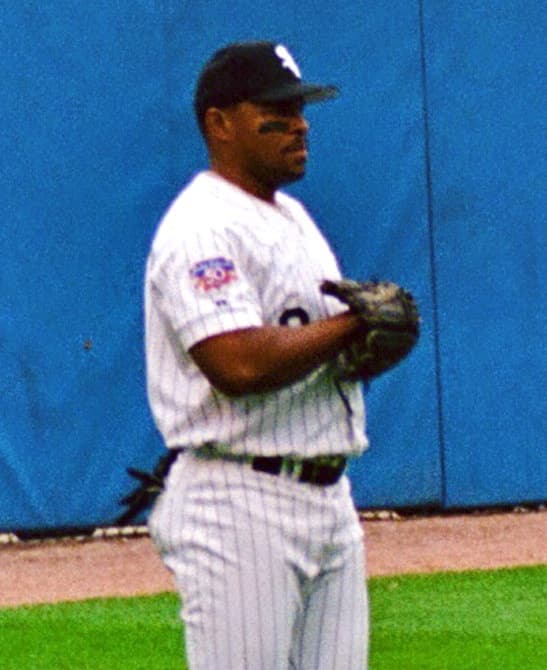
Albert Belle in 1997.
Photo credit: Unknown photographer via Wikimedia Commons
Albert Belle was the most feared right-handed hitter in baseball for the better part of a decade and one of the angriest, a slugger whose bat terrified pitchers and whose temper alienated nearly everyone else. He became the only player in history to hit 50 home runs and 50 doubles in a single season, drove in a hundred runs eight years running, and put up a peak that looked like a Hall of Fame career until a degenerative hip ended it at 34. The personality and the brevity kept him out of Cooperstown, and the dominance is undeniable all the same.
Joey
Belle was born on August 25, 1966, in Shreveport, Louisiana, the son of a math teacher and a coach, and he went by his middle-name nickname Joey early in his career before switching to Albert around 1990. He reached the Cleveland Indians in 1989 and grew into the centerpiece of a powerhouse lineup, a hitter of rare strength and an intensity that curdled into something darker over the years. He played the game with a glower, treated the media as an enemy, and built a reputation for volatility that followed him from city to city. The talent was never in question, only the temperament.
Fifty and Fifty
The season that defines Belle came in 1995, and it stands alone in history. In a year shortened to 144 games by the previous summer's strike, he hit 50 home runs and 52 doubles, the only player ever to reach 50 of each in a single season, a feat of power that no one before or since has matched. He led the American League in runs, home runs, runs batted in, slugging, and total bases, the most productive hitter in the game by a wide margin. The writers gave the Most Valuable Player award to Mo Vaughn instead, by a margin of a few points, a result that many later admitted was shaped by Belle's reputation as much as by the numbers.
The Incidents
Belle's career was punctuated by confrontations that became as famous as his home runs. He was suspended for using a corked bat in 1994, in an episode so brazen that a teammate crawled through the clubhouse ceiling to swap the doctored bat for a clean one before it could be inspected. He chased a group of teenagers in his car after they egged his house one Halloween, drawing a conviction for reckless operation, unleashed a profane tirade at a television reporter during the 1995 World Series, and was known to smash clubhouse thermostats and fixtures when the mood took him. He was, by every account, a difficult and intimidating man, and he made little effort to be otherwise.
The Production
Belle hit 381 home runs and drove in a hundred runs in eight consecutive seasons, leading the league in runs batted in three times, and he hit 30 home runs with 100 runs batted in every year from 1992 through 1999, a run of sustained slugging that only Ruth, Foxx, and Gehrig had managed before him. He made five All-Star teams and won five Silver Sluggers, a hitter who never had an off year in his prime, the dependable engine of contending lineups. For most of the 1990s he was the bat opposing managers least wanted to face.
The Money
Belle's dominance made him the highest-paid player in the game. After the 1996 season he signed with the Chicago White Sox for 55 million dollars over five years, the first player to average 10 million dollars a year, a deal that reset the market for sluggers. Two years later he jumped to the Baltimore Orioles for an even larger contract, cashing in on a decade of production that had made him one of the most valuable hitters alive. The contracts were the market's verdict on the talent, an acknowledgment that for all the trouble he brought, the bat was worth almost any price.
The Sudden End
Belle developed a degenerative arthritis in his right hip, and before the 2001 season the Orioles announced he could no longer play, his career over at 34 with the bat still dangerous and the milestones still in reach. He had hit a home run in his final game the previous October, giving no sign that the end was so close, and then the hip simply gave out. The abrupt finish froze his record at a point that, for another player, might have been a midpoint, the Hall of Fame trajectory cut off before it could complete itself.
The Argument
Belle's case for Cooperstown is the sharpest test of how much a peak can outweigh everything around it. He fell off the writers' ballot quickly, peaking below eight percent, the short career and the combative reputation working against a decade of production that, year for year, matched almost anyone's. His defenders point to the dominance, the fifty-fifty season and the eight straight hundred-RBI years and the contracts that proved his worth, and his detractors point to the brevity and the personality that made him so hard to root for. The argument has never resolved, which is fitting for a player who spent his career refusing to make anything easy.