Profile
Billy Hamilton
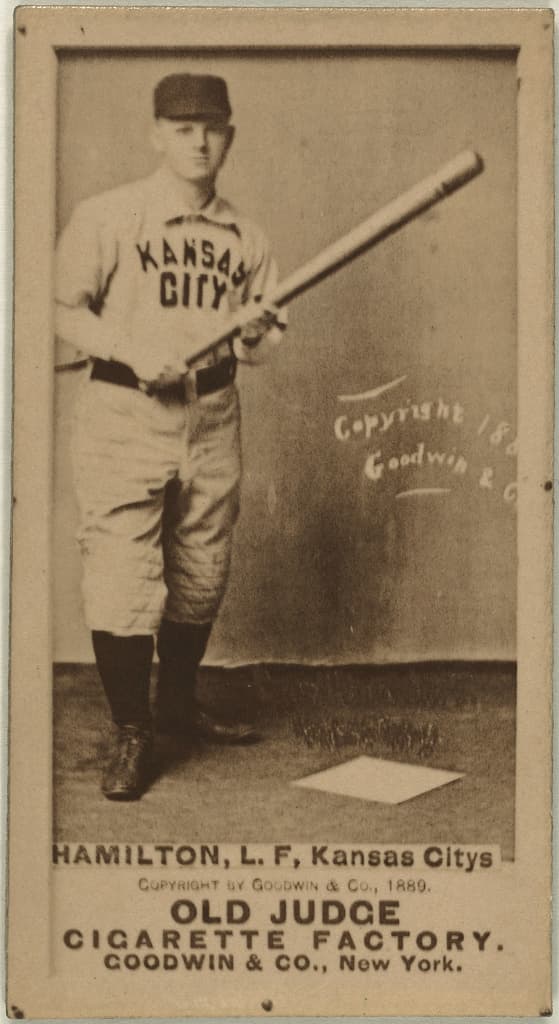
Billy Hamilton baseball card portrait.
Photo credit: Unknown author via Wikimedia Commons (Public domain)
William Robert Hamilton scored 196 runs in the 1894 season, a record that has stood for more than 130 years and that no player in the modern game has come within 20 runs of matching. He stole 914 bases, hit .344 over 14 major league seasons, and crossed home plate more often than anyone else in baseball during the 1890s. He was small, fast, and relentless on the basepaths, a player built for the high-scoring, high-chaos style of baseball that defined the nineteenth century. The Veterans Committee elected him to the Hall of Fame in 1961.
Newark
Hamilton was born on February 16, 1866, in Newark, New Jersey. He played semipro ball in the region through his teens and signed with the Kansas City Cowboys of the American Association in 1888. He hit .264 in 35 games during his first professional season, an unremarkable debut that gave little indication of what followed. In 1889, he hit .301 and stole 111 bases, a total inflated by the era's liberal stolen base rules, which credited a steal for any extra base taken on a hit or an out. Even accounting for the different scoring conventions, Hamilton's speed was exceptional. He earned the nickname "Sliding Billy" for his headfirst slides, an aggressive technique that was less common in the 1880s than it would become in later decades.
Philadelphia
The Kansas City franchise left the American Association after the 1889 season, and Hamilton was sold to the Philadelphia Phillies. He became one of the most dangerous offensive players in the National League almost immediately, hitting .325 in 1890 and .340 in 1891 to win the batting title. He stole 111 bases in 1891 and led the league in walks and on-base percentage in multiple seasons, establishing a pattern of reaching base at rates that no contemporary could sustain.
The 1890s Phillies were one of the most powerful offensive teams of the decade, yet they never won a pennant. Hamilton, Ed Delahanty, and Sam Thompson formed an outfield that terrorized opposing pitchers, and the three of them combined for batting averages and run totals that staggered the imagination. Hamilton led the league in walks five times and in on-base percentage five times over his career, reaching base constantly and scoring from there with a frequency that bordered on automatic.
His peak season was 1894, when the entire National League batted over .300 and Hamilton stood above even that inflated standard. He hit .404 with 196 runs scored, the figure that remains the all-time single-season record. Different sources have counted the total as high as 198, depending on how protested games are tallied, but the figure recognized by the Hall of Fame and SABR research has never been approached. He stole 98 bases that year and reached base at a .523 clip. In 1895, he hit .389 with 166 runs scored and led the league in on-base percentage again, following one historic season with another that would have been the best in almost anyone else's career.
Boston
Hamilton was traded to the Boston Beaneaters before the 1896 season. He continued producing at an elite level, hitting .366 in 1896 and .343 in 1897 as the Beaneaters won consecutive National League pennants. The 1897 and 1898 Boston teams featured Hamilton alongside Hugh Duffy in the outfield, giving the club two of the era's finest hitters. Hamilton batted .369 in 1898 and remained an everyday player through 1901 before retiring at age 35.
He finished with a .344 career batting average, 2,164 hits, 914 stolen bases, and 1,697 runs scored in 1,594 games. He scored more runs than he played games across his full career, a ratio that speaks to how thoroughly he dominated the art of reaching base and getting home. His career on-base percentage of .455 ranks among the highest in baseball history, a testament to his selectivity at the plate and the fear that his speed instilled in opposing pitchers and catchers.
After Baseball
Hamilton settled in Worcester, Massachusetts, after retiring and worked as a production foreman at a leather manufacturing plant. He lived quietly and was largely forgotten by the baseball world during the decades after he stopped playing. He died on December 16, 1940, in Worcester, at age 74, more than two decades before the honor that would finally arrive. The Veterans Committee elected him to the Hall of Fame in 1961, recognizing a player whose numbers had been waiting for the historical attention they deserved since the turn of the century.