Profile
Bud Fowler
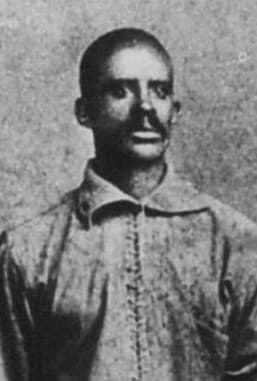
Bud Fowler portrait.
Photo credit: Unknown photographer via Wikimedia Commons
Bud Fowler was the first Black man known to play professional baseball, and he played it for more than 20 years against a country that did not want him on the field. He moved from town to town because prejudice would not let him stay, suiting up for white minor-league and semipro teams across two dozen states, the best player on many of them and welcome on none of them for long. When the color line finally shut him out, he built Black teams of his own and kept the game alive for those who came after. The Early Baseball Era Committee elected him to the Hall of Fame in 2022, more than a century after he died forgotten and poor.
The Boy From Cooperstown
He was born John W. Jackson on March 16, 1858, in Fort Plain, New York, the son of a barber who had escaped slavery, and the family moved while he was small to Cooperstown, the village that would one day house the Hall of Fame. He grew up there learning the game in the town now synonymous with it, an irony that would take 144 years to resolve. He took the name Fowler as a young man, for reasons no record explains, and by his late teens he was good enough to be paid to play, which made him a pioneer the moment he stepped onto a professional field.
The First
Fowler made history in 1878, in the years before the color line hardened into law, when a Black player could still find a roster that would take a chance on his talent. In April he pitched a picked nine to a 2-1 win over the defending National League champions from Boston, and a month later, on May 17, he took the mound for a club in Lynn, Massachusetts, the first documented appearance by a Black player in organized baseball. He is the first acknowledged African American professional in the history of the game, the man who reached the field decades before Jackie Robinson and found it closing against him. The breakthrough sparked no revolution, only a long, hard career.
A Career on the Move
For two decades Fowler played wherever a team would have him, a second baseman and pitcher whose skill kept earning him jobs and whose color kept costing him them. He suited up for clubs in New England, Canada, the Midwest, and the mountain West, and by his own account he played in 22 states and Canada, rarely lasting a full season anywhere before the prejudice of teammates or crowds pushed him along. He hit better than .300 over thousands of at-bats and set a record for longevity among Black players in white baseball that stood until Robinson's final season. The constant moving was the price of being great and Black at the same time.
The Wooden Guards
The hostility followed him onto the field, into the spikes of base-runners who came into second base looking to hurt him. Fowler was among the first players to protect his legs with wooden slats strapped below the knee, an improvised armor against opponents who tried to maim him on the bases. A teammate explained the precaution to a newspaper of the day, noting that Fowler "knew that about every player that came down to second base on a steal had it in for him and would, if possible, throw the spikes into him." The guards were a defense against more than the game, a small invention born of the danger he played through every afternoon.
The Color Line
The door that had cracked open in 1878 slammed shut in the late 1880s. As the unwritten color line hardened across organized baseball, white players refused to take the field with Black teammates, leagues barred new Black signings, and the era's biggest star, Cap Anson, led the campaign to drive them out. Fowler was released from team after team and finally pushed out of white baseball altogether. He understood exactly why. "My skin is against me," he said in 1895. "The race prejudice is so strong that my black skin barred me," a plain-spoken verdict on a game that had no place for him despite his obvious gifts.
The Builder
Shut out as a player, Fowler became an organizer, a pioneer of Black professional baseball in his second act. In 1894 he helped found the Page Fence Giants, a celebrated Black touring team that traveled the country in its own railroad car and beat white and Black clubs alike, and he organized or promoted several other Black teams in the years that followed. He had spent his career fighting to play in a white game, and when that game expelled him, he set about building one that would have him. The teams he helped create became part of the foundation that the Negro Leagues would rise from.
An Unmarked Grave
Fowler had nothing at the end. He fell ill and returned to Frankfort, New York, where he died on February 26, 1913, at 54, too poor for a proper burial, and was laid in an unmarked grave that stayed bare for 74 years. A baseball researchers' group finally placed a headstone in 1987, calling him a Black baseball pioneer, the first public marker of a career the game had forgotten. The Hall of Fame completed the long restoration in 2022, when the Early Baseball Era Committee elected him at last. The boy from Cooperstown had come home to the village where he learned the game.