Profile
Eppa Rixey
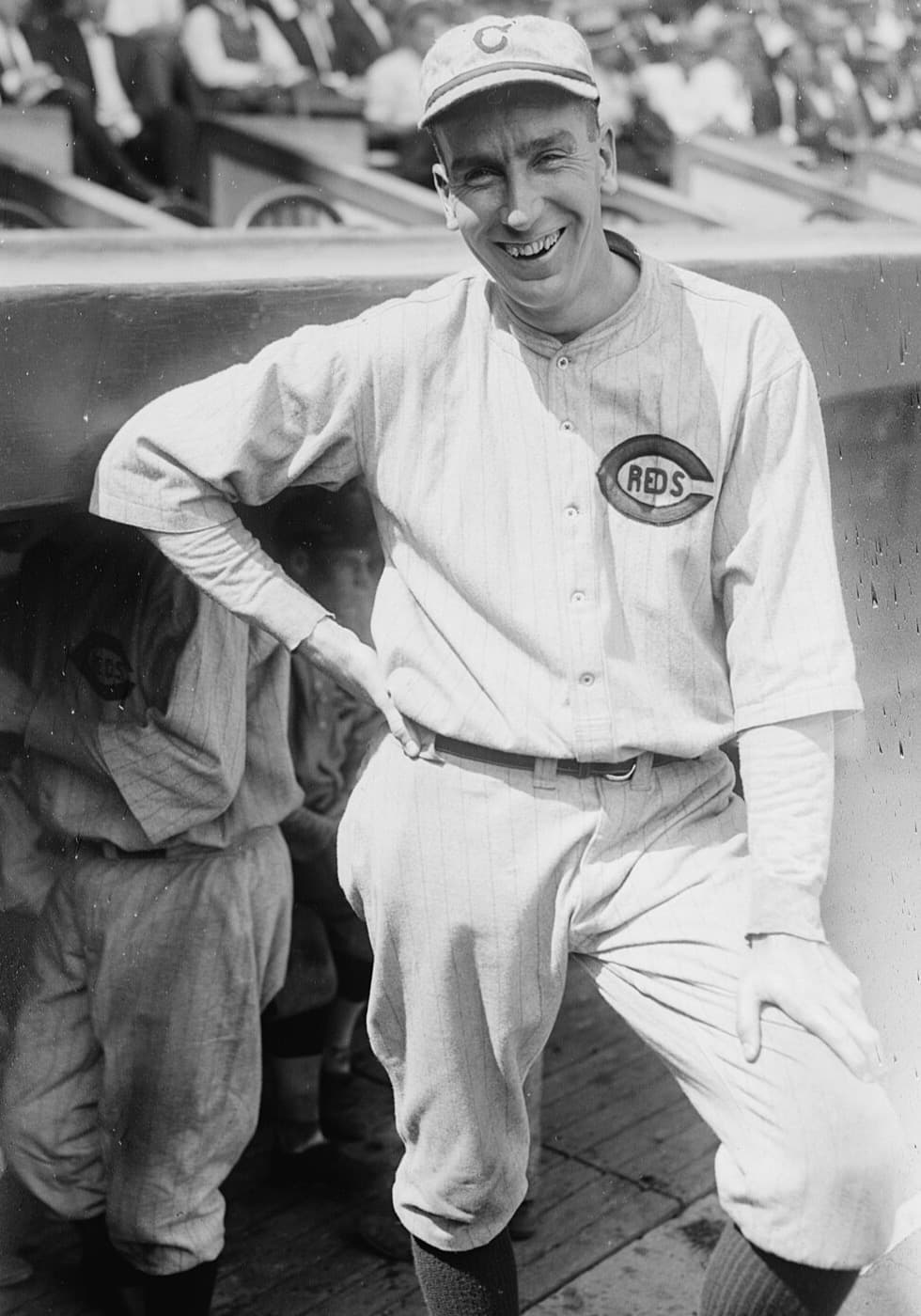
Eppa Rixey portrait (Cincinnati NL).
Photo credit: Bain News Service / Library of Congress via Wikimedia Commons (Public domain)
Eppa Rixey stood six feet five inches tall in an era when most pitchers barely cleared six feet, threw left-handed, and won 266 games over 21 seasons without ever pitching a day in the minor leagues. He held the National League record for career wins by a left-hander for 26 years until Warren Spahn surpassed him in 1959, and the Veterans Committee elected him to the Hall of Fame in January 1963, just weeks before he died. He reportedly quipped upon hearing the news, "They're really scraping the bottom of the barrel, aren't they?"
Culpeper
Eppa Rixey Jr. was born on May 3, 1891, in Culpeper, Virginia, into a family prominent enough that his father was one of the town's leading citizens. He attended the University of Virginia, where he studied chemistry and pitched for the baseball team. His college coach, who had connections to the Philadelphia Phillies, arranged a tryout, and the Phillies signed Rixey directly out of the university in 1912. He skipped the minors entirely and made his debut on June 21, 1912, at 21 years old, one of the last players of his generation to reach the majors without a minor league apprenticeship.
Philadelphia
Rixey pitched for the Phillies from 1912 through 1920, developing slowly into a reliable starter on a team that offered him little support. He went 10-10 in his debut season and improved steadily, reaching 22 wins in 1916 with a 1.85 ERA. That season represented the peak of his time in Philadelphia. The Phillies had won the National League pennant in 1915, with Rixey contributing 11 wins, and the team remained competitive for the next few years before declining sharply.
His delivery relied on control rather than overpowering stuff. He worked the corners with a sweeping curve and a changeup that kept hitters off balance, and he walked fewer batters per nine innings than most of his contemporaries. He was not flashy, and the sportswriters of the era paid him less attention than pitchers with higher strikeout totals, but managers and hitters understood what he was.
The Phillies traded Rixey to the Cincinnati Reds after the 1920 season, and the move revived his career.
Cincinnati
Rixey won 179 of his 266 career victories in a Reds uniform, pitching for Cincinnati from 1921 through 1933. He won 25 games in 1922, leading the National League, and 21 in 1925, and he remained a dependable mid-rotation starter well into his late thirties. His best seasons in Cincinnati coincided with a competitive Reds team that finished second in the National League in 1926, and Rixey's durability gave the franchise a consistency on the mound that few other pitchers of the era could match.
He retired after the 1933 season at age 42 with a career record of 266-251, a 3.15 ERA, and 290 complete games. The win total made him the winningest left-hander in National League history, a distinction he held from his retirement until Spahn broke the record with his 267th NL victory in late September 1959.
After Baseball
Rixey settled in Cincinnati after his playing career and worked in the insurance business for decades. He remained a visible figure in the city's baseball community, attending games and old-timers' events into the early 1960s. He died on February 28, 1963, in Terrace Park, Ohio, at 71. He had been elected to the Hall of Fame the previous month, making him the first player to die between election and induction. His plaque in Cooperstown honors a pitcher who won with intelligence and endurance rather than velocity, and whose record stood long enough to prove it was built on something durable.