Profile
Ernie Lombardi
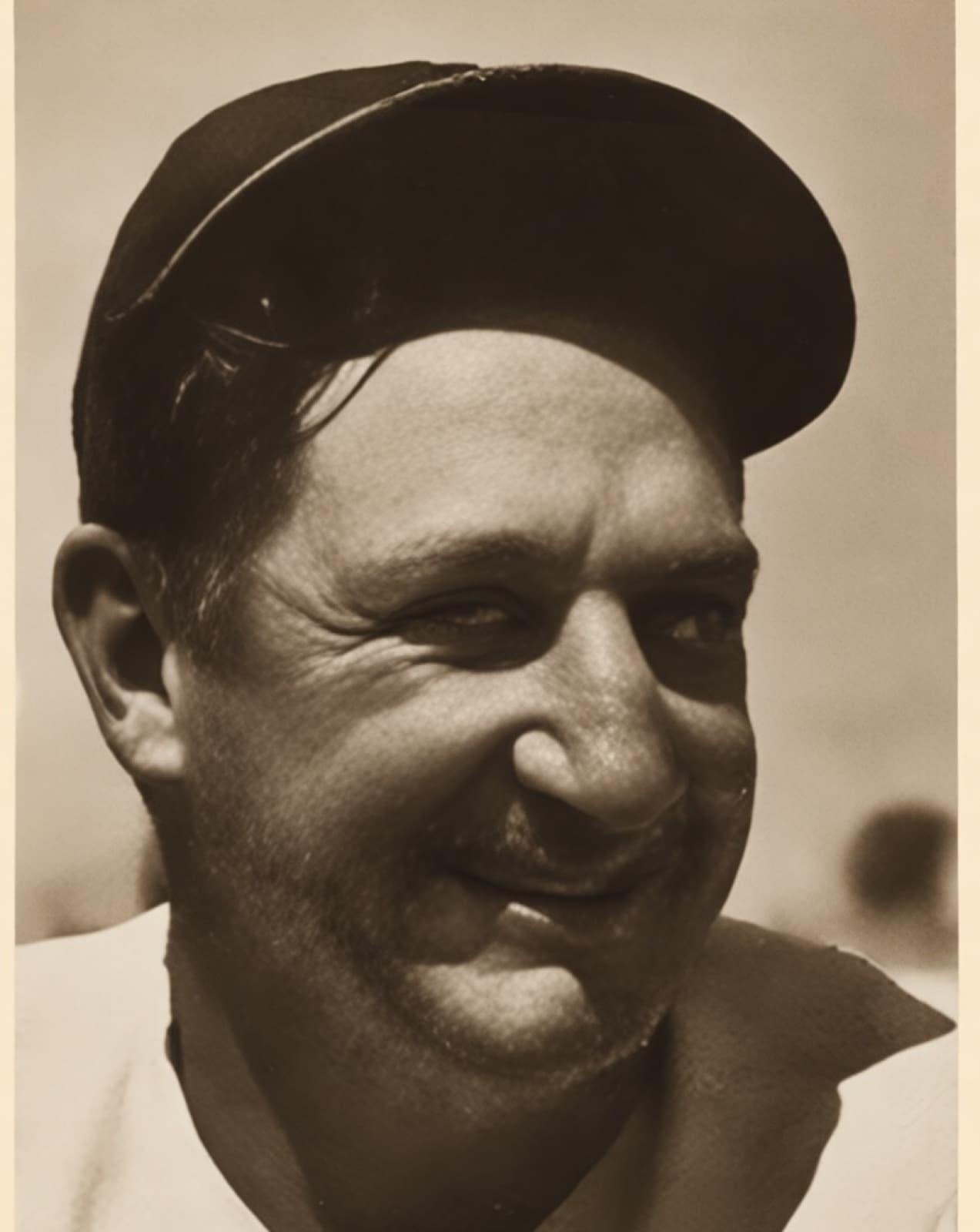
Ernie Lombardi portrait with the Reds.
Photo credit: Cincinnati Reds - 1940 Team Issue via Wikimedia Commons (Public domain)
Ernesto Natali Lombardi was six feet three, weighed 230 pounds (probably more by the end), swung a 42-ounce bat with an interlocking grip that looked like a man holding a golf club, and hit line drives so violently that opposing defenses moved all four infielders onto the outfield grass whenever he came to the plate. They had to, because Lombardi was the slowest runner the game ever produced, and the only way to get him out on a ball hit in the infield was to play deep enough to have time. "Next to Ernie, molasses is a blur," his teammates said. He ran, one observer noted, "like he was carrying a piano, and the tuner." None of it prevented him from batting .306 across 17 seasons, winning two National League batting titles as a catcher (the first catcher to win multiple), earning the 1938 NL MVP, and catching both of Johnny Vander Meer's consecutive no-hitters. Bill James called him "the slowest man to ever play major league baseball well." The Veterans Committee elected Lombardi posthumously to the Hall of Fame in 1986.
Oakland
Lombardi was born on April 6, 1908, in Oakland, California. His father Domenic had emigrated from Italy and owned a small grocery store. Lombardi attended McClymonds High School and could hold seven baseballs in one hand, a feat that illustrated the oversized hands and wrists that generated his power. He signed with the Brooklyn Robins after starring in the Pacific Coast League, debuted in 1931, and was traded to the Cincinnati Reds in March 1932, where he spent the next decade becoming one of the best hitting catchers in the history of the game.
Lombardi won his first batting title in 1938 with a .342 average, 19 home runs, and 95 RBI, and the BBWAA named him the National League's Most Valuable Player. That same season he caught both of Vander Meer's consecutive no-hitters on June 11 and June 15, hitting a home run during the first one. The Reds won the 1940 World Series over the Tigers, though Lombardi missed most of it after spraining his ankle in September. Lombardi won a second batting title in 1942 with the Boston Braves, hitting .330 in only 309 at bats, and he made eight All-Star teams across his career.
The Snooze
The play that defined Lombardi's reputation happened in Game 4 of the 1939 World Series on October 8 at Crosley Field. The Yankees led the Series three games to none, and the game was tied 4-4 in the top of the tenth when Joe DiMaggio singled and Charlie Keller barreled into Lombardi at home plate. Right fielder Ival Goodman fumbled the ball, relayed it to Frank McCormick, and McCormick threw home, where Keller's knee caught Lombardi in the groin as they collided. Lombardi lay on the ground, the ball a few feet away, and DiMaggio, seeing the catcher incapacitated, raced around the bases and scored. The Yankees won 7-4 to complete the sweep.
The press called it "Lombardi's Big Snooze," as though the catcher had fallen asleep, and the name stuck. Vander Meer, Lombardi's teammate, said the collision caught Lombardi in the cup and "paralyzed" him, and DiMaggio confirmed that Keller's collision "put Ernie out of commission." Bill James called the media criticism "absurd" because the Yankees already led three games to none and the extra run was meaningless. But the framing followed Lombardi for the rest of his life and became the primary obstacle to his Hall of Fame candidacy.
Oakland Again
Lombardi spent his final major league seasons with the New York Giants from 1943 through 1947, hitting .307 in his last full year, and finished his career with the Oakland Oaks in the Pacific Coast League in 1948. The years after baseball were brutal. Lombardi could not find stable work and drifted between jobs, including a stint pumping gas in Oakland and a public relations role at Candlestick Park. He grew reclusive, bitter about the "Snooze" label and about being passed over for the Hall of Fame. In April 1953 he slit his throat with a razor, fought the emergency personnel who tried to save him, and survived.
Lombardi married Bernice Ayers in 1944, and they had no children. Bernice died in 1973. Lombardi died on September 26, 1977, in Santa Cruz, California, at 69, after a long illness. He was buried at Mountain View Cemetery in Oakland. The Veterans Committee elected him in 1986, nine years after his death, after fellow catcher Birdie Tebbetts lobbied his colleagues for years on Lombardi's behalf. A bronze statue was dedicated outside Great American Ball Park in Cincinnati in 2004. Lombardi once said he would never attend a Hall of Fame induction even if elected. He never had to find out.