Profile
Frank Grant
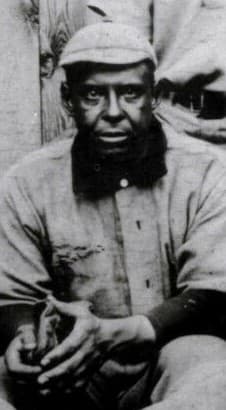
Frank Grant portrait, 1902.
Photo credit: Unknown photographer via Wikimedia Commons (Public domain)
Ulysses Franklin Grant played second base for the Buffalo Bisons of the International League in the 1880s, batted .353 in 1887 with 11 home runs and 40 stolen bases, hit for the cycle, stole home twice in a single game, and endured racial abuse so violent that opposing players filed their spikes to cut him at the bag. He and Bud Fowler invented wooden shin guards to protect their legs, the first known use of shin guards in baseball, and when the guards split under sharpened cleats, his manager moved him to the outfield. Sol White called him "the baseball marvel" whose "playing was a revelation." A Buffalo correspondent wrote that Grant "is the best all-around player Buffalo ever had." The International League banned the signing of black players in 1887, the year Grant led them in home runs, and by 1891 the color line forced him permanently into black baseball. He died a pauper at Bellevue Hospital in 1937, his funeral attended by Smokey Joe Williams and Sol White, and his grave sat unmarked for 74 years. The Special Committee on Negro Leagues elected him to the Hall of Fame in 2006.
Pittsfield
Grant was born on August 1, 1865, in Pittsfield, Massachusetts. His father Franklin worked as a farm laborer. His mother Frances Hoose raised at least eight children. Grant and his brother Clarence played on a youth team called the Rough and Readys in the Williamstown area. Bliss Perry, a future editor of The Atlantic who played alongside them, later wrote, "Two of the players, Clarence and Frank Grant, were colored boys, sons of our 'hired girl.'"
Grant began his professional career in 1884 with the Graylocks, a team from the Pittsfield and Williamstown area, pitching at 18. In 1885 he played catcher without a mask on the Adirondack vacation circuit for a Plattsburgh club, winning $100 at the Franklin County Fair tournament when his team won 24-1. The St. Louis Globe-Democrat disguised his race by calling him "a Spaniard."
Buffalo
Grant joined the Meriden club of the Eastern League in 1886, batting .316 in 44 games and hitting the longest home run on the grounds. He moved to the Buffalo Bisons of the International League at midseason and batted .344, the third highest average in the league.
In 1887, Grant batted .353 with 27 doubles, 10 triples, 11 home runs (leading the league), and 40 stolen bases across 105 games. He hit for the cycle on May 30 and stole home twice in one game. On September 7, he recorded 10 assists at second base in nine innings. Sportswriters called him "The Black Dunlap" after white star Fred Dunlap. A New York newspaper noted his style off the field, describing him in a blue corduroy coat, striped trousers, yellow gloves, patent leather shoes, a slate fedora, and a cane topped with gold.
The same summer, white players targeted him. Opposing runners slid into second base with sharpened spikes aimed at his legs. Ned Williamson, a major league player, described the campaign in Sporting Life, writing, "They made a cabal against this man. The players of the opposing teams made it their special business in life to 'spike' this brunette Buffalo. The poor man played in two games out of five perhaps, the rest of the time he was on crutches."
Grant and Bud Fowler built wooden shin guards to protect themselves, the first known use of the equipment in baseball history. Opponents responded by filing their spikes to split the guards. His manager eventually moved him to the outfield to remove him from the direct path of base runners. In Toronto, on July 27, 1887, fans broke out in a chorus of "Kill the Nigger." Several Buffalo teammates refused to sit for a team portrait if Grant was included. In 1888, the team took no portrait at all.
On July 14, 1887, the International League formally voted to ban the signing of black players. The league secretary was directed to "approve of no more contracts with colored men." The same day, Cap Anson's Chicago White Stockings refused to take the field against Newark if its black players appeared. Grant and a handful of other black players under contract were allowed to finish the season, but the door was closing. By 1891, Grant was forced out of organized baseball entirely.
The Cuban Giants
Grant joined the Cuban Giants in 1889, batting .313 in the Middle States League, and became team captain. His brother Clarence joined him. In 1891, he played for Sol White's Big Gorhams in the Connecticut State League on a team that won 39 consecutive games, a squad White called "one of the strongest teams ever gotten together, white or black."
Grant played for the Cuban X-Giants from 1898 through 1899 and the Philadelphia Giants from 1902 through 1903, competing in the first significant black baseball playoff when the Giants lost 5-2 to the Cuban X-Giants in 1903. His final documented season came in 1907 with the Brooklyn Royal Giants. Across his career in organized baseball, Grant batted .337 with a .489 slugging average in 458 games. Sol White wrote that Grant was "a born ballplayer" whose "fielding bordered on the impossible."
Bellevue
After 1907, Grant lived in Manhattan's Greenwich Village, working as a waiter for a catering service, a porter at a woolen house, and at various laboring jobs. The 1910 Census still listed his occupation as "baseball player." He died on May 27, 1937, at 71, at Bellevue Hospital in Manhattan, of arteriosclerosis. His pallbearers included Smokey Joe Williams and Sol White.
Grant was buried in an unmarked grave at East Ridgelawn Cemetery in Clifton, New Jersey. The grave remained unmarked for 74 years until a tombstone was placed in June 2011. The Baseball Hall of Fame website lists his primary position as "Executive," but Grant never served as a baseball executive. He was a second baseman who batted .353 in the International League and was forced out by the color line. The Harrisburg Morning Patriot wrote of him in 1890, "The most famous colored ballplayer in the business. When he appeared on the field, a great shout went up from the immense crowd to receive him, in recognition of which he politely raised his cap."