Profile
Fred McGriff
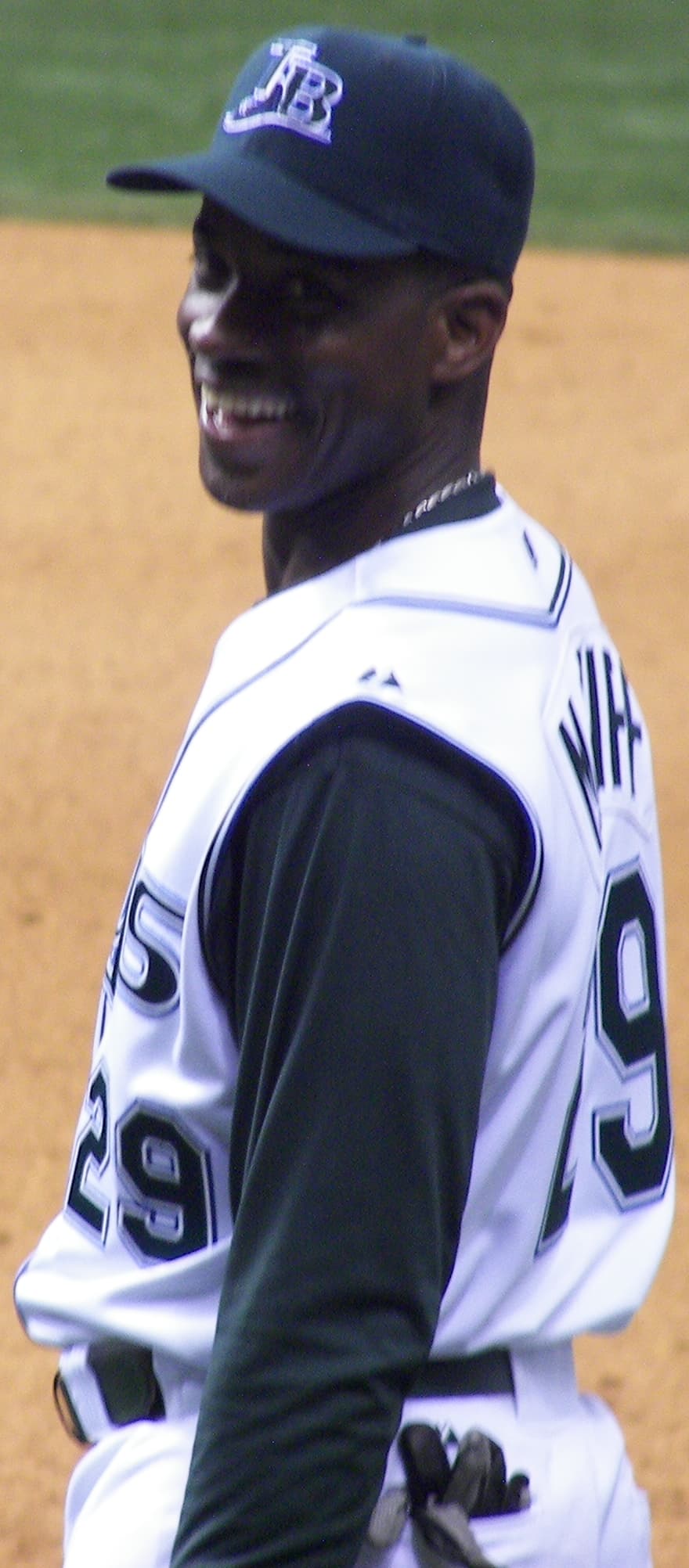
Fred McGriff portrait.
Photo credit: Unknown photographer via Wikimedia Commons
Fred McGriff hit 493 home runs without ever seeming to strain, a smooth left-handed slugger who put up the same numbers year after year for whoever happened to employ him. They called him the Crime Dog, and he was the steadiest power hitter of his era, the kind who led both leagues in home runs, won a World Series, and never once invited a whisper of suspicion in the dirtiest age the game has known. He finished seven home runs short of the round number that would have made him an obvious choice, and the wait that followed lasted years. The Contemporary Baseball Era Committee elected him unanimously to the Hall of Fame in 2023.
The Crime Dog
McGriff was born on October 31, 1963, in Tampa, Florida, a few blocks from a ballpark, and he grew up with the level left-handed swing that would carry him for two decades. The broadcaster Chris Berman gave him the nickname that stuck, the Crime Dog, after the cartoon mascot McGruff, and it fit the quiet, unhurried way he went about hitting home runs. He started as property of the Yankees, who traded him to Toronto before he ever reached the majors, and he broke through with the Blue Jays in the late 1980s as one of the best young sluggers in the game. The swing was the same then as it would be at the end, smooth and repeatable and built to last.
A Slugger for Hire
McGriff spent his career on the move, hitting home runs in every uniform he wore. He played for six teams over 19 years, the Blue Jays and the Padres and the Braves and the Devil Rays and the Cubs and the Dodgers, and the production never changed no matter the city. He led the American League in home runs with Toronto in 1989 and the National League with San Diego in 1992, one of the few players ever to lead both leagues, and he became the first to hit 30 home runs for five different franchises. He drove in a hundred runs eight times and made five All-Star teams, the rare star who was a bargain everywhere because everyone knew exactly what they were getting.
The Trade That Lit Atlanta
The most important stop was Atlanta. The Braves traded for McGriff in the middle of 1993, and his arrival lit a fire under a team that had been chasing the Giants, sparking a furious finish that won the division on the final day. He gave the Atlanta dynasty the middle-of-the-order bat it had lacked, and two years later he helped finish the job, winning the 1995 World Series over Cleveland with two home runs in the Series. He had joined the best teams of the decade at the right moment and supplied exactly what they needed, the steady slugger in a lineup built on pitching.
The Clean One
McGriff played through the steroid era and came out of it without a mark, and the contrast became central to who he was. While sluggers around him added muscle and home runs at suspicious rates, his numbers stayed consistent and believable, the same 30-odd home runs a year he had always hit, and no investigation or accusation ever touched him. The 493 home runs looked modest next to the inflated totals of his contemporaries, but they were earned the clean way, and time turned that into a point in his favor. He had been overshadowed in his prime by men who cheated, and he outlasted the suspicion that buried some of them.
Seven Short
The number that defined McGriff's candidacy was the one he did not reach. He finished with 493 home runs, seven shy of the 500 that has long been a near-automatic ticket to Cooperstown, and the case for him often turned on what cost him those seven. The 1994 players' strike wiped out the end of a season in which he was hitting .318 with 34 home runs, the prime of his career interrupted at exactly the wrong moment, and a full season at that pace would have carried him past 500 with room to spare. He had been on pace for the milestone and the work stoppage took it away, a slugger denied his round number by labor strife.
The Steady Hand
What McGriff offered was reliability, the trait that rarely makes a player famous and never makes him flashy. He hit in the heart of the order for a generation, durable and productive and unspectacular, the same dangerous bat in April and September and across every team that acquired him. He finished with a .284 average, 1,550 runs batted in, and 2,490 hits to go with the 493 home runs, the accumulation of a man who simply kept producing. The consistency was its own kind of greatness, easy to take for granted while it happened and clearer in hindsight, once the full record was laid out.
Unanimous at Last
The writers never warmed to McGriff, and he spent his full 10 years on the ballot peaking below 40 percent, the round-number shortfall and the quiet career working against him. A veterans committee saw it differently, electing him in December 2022 with all 16 votes, a unanimous verdict that the writers had never come close to delivering. He chose to enter the Hall with no logo on his cap, declining to pick one of the six teams he had played for, a fitting choice for a slugger who had belonged a little to all of them. The Crime Dog went in alongside Scott Rolen, his clean 493 home runs finally enough.