Profile
Gary Carter
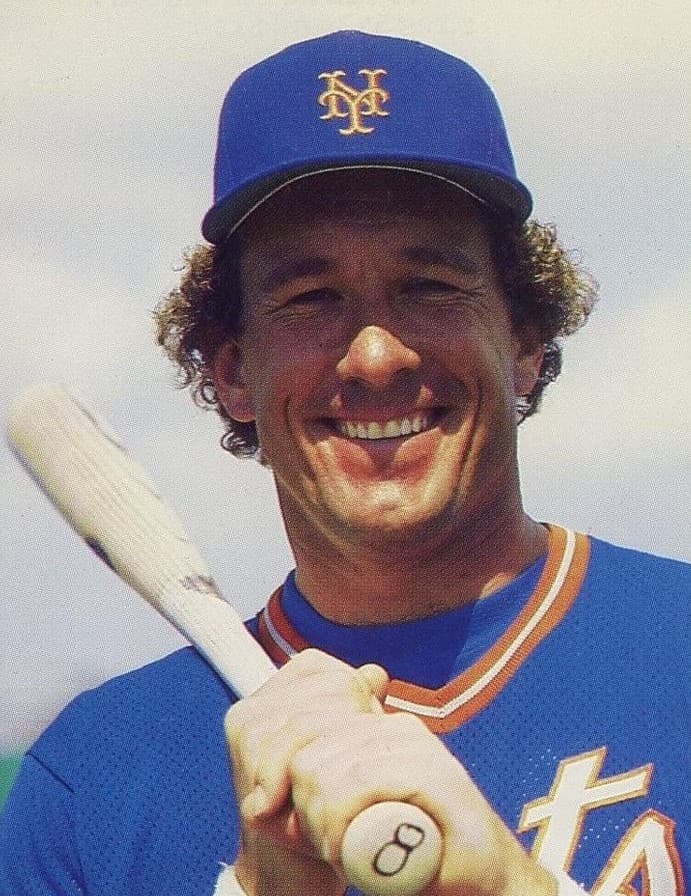
Gary Carter portrait in New York Mets uniform.
Photo credit: Unknown photographer via Wikimedia Commons (Public domain)
Gary Edmund Carter lost his mother to leukemia when he was 12 years old, won the national Punt, Pass & Kick championship at seven, turned down a football scholarship to UCLA to play baseball, and spent 19 years behind the plate as the most enthusiastic catcher of his generation. His teammates in Montreal called him "The Kid" because he tried to win every sprint and hit every pitch out of the park from his first spring training onward. He caught 2,056 games, hit 324 home runs, drove in 1,225 runs, made 11 All-Star teams, and in the 10th inning of Game 6 of the 1986 World Series, with two outs, nobody on, and the Mets one strike from elimination, singled to left field and started the rally that became the most replayed sequence in postseason history. "I was not going to make the last out of the World Series," Carter said afterward. "I felt certain of that." The BBWAA elected him to the Hall of Fame in 2003 with 78.0% of the vote.
Culver City
Carter was born on April 8, 1954, in Culver City, California. His father James worked as an aviation parts inspector for Hughes Aircraft and later in procurement for McDonnell Douglas. His mother Inge Charlotte Keller, born to German immigrant parents, was a champion swimmer who died of leukemia at 37 when Gary was 12. Her death left him with a determination to live at full intensity that teammates and opponents noticed for the rest of his career.
Carter's older brother Gordy was drafted by the California Angels in 1968 but chose to attend USC, then played Class A ball in the San Francisco Giants organization. Gary attended Sunny Hills High School in Fullerton, where he captained the football, basketball, and baseball teams, earned All-America honors as a quarterback, and made the National Honor Society. He signed a letter of intent with UCLA before the Montreal Expos drafted him in the third round in 1972. He chose baseball.
Montreal
Carter reached the Expos in September 1974 and established himself as the starting catcher in 1975 after a brief experiment in right field. His first spring training told the story. "I was trying to win every sprint," Carter recalled. "I was trying to hit every pitch out of the park." Teammates Tim Foli, Ken Singleton, and Mike Jorgensen started calling him "The Kid," and the name stuck because Carter never lost the quality that prompted it.
Carter won three Gold Gloves in 1980, 1981, and 1982, and five Silver Slugger Awards. He won the 1981 All-Star Game MVP and won it again in 1984. He hit .293 with 32 home runs and 106 RBI in 1984, his final full season in Montreal. Gene Mauch, who managed him as an Expo, said, "I've never seen a better package. I've never seen someone who loves to play the game more."
The Expos traded Carter to the New York Mets after the 1984 season. Montreal fans protested. Carter said he understood both sides but that a chance to win changed everything.
Game 6
The 1986 Mets won 108 games and reached the World Series against the Boston Red Sox. Carter hit two home runs at Fenway Park in Game 4 to help tie the series. The series reached Game 6 on October 25 at Shea Stadium with Boston leading three games to two.
The Red Sox led 5-3 with two outs and nobody on base in the bottom of the 10th inning. The Shea Stadium scoreboard briefly flashed congratulations to the Red Sox. Calvin Schiraldi was one out from ending it. Carter walked to the plate.
Bob Ojeda, a Mets pitcher, recalled, "If you watch the video with Gary walking to the plate, you see that sense of determination in his step, in his swing. He was not going to make that out." Carter singled to left field. Kevin Mitchell pinch-hit a single to center. Ray Knight, down 0-2, singled to center, scoring Carter. Bob Stanley's wild pitch tied the game. Mookie Wilson's grounder went through Bill Buckner's legs and Knight scored the winning run.
Carter finished the World Series 8-for-29 with two home runs and nine RBI. The Mets won Game 7 to clinch the championship. Carter's single in the 10th inning of Game 6 is the swing that kept the season alive.
The Kid
Carter played four more seasons after 1986, splitting time between the Mets, Giants, and Dodgers before returning to Montreal for a final season in 1992. He caught his last game as an Expo, where he started and where he wanted to finish.
Carter finished with 2,092 hits, 371 doubles, 324 home runs, 1,225 RBI, and a .262 batting average across 2,296 games and 19 seasons. He caught 2,056 games, fourth on the all-time list. The Expos retired his number 8 in 1993. Ron Darling, his teammate on the 1986 Mets, called him "the moral compass of the hard-living squad."
Carter's path to the Hall of Fame took six ballots. He first appeared in 1998 with 42% of the vote, dipped below that mark, then climbed steadily to 78.0% in 2003. He chose an Expos cap for his plaque. "The fact I played 11 years in Montreal and the fact that the majority of my statistics and accomplishments were achieved there," Carter said, "it would be wrong, probably, to do it any other way." His father James died in January 2003, less than a month after the election was announced. Carter's induction speech honored both parents.
Carter managed in the minor leagues after retiring, winning Manager of the Year awards with the Gulf Coast Mets in 2005 and the St. Lucie Mets in 2006, and coached baseball at Palm Beach Atlantic University beginning in 2009. In May 2011, doctors diagnosed him with glioblastoma, an aggressive brain cancer. Carter continued coaching through the fall. His last public appearance came at the Palm Beach Atlantic season opener on February 2, 2012. He died on February 16, 2012, in West Palm Beach, Florida, at 57. Darryl Strawberry, his teammate on those 1986 Mets, said, "I wish I could have lived my life like Gary Carter. He was a true man."