Profile
Iván Rodríguez
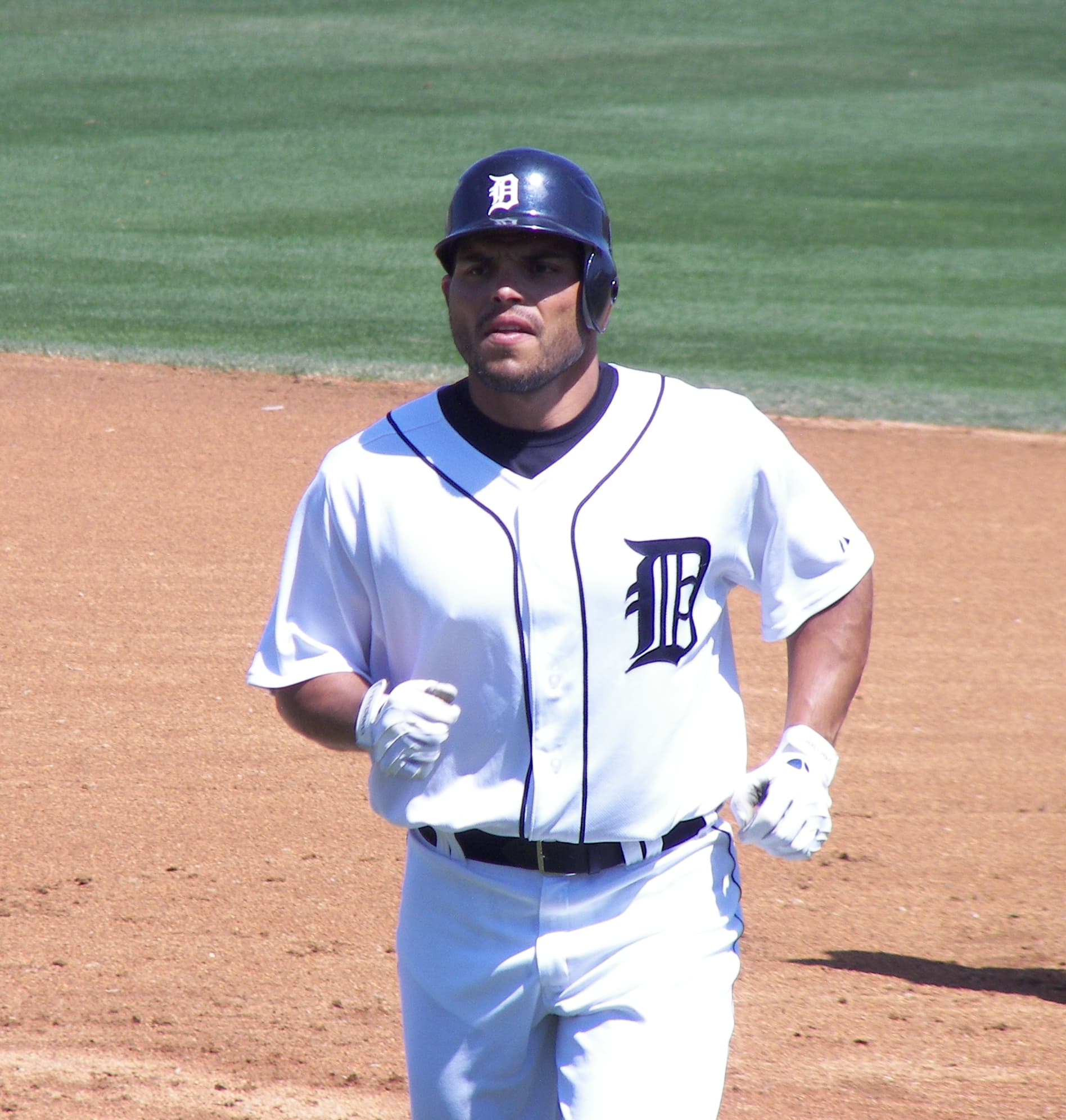
Ivan Rodriguez in Texas Rangers uniform.
Photo credit: Unknown photographer via Wikimedia Commons
Iván Rodríguez caught more games than any man in the history of baseball and threw out runners from a crouch the way other players throw from the outfield. They called him Pudge, and for two decades he was the best defensive catcher alive, a quick release and a cannon arm that turned stolen bases into a bad idea. He hit too, a Most Valuable Player award and a batting eye to go with 13 Gold Gloves, and he caught a World Series winner along the way. The BBWAA elected him to the Hall of Fame in 2017, on the first ballot.
A Teenager Behind the Plate
Rodríguez was born on November 27, 1971, in Manatí, Puerto Rico, and grew up in Vega Baja, where his mother taught school and he started catching at seven. He was short and thickly built, and a coach hung the nickname Pudge on him for it long before anyone compared him to Carlton Fisk. The Texas Rangers signed him at 16 in 1988, a free-agent teenager whose throws to second base already cracked into the glove like a grown man's. He reached the major leagues on June 20, 1991, at 19, married that same morning, and threw out two base-runners in his first game.
The Arm
What made Pudge a legend was the throwing. He led his league in caught-stealing percentage nine times and threw out more than half of the runners who dared him in eight separate seasons, a level of control over the running game that the position had rarely seen. Joe Torre summed up the dread he created. "If he doesn't hurt you with his bat, he'll hurt you with his arm," Torre said. The release was so fast and the accuracy so reliable that runners simply stopped going, which is the highest compliment a catcher can earn. He won 13 Gold Gloves, the most any catcher has ever won.
The MVP Catcher
Rodríguez could hit as well as throw, and in 1999 he put together one of the finest offensive seasons a catcher has managed. He batted .332 with 35 home runs, 113 runs batted in, 116 runs scored, and 25 stolen bases, and the writers named him the American League Most Valuable Player. He was the first catcher in history to steal 20 bases and hit 20 home runs in a season, and the first to reach 30 home runs, 100 runs, and 100 runs batted in all at once. For a man whose value lived in his glove, the bat made him complete.
A Title in Florida
After 12 years in Texas, Rodríguez signed a one-year deal with the Florida Marlins in 2003 and turned it into a championship. He was the Most Valuable Player of the National League Championship Series, driving in 10 runs in a seven-game win over the Cubs, a record for the round. In the division series against San Francisco he made the defining defensive play of his career, holding the ball through a violent collision with J.T. Snow to tag the final out at the plate and end the series. The Marlins went on to beat the Yankees in the World Series, the only title Rodríguez would win.
The Tigers and the Record
Rodríguez signed with the Detroit Tigers in 2004 and helped lift a hundred-loss franchise back to respectability, catching them to the American League pennant in 2006 and handling Justin Verlander's no-hitter in 2007. The body wore down from the workload, as it does for every catcher who plays that long, but he kept squatting behind the plate year after year. On June 17, 2009, he caught the 2,227th game of his career and passed Carlton Fisk for the most ever, and he finished with 2,427, a record built one nine-inning crouch at a time. He retired after the 2011 season.
The Steroid Question
Rodríguez played through the game's chemical years, and the suspicion reached him in 2005, when José Canseco's book claimed he had personally injected him during their Texas days. Rodríguez denied it flatly. "I didn't use any of that stuff," he said. "I don't need it." Asked whether his name was among the anonymous positive tests from 2003, he gave a careful answer, "Only God knows." He reported to camp that spring more than 20 pounds lighter, which fed the talk, and he never failed a public test. The accusation trailed him without ever being proven.
Cooperstown in a Rangers Cap
Rodríguez finished with a .296 average, 311 home runs, 2,844 hits, and more games caught than anyone, and the writers elected him to the Hall of Fame in 2017 on the first ballot. He drew 76 percent, only four votes more than he needed, one of the narrowest first-ballot margins ever, and he went in as a Texas Ranger, the first Rangers position player enshrined. He was the second catcher elected in his first year of eligibility, after Johnny Bench, the man he had idolized as a boy in Puerto Rico. The kid signed at 16 had become the standard for everything a catcher could be.